A 6-Step Plan for Differentiated Instruction
Middle school teachers can follow a straightforward method that facilitates customization of support for students.
Your content has been saved!
Go to My Saved Content.
Students need instructional clarity, and so do teachers.
In my coaching work at Tuba City Schools within the Navajo Nation, we focused on refining our system for instructional innovation—in partnership between central office administrators and the school’s teaching teams. During our first-quarter instructional rounds, we noticed something really important during learning walks at the junior high school. Many teachers were doing many things right in their daily teaching practice, but they needed clear coherence around core instruction and how to translate it into a consistent structure for daily differentiated lessons that take middle school students’ different levels of ability into account.
Differentiated instruction, developed and made popular by Carol Tomlinson, refers to teachers being responsive to students’ learning needs through multiple modes of assessment and instruction as part of their instructional design.
At the request of the assistant superintendent, Melissa Bilagody, I designed coaching and professional learning to help teachers firm up their understanding of solid core instruction and then anchor it in their daily differentiated instruction. I identified six clear lesson steps that embedded a Multi-Tiered System of Support (MTSS) directly into everyday teaching, rather than treating the tiered supports as separate initiatives or add-ons.
Important note: This framework is inspired by a teaching framework created by Samantha Bennett and refined by research-informed strategies drawn from my coaching work across various classrooms, schools, and leadership teams since 2007. It is not meant to replace MTSS training or imply that it is the only way to teach. This is a replicable way to teach for teachers who need a method to improve their instruction.
Offer Meaningful Grade-Level Work With Customized Support
The steps are grounded in research, suggesting that students learn more when support is delivered in the context of meaningful grade-level work rather than in isolation. These types of approaches consistently outperform models that rely on isolated remediation.
For flexibility, teachers can select the acceleration approaches that work best for their learners, including scaffolding, small group instruction, and targeted supports integrated into core lessons.
We also developed a lesson planner visual along with a graphic and explainer video using Google’s language model tools (such as NotebookLM), to support workshops and teachers’ lesson design.
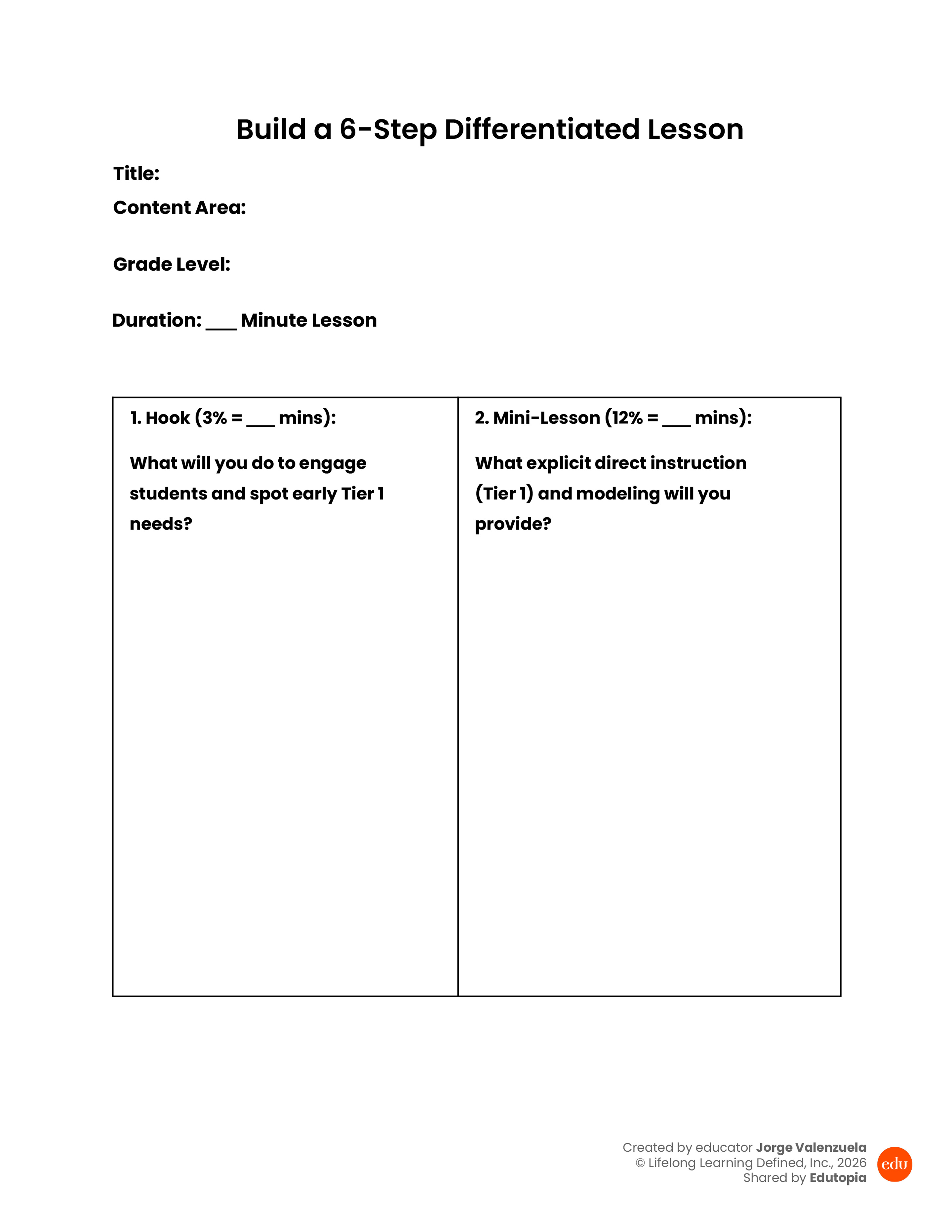
Here’s a brief breakdown of the tiers we provided teachers.
Tier 1: Strong universal instruction, smart grouping, and quick data for determining next steps.
Tier 2: Targeted small group help that is planned, aligned to specific student needs and monitored for progress.
Tier 3: Intensive support provided when Tier 1 and 2 interventions don’t suffice.
The Differentiated Lesson Framework
Keeping all of this in mind, here are six steps to a differentiated lesson that show how schools can operationalize strong core instruction and MTSS in a way that is practical, sustainable, and teacher-friendly.
The percentages for each step aren’t meant to be research-prescribed or definitive. Instead, they’re suggestions designed to protect time for guided practice, differentiation, closing lessons, and helping you stay organized. Feel free to adjust the timings to best meet your students’ needs. Calculate the timing by multiplying the percentages by your class duration (e.g., 50 minutes, 90 minutes) to help you determine how long each step should take.
Step 1 (Hook 3%): Begin with an engaging lesson hook. Hooks are not stand-alone activities—they prepare students for what they’re going to learn and why it’s important. Engagement here is cognitive—not entertainment. Hooks should prompt curiosity, activate prior knowledge, be time-bound (two to five minutes), and effectively set up the lesson. Through informal checks, skilled teachers can determine who may need differentiation support.
Step 2 (Mini-lesson 12%): Using John R. Hollingsworth and Silvia E. Ybarra’s strategy Explicit Direct Instruction (EDI) in a mini-lesson is a powerful tool for providing learners with the daily learning goal(s) and setting the tone for the remainder of the learning block (e.g., work time). Good EDI provides teacher and student clarity because it removes all the guesswork for students—teachers explain, model, and guide kids step-by-step through unpacking learning goals, explaining new concepts, and modeling new skills. This is Tier 1 instruction because every learner receives common learning goal(s) and expectations.
Step 3 (Work Time and Flexible Grouping 35%): Flexible grouping is a research-informed strategy for grouping students to achieve the learning goals unpacked in the mini-lesson (step 2). Using guided differentiated instruction and collaboration, teachers can organize flexible groupings using three primary rotation formats:
1. Work with the teacher or paraprofessional
2. Work with peers
3. Individual work
In this phase of the lesson, the work time may include differentiation within Tier 1 and targeted support aligned with planned, documented, and progress-monitored Tier 2 interventions.
Step 4 (Brain Break 5%): A brief moment for students to restore attention and physiological regulation as needed. Some schools make this a social and emotional learning (SEL) moment; others like to make it a short reset. I like to help learners clear their minds with three deep breaths—to help restore a sense of peace. Do what works for your students as long as you’re teaching them to calm their nervous system and prepare for learning. Over time, this will be an important tool in their life skills arsenal. When an SEL regulation moment is taught universally, it’s often referred to as Tier 1.
Step 5 (Continued Work Time and Practice 30%): This chunk of work time can be used for extended practice time and differentiated support. Here, teachers can continue instruction considering that the lesson remains Tier 1. Tier 2 needs to be planned and progress-monitored, and Tier 3 supports can be reinforced in this step in the lesson when they are already part of a student’s intervention plan. It’s important that Tier 3 supports be individualized as much as possible, never improvised, always planned, and not reactive, and that they never compete with the lesson launch (steps 1–3).
Step 6 (Debrief and Lesson Closeout 15%): Notice that this step in your lesson is longer than steps 1 and 2 (the hook and mini-lesson). This is by design. Cognitive psychology research tells us that learning is strengthened during retrieval, reflection for metacognition, and consolidation—not during initial exposure to the concepts and ideas.
It’s critical for students to know what they’re learning and why. Short quizzes, exit tickets, and brief reflective prompts work for this purpose. Drawing inspiration from educator Paul Emerich France, here are three reflection questions you can adapt to fit unique contexts.
- What are we learning today?
- Why are we learning this?
- How does this connect to what we already know?
Listening to student reflections and discussing next steps are critical for teachers’ growth and planning their next lessons. At Tuba City, we implemented this at the beginning of the 2025–26 school year for the middle grades and will expand it to elementary and high school later in the current school year.