Designing Outdoor STEM Learning for Elementary Students
A framework for turning nearby trails, campus green spaces, and community sites into classrooms.
Your content has been saved!
Go to My Saved Content.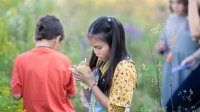
Over the last four years, I’ve partnered with preservice teachers and local schools to transform nearby trails, campus green spaces, and community sites into standards-aligned STEM learning environments for elementary school students.
The outdoors supports inclusive, multimodal instruction by offering visual, kinesthetic, auditory, and social entry points, all of which make STEM learning more accessible and meaningful. During outdoor learning, students work in small groups to collect data, test ideas, and make sense of real-world phenomena. Literacy integration emerges organically; students read informational texts before visits, then record field notes, discuss observations, and construct evidence-based explanations.
In the book Visible Learning, John Hattie highlights some of the benefits of intentionally designed outdoor experiences, which can boost student motivation and reduce anxiety. When students learn outdoors, they’re more engaged and curious. Their learning becomes embodied through movement, observation, and hands-on investigation, leading to deeper conceptual understanding of STEM concepts.
Crucially, outdoor, place-based STEM learning doesn’t require new programs or extensive resources—only the intentional use of spaces that students already inhabit. When teachers start small and plan with purpose, local places can become powerful classrooms.
A Replicable Framework
Below, I’ve outlined a framework—which we’ve piloted with hundreds of students across multiple districts—for teachers who want to design outdoor lessons rooted in place-based STEM learning.
Identify a local site that students can easily access: This could be trails, school grounds, environmental centers, or community green spaces. Really, almost any outdoor space qualifies for standards-aligned lessons. We’ve used a local college campus, a paved trail one mile from school, and a nearby rugged trail. Students walked to each location, adding to the experience at no cost.
Conduct a site walk to observe teachable moments: Use what you notice outdoors to generate STEM and cross-curricular ideas, then align them with Next Generation Science Standards and grade-level state standards. To prevent “outdoor chaos,” identify one or two core ideas per visit, rather than trying to teach everything the site supports. Take the standards with you to the site so you can develop ideas and learning outcomes that are practical and logistically feasible. For instance, you might come up with a lesson plan where students look for evidence of living things—tracks, nests, chewed leaves, or insect activity—and use that evidence to infer which animals live in the area.
Design an explicit, three-part learning sequence: The learning sequence starts with a pre-visit phase, followed by an outdoor visit phase, followed by a post-visit phase. Each part of the sequence should integrate English language arts, math, social and emotional learning, and other content areas.
1. Pre-visit: Before the visit, teachers inform students about their learning objectives and make sure they have a familiarity with the outdoor location. This phase serves as schema activation and sets a clear purpose for the outdoor experience. Examples include reading a nonfiction text, previewing vocabulary, recording observation questions, writing predictions, and setting up charts. For instance, students might read an informational text about habitats and complete the K–W sections of a Know, Wonder, Learn (KWL) chart. Or, they might complete a picture-based vocabulary sort with terms like habitat, organism, evidence, and pollinator, then choose two terms to look for during the visit.
2. Outdoor visit: Onsite visits work best when objectives are clearly mapped out, aligned to standards, and shared with students beforehand. Rather than free exploration, students participate in structured, intentional tasks tied directly to the learning goals, and teachers circulate the area to reinforce productive discourse. Students might do the following:
- Check out observation/investigation stations
- Collect data from measurements, tallies, sketches, and labeled diagrams
- Collaborate in small groups where everyone has an assigned role
- Create field sketches, maps, or models that represent systems, habitats, and processes
- Work off guided prompts that simulate environmental changes such as erosion, water flow, or habitat disruption
- Model scientific concepts with natural materials and/or physical movements
- Engage in structured discussions via sentence stems, where students can explain observations and make evidence-based claims
3. Post-visit: Because learning centers on synthesis and reflection, students should analyze data collected on-site, revisit initial questions and predictions, and identify patterns in their observations. They communicate their understanding through Claim-Evidence-Reasoning responses, discussions, and visual representations—and they can extend learning by connecting their findings to subsequent science, literacy, math, and community-focused lessons.
Tips for Getting Started
There’s nothing wrong with starting small—in fact, beginning with a lesson, as opposed to a unit, is preferable. Here are a few things to keep in mind as you pilot your outdoor lessons:
Teach outdoor routines explicitly: Clear expectations and procedures are essential for effective classroom management in outdoor learning environments. Model and practice a simple attention signal like “Freeze and face me” before going outside, and rehearse how students will walk, gather, and respond during the first few visits.
Plan for bathrooms and transitions: Travel takes longer than expected, and scheduling breaks helps prevent disruptions. Build in a bathroom and water break before heading out, assign partners, and use a set walking order and timer to keep transitions quick and predictable.
Expect weather and plan for it: Consider backup plans and flexible adjustments if conditions change. If it’s too wet or windy for clipboards, have students take photos and then record observations when they’re back inside; if rain starts mid-lesson, shorten the outdoor portion and finish indoors with a quick sorting, graphing, or writing task.
Use simple, reusable materials: Clipboards, pencils, and laminated cards are easy to transport and can be reused to support multiple outdoor learning experiences.
Assess, reflect, revise: Teachers should collect evidence of learning and engagement across the pre-visit, on-site, and post-visit phases. Through student work and feedback, assess learning, reflect on what worked, and revise the experience for future lessons.