How to Create a Values-Aligned Classroom
Teachers can collaborate with students to identify shared values that establish a foundation of respect and a positive learning environment.
Your content has been saved!
Go to My Saved Content.
Every student deserves a classroom space where they feel psychologically safe and a sense of belonging: free to voice their opinions, make mistakes, and ask for help. This type of classroom culture doesn’t magically appear; it needs to be cultivated by a caring, responsive teacher and sustained over time. One way for teachers to provide a strong foundation for learning is to cocreate a values-aligned classroom with their students. And then, throughout the school year, devote time and attention to making these values visible. Consider how you might follow the steps below to cocreate a classroom culture that supports both you and your students.
Identify Your Core Values
First, it’s important for teachers to be clear about the nonnegotiables in their classroom. For some teachers, students must arrive on time and be prepared for class; for others, showing kindness and taking care of classroom materials are paramount. Regardless of your particular expectations, you often will find that these nonnegotiables stem from your core values. In our experience, becoming clear about what you value with a value exercise can provide a helpful lens for navigating a barrage of decisions each day.
Although there are many value exercises online, we like and use one that Brené Brown created. After completing that exercise to determine your top two or three values, you can deepen your understanding of them by reflecting on the following questions from Brown and organizational psychologist Adam Grant:
- Does this value define me?
- Does this value exemplify who I am when I’m at my best?
- Is this value a filter I use to make hard decisions?
- Is this value something for which I’m willing to make sacrifices?
When you’re sufficiently clear on your values, share them with your students in a way that respects your personal boundaries, taking time to explain how they show up in your life. As Brown writes in Strong Ground: The Lessons of Daring Leadership, the Tenacity of Paradox, and the Wisdom of the Human Spirit, “A list of values means nothing if the values are not translated into behaviors.”
For example, Beth’s core values are relationships, learning, and justice, and these values consistently align with what she prioritizes across all aspects of her life; they are observable through her reading, writing, advocacy, and time with family and loved ones. Margaret most values curiosity and reflection, so she consistently offers her students choice and keeps a “thinking notebook” to support her personal and professional goals.
Support Students to Define Their Values
Next, invite your students to engage in the same values exercise, and have them enter their top two to three values in a polling and feedback platform such as Mentimeter’s word cloud generator. Mentimeter will automatically enlarge students’ most common responses, and you can project this word cloud on an interactive whiteboard or display it in your learning management system to make the results visible to students. If you have access to a poster printer, adding a values word cloud to the wall can brighten the classroom space and communicate the expectations and norms of your classroom community.
The final step is to select the top two values from the word cloud and have students brainstorm in small groups what these values might look like, sound like, and feel like in practice, or, in other words, how they will show up in the classroom. For example, if students share that they value respect, you might point out that respect looks like making eye contact with the teacher or classmate who is speaking; that it sounds like silence, with everyone listening to the person who is talking; and that it feels like a safe space where ideas are welcomed.
CoCreate a Visible Culture Map
Once you and your students are clear on your values and have translated them into classroom behaviors, the next step is to post and cocreate a Visible Culture Map as we explain in our upcoming book, The Engaging ELA Classroom. This map both makes the class values visible for continued clarification and reinforcement and also identifies other critical aspects of culture, making them explicit for everyone.
For our Culture Map, we include five categories: Symbols and Artifacts, Language, Signs of Respect, Signs of Disrespect, and Shared Values. These categories are by no means discrete, and you can certainly expand the map to include other aspects of culture that you feel need to be made explicit.
When Margaret considered how to develop a values-aligned classroom culture, she first determined that her core values are collaboration and creativity. She made some practical decisions about how these values might translate into the observable classroom environment. For example, her students participate in book clubs and combine visual and textual evidence in the notebooks they use every day.
Here’s a sample Visual Culture Map in its early stages, cocreated with students, that can serve as a foundation to support and fine-tune a classroom culture throughout the school year.
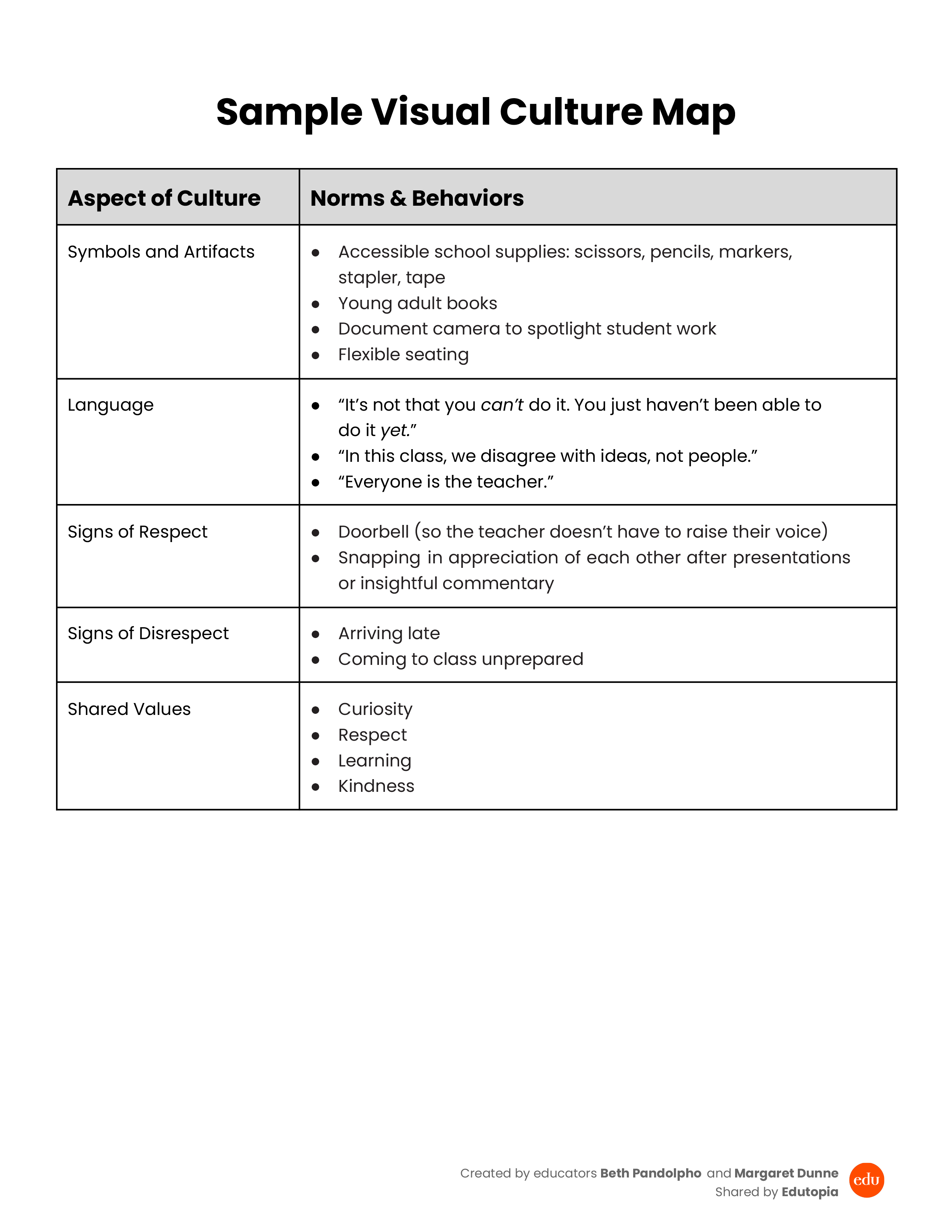
The Visual Culture Map then becomes a conversation piece that both names and captures the desired norms and behaviors, and guides everyone back when inevitable emotions and conflicts lead us away from living up to our values. Prioritizing and dedicating time to cocreating and sustaining a positive classroom culture benefits students by fostering a supportive and motivating learning environment. As an added benefit, establishing a values-aligned set of classroom norms builds self-efficacy and makes school more joyful, peaceful, and productive for everyone.