Adapting Wordle to Improve Elementary Students’ Phonics Skills
In the early grades, start with three-letter words connected to the week’s lesson and a limited set of letters. Students will grow to be able to handle four- and five-letter words using the whole alphabet.
Your content has been saved!
Go to My Saved Content.We’ve all experienced the nagging frustration: “I taught it, but they’re not using it (yet).” As a literacy coach, I saw this in my own practice and repeatedly heard a specific concern from classroom teachers: Their second graders had been taught with a direct instruction phonics program since kindergarten but were not independently applying the phonics skills they had practiced.
So for my second-grade intervention, I designed a 10-minute, weekly Wordle-type game to make the practice fun, make the phonics learning stick, and eventually put students in the driver’s seat.
Getting Started
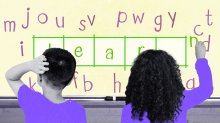
Our Wordle Wednesday is based on the popular New York Times spelling game and adapted for elementary-aged students. Confronted with a blank 5x6 grid, players use phonological and orthographic mapping skills to guess letters in the hidden word. They work together to apply their phonics reasoning skills while also building their metacognition.
Materials needed:
- Whiteboard (freehand) or projector (a grid of 5 [or however many letters you’re using] by 6 squares on a slide)
- Green and yellow markers
- List of one-syllable decodable words that fit the instructional focus
As the teacher, begin by choosing a target (hidden) word that fits the weekly instruction—for example, dream when learning about vowel teams. To make the game accessible to young students, supply a controlled set of eight to 12 letters to choose from rather than choosing haphazardly through the alphabet: e, a, o, m, s, d, h, r, b, w. This controls for error and narrows the cognitive demand, so that students spend their effort applying the target phonics pattern rather than wildly guessing letters. Most important, it creates productive struggle: Students grapple with a hard challenge, but one that is within their ability to solve. Brain research tells us that creating the conditions for productive struggle in the classroom accelerates student learning.
Implementation
Working together, students test words, and the teacher acts as the game, revealing whether they have a correct letter but not in the correct position (yellow box), or the correct letter in the correct position (green box). Simply color the box on the whiteboard with a yellow or green marker, or build a slide that does the same. With each guess, students gain orthographic information about the word and get closer to solving the puzzle. For example, if they know the focus is vowel teams and learn that o is not correct, they immediately know to suggest words with ee or ea. If they learn that r is in the second position, they can determine that the word may begin with an r-blend.
Students nearly always solved the puzzle before filling the grid. As they collectively suggested words, they uncovered phonics principles they had been taught, now putting them to work in game format; I heard excited phrases like, “If h is the second letter, it must start with a digraph!” or “Try e at the end. We know lots of silent-e words.”
The key to success is when the hidden word is revealed, and they celebrate their win, then look back at their guesses and discuss what worked. Which words led them in the right direction? You’re not just dissecting the game; you’re teaching them critical metacognitive skills and building their independent application. This leads to self-talk later during writing and proofreading: “We know the long-o sound needs two vowels. What letters could you use?”
Adapting and Scaffolding the Game
We started by using three-letter words to learn the game; as the teacher, I fully led the activity by choosing the hidden words and controlling the game board. With our phonics books open to that week’s lesson, students knew my hidden word would have this week’s target skill (e.g., digraphs, silent e, etc.).
As students learned the game format, we grew into four- and five-letter words. I put more options in the controlled letter set (15, 20, eventually all 26). We stopped relying on our phonics books for reminders of that week’s lesson; the students instead retrieved their knowledge of long-vowel teams and blends within words.
I also started “training” them to be the puzzle leader by becoming my assistant. One student chose the hidden word, then helped control the game board while their friends played. This gradual release of responsibility helped build their metacognition even faster: They had to compare students’ guesses with the actual spelling of the hidden word, then reveal if the guesses were accurate. It builds strong orthographic mapping and the ability to check and correct.
Eventually, students led the puzzle independently, and I became a player, completing the “I do, we do, you do” release.
Why Does It Work?
On midyear phonics assessments, these students showed growth in decoding and encoding that outpaced their peers’. Though they had further to grow, they effectively closed the gap in phonics foundational skills by the end of the year. For example, one student, who scored only 25 percent of words correctly in the fall, spelled 75 percent of second-grade words correctly on our end-of-year assessment. She started the year at risk but ended the year on grade level.
It works because kids love games, and it doesn’t feel like work. Many see their parents play Wordle and feel grown-up enough that they can play too. As they become the leader, they grow their literacy skills alongside confidence, reasoning, and independent application. The productive struggle they encounter for 10 minutes each week trickles into their daily reading and writing, because they know they can grapple with sound-spelling challenges.
The permutations of scaffolding and support are almost endless among elementary students. Adjustments can allow kindergarten students to guess CVC words with support, or fourth graders to challenge each other in a partner activity format. A whole class can even play with whiteboards to suggest words and keep track of their own grid. All you need is a whiteboard, a list of decodable words, and a commitment to letting kids productively struggle.