Kicking Your Beginning-of-Year Activities Up a Notch
A teacher shares variations on covering the syllabus, creating class norms, and starting to build a community that he designed to boost student engagement from day one.
Your content has been saved!
Go to My Saved Content.There’s nothing I hate worse than starting off a school year sounding like Charlie Brown’s teacher, droning on as I cover the syllabus, rules, policies, etc. Nothing says “This is going to be a great year” quite like a long, dry first few days of a class.
That’s why I began experimenting to spice up my beginning-of-the-year activities—not just for the sake of entertainment but also because they weren’t working. My monologues about rules weren’t piquing the parts of the brain designed for attention, so I began to ask how I could do things differently. Here are a few ways I’ve found to increase students’ engagement and enjoyment as we review the syllabus, set up classroom norms, and get to know each other’s names and form a community.
Reviewing the Syllabus
When I started the year by simply reading the syllabus, I found that students remembered very little of it a few days later. No surprise, right? Part of it was because that’s too passive for students. I made it my goal to have them engage with the syllabus in a way that would demonstrate that they would be active participants in any learning we did as a class. Here are a few different ways I’ve tried to achieve that.
Breakout Scavenger Hunt: This is somewhat like an escape room—the students have to figure things out to move through the syllabus. I break it into sections and have students work in groups to identify key information to reveal a password (the first letter of specific words, for example). They need to tell me the password to receive the next part of the syllabus.
Every team receives a reward—a sticker or a small piece of candy—when they complete the activity, and sometimes I’ll have a special reward for the team that comes in first. Aside from making the syllabus more memorable, this activity really helped students start to get to know each other.
Syllabus Bingo: Instead of handing out the syllabus, I’ll give students bingo cards with squares containing phrases like “tutoring availability” or “weighting of formative assignments,” and they have to write the tutoring times or whatever is relevant in the boxes as I read. When a student gets a bingo, they win a prize. I find this helps students listen closely. (Tip: There are many online bingo card generators you can use to save yourself some time.)
Quiz Game Show: At one time, I tried to help students remember information on the syllabus by adding a digital quiz at the end. This worked better when I flipped the order: Instead of reading the syllabus and then introducing the quiz, I would start by asking a question like, “What percentage of your grade is dependent on your overall performance on the course standards?” and students would guess before I revealed the answer. This tapped into their curiosity and drove engagement up.
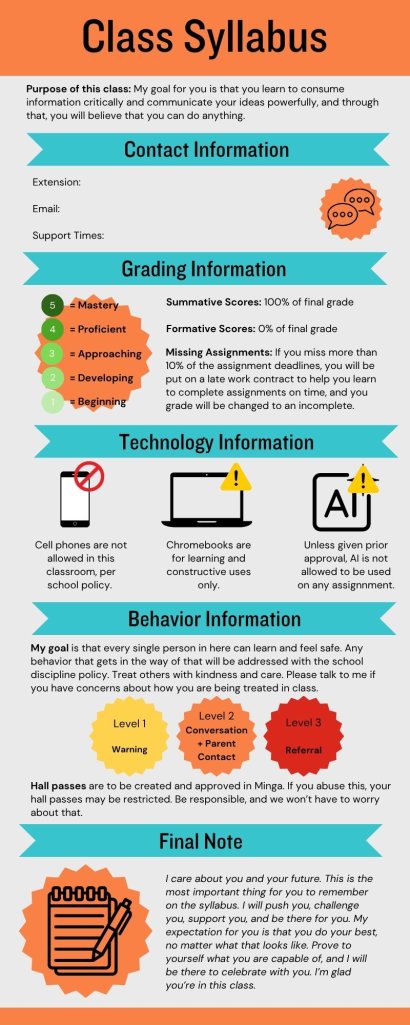
Infographic: If you aren’t required to use a specific written format, making your syllabus an infographic is worth a try. I like it because it condenses all the information down to a digestible format for the initial overview. It also can be useful as a printed poster for easy reference throughout the course.
Classroom Rules
Getting students involved in the creation of classroom norms and rules is helpful in generating buy-in. My initial approach was to go over my own list of rules and ask, “Is there anything we should change or add?” Not very engaging. Even when students did offer rules, they would usually just parrot rules from other classes. The following ideas helped generate more meaningful ideas for our rules and norms.
Worst-Case Scenarios: I’ve been able to start the year with so much laughter simply by asking, “What are some of the worst possible ways we could function as a class together this year?” I push students to go with outlandish examples and capture some of the major concepts as we go. Then we pivot: If a student has said something about an all-out brawl every class, I can say, “So it sounds like it’s bad if people don’t feel physically safe in the room—what are ways we can ensure that people do feel safe?”
This activity gets us all laughing but often helps bring out important points about safety, learning needs, etc., that students might not think about on their own. I’ve also done this before having a substitute teacher come in as a way to set expectations for when I’m gone.
Word Wall: Either physically or digitally, I like to have students write down words and phrases to describe how they want to feel in class. I typically get words like safe, smart, happy, fun, etc. I cluster words together (words like fun and happy, or smart and focused, go together), and then we talk about rules or norms that would be helpful in ensuring that people can feel that way. This not only engages students but also helps them connect with the purpose behind the rules.
Empathy Exercises: Let’s be honest: Ninth graders aren’t always the most empathic of people, and sometimes that means they don’t fully understand the experiences of others. To help with this, I like to use empathy exercises in helping us come up with our norms. For example, I may write a scenario in which a student is stressed about an upcoming essay and is having a hard time. I give students time in small groups to discuss norms that would be helpful for them if they were in that position, and then we discuss as a class.
Student Introductions
It’s important to me and the culture in my classroom that students get to know each other beyond just their names. I’ve done posters on the wall (not very interactive by themselves), and I’ve done in-class presentations (a pretty rough start for shy students). The options below are effective ways to have students introduce themselves and start to build real connections.
Inference Activity: To teach students how to make an inference, I ask a random friend to let me take a picture of whatever is in their pockets. In class, I have students make inferences about the person based on the items, and we talk about the process. I realized this could also be a fun way for students to get to know each other. I typically have students select five items that represent them; they can either take pictures of the items or find pictures online, and put them on a slide. I put the slide up on the screen, and we briefly discuss what we might know about the person before guessing who it is. It’s important with this activity to set some ground rules about kindness and tone to ensure that the activity is supportive and positive for all students.
Playlist of Me: Music is a big part of students’ lives, and it often connects to their culture and interests. To affirm those identities, I like to have students do an opening activity where they choose three to five songs that they feel represent them or connect to who they are. I have students write them down with a brief sentence explaining each one. Students then break into two circles facing each other (one inside, one outside) and share their songs with their partner. Then the students in one circle move one seat to the left and share again. It’s fun to watch students connect over their music tastes.
To save myself the time of vetting each song on the spot, I don’t play them for this activity. If I find out later when I have time to vet them that they are acceptable for classroom use, I put them into a playlist that we use for various activities.
Interest Profiles: An interest survey—where students identify movies, music, sports, hobbies, etc., that they’re interested in—isn’t a new idea, but the fun part for me has been how I use them for activities. Once I’ve gathered the surveys, I compile them into a digital list that I can insert into an AI prompt to tailor an activity toward those interests. For example, I typically have entry tasks whereby students correct sentence errors, and I generate the sentences using a prompt that pulls from the student interests. As an extra step, sometimes I ask the class to guess which student or students listed the topic in their interest survey.
Learning Student Names
This isn’t a class activity, per se, but any middle or high school teacher knows how important (and difficult) it is to learn student names quickly. I also work to make sure students learn each other’s names.
Name Quiz Cards: On one of the first days of class, I pass out index cards and have students write their name on one side and a couple of facts about themselves on the other, things like hobbies and interests. (I’ve done this in years when I didn’t do the interest profiles above.) I spend the next few days repeatedly passing out and collecting those cards whenever I can. What I have found most helpful is to begin by calling out names as a scaffold for myself and then progress to attempting to pass out all the cards based on memory. I say students’ names out loud as I hand them their cards to ensure that I’m learning the pronunciation correctly.
Around the World With Names: This strategy helps me and the students learn everyone’s names. Each class, I ask a couple of students to attempt to go around the entire room and say the name of each student. If they make it all the way around, I often have a little prize like a sticker (please, no extra credit points here) as a reward. My goal is to be able to internally identify students before the student attempting the activity can. This trains me to identify students quickly, simulating classroom moments that require split-second recall of names.
Student Pass-Back: Once I’ve learned student names, I like to have students begin passing back papers—things without scores or grades on them. This may just be the index cards I use to quiz myself, or ungraded work. I continue this throughout the year to make sure all students know each other’s names, as that has a significant impact on the classroom community.
Community Building
I have been guilty of cheesy icebreakers and community-building activities that felt forced and fell flat. At some point I thought, “Well, how do I connect with people?” My answer really settled on two things: laughter and navigating challenges together. Because these can be seen as a diversion from the curriculum, I usually restrict these activities to no more than one class period (less, when possible), and I typically only do this one time early in a term. It’s important to make sure your administrator and the students are aware of what you’re doing and the purpose behind the games—otherwise, both may interpret them as a waste of time.
Games: I have found games to be very effective in building student connections. The goal is to help students laugh and have fun together, as the brain chemicals associated with laughing together are powerful elements of connection. I’ve had the most success with Apples to Apples, What Do You Meme? (please use the family-friendly one to avoid getting fired!), and Uno.
Breakout Challenges: I like to do a breakout activity with students where the purpose is building connections and teamwork skills as they learn to navigate challenges together. I’ve had students build towers with marshmallows and toothpicks—make sure they do this on a paper towel or plate, as I have spent a lot of time with Clorox wipes without those—solve riddles, develop and perform a secret handshake with 10 moves, etc. Students must complete a challenge to receive instructions for the next one. An important element of this approach is the setup and debrief in which you discuss what it means to work well with others.
Welcome Letters
My first school district required welcome letters that were sent home to families and caregivers, and the purpose of these letters was to briefly introduce myself, give an overview of the curriculum, and invite connection through various methods. However, I found that these letters were often just treated as a checkbox, so here are some of the ways I’ve tried to make them more effective.
Video Messages: Instead of sending home a letter to families, I’ve found it valuable to record a video greeting that students show to their caregivers at home. I like this in part because it feels more personal and often results in increased communication with families throughout the year. I add captions for accessibility and use a program to translate the captions for families who speak another language. I often end by asking families to reach out and connect as a way to open positive communications early.
This hinges on technology access, and it’s important to be mindful of that; you can show students how to make the video accessible offline for home viewing without internet, if needed.
Student Goals: My welcome message covers my goals for students in the class, in addition to the overview of the course itself. However, I started having students also identify their own goals, not just for the class, but for themselves in general. This has had a positive impact on the message I send home to families: It communicates that we’re both partners in supporting the whole student, and it helps students know that I am invested in them as people, not just as students.
My goal with all of these activities isn’t necessarily for students to have fun, though I don’t mind fun as a by-product. What I really want is for students to experience and understand early on that my class is about active participation, that my expectations are for them to be involved in their learning. I want them to know that they are a part of a community, not a passive watcher of a class. If I can establish these two elements early on, I know I am starting with an effective foundation for the term or year.