Balancing Play-Based Learning With Literacy Mandates in Preschool
These strategies help teachers set up engaging and enriching opportunities for literacy exploration throughout the day.
Your content has been saved!
Go to My Saved Content.
Walk into our 4K (4-year-old kindergarten) classroom on any given morning and you might find my class gathered at the carpet for morning meeting where pairs of children are passing toy microphones back and forth as they take turns responding to the question of the day.
Or perhaps you’ll join us as students act out the story “The Little Pigs” using puppets, felt board pieces, and realia. Meanwhile, partners are focused on a game in which they take turns rolling dice, moving their pigs along an alphabet path, then identifying the letter and sound their pigs land on.
Or maybe you’ll discover our classroom community gathered around a big book. We might be naming the characters in a story about a fairy who loves flip-flops or discussing the meaning of the fancy (vocabulary) word neighborhood from a nonfiction book about communities.
Or it’s possible you might find our students following the lead of Pixel, our robot puppet, as he helps us isolate the beginning sounds from a list of words. This is quickly followed up by our 4K friends reciting the alphabet song using our silly voice of the day: cheerleader-style.
Each of these snapshots is part of our literacy block—even though they all look a lot like play, because they are. Our state, like many across the country, has increased expectations, and as a result our school district implemented a new universal curriculum across all 4K classrooms. This was a shift from the play-based curriculum we had designed based on decades of research about play-based learning. With this mandate, I began to feel the tension between our play-based learning philosophy and the structure of our new curriculum. I started to ask questions like, “How can I balance play and academic expectations?” and “How can I meet literacy mandates without sacrificing the power of play?”
As a lifelong learner, I made these critical questions the center of my work this school year. I started to come to the realization that we were not in a “curriculum or play” dilemma, but rather a “literacy expectations and playful learning” situation. It was at that point that I simply had a planning and design challenge on my hands. Well, challenge accepted.
Planning a Balanced Literacy Block
When I sit down to plan one week ahead of time, I begin by opening the (digital) teacher’s manual and locating the next literacy session. I look closely at each activity through the lens of the following three important questions.
Question 1: Is this specific activity a requirement? While our universal curriculum includes other content areas (like social and emotional learning, science, and math), I don’t allow myself to be distracted from what’s actually required by my school district. Since we’re successfully teaching and learning other domains during different parts of our school day already, I’m able to confidently ignore any shiny objects and focus on the literacy instruction.
Question 2: Have my students mastered this skill? While review and application are critical for student learning, it’s important to be aware of redundancy. For this reason, if our universal curriculum prompts us to repeat an activity, but my students are ready to move on, I follow their lead.
For instance, when our curriculum prompted lots of consecutive repetition for learning and practicing the letter C and its corresponding sound, I was confident there was no need to keep spinning our wheels. Likely due to the fact that we have five students whose names start with C, our students demonstrated proficiency. We continued with the alphabet introduction order prescribed by our curriculum, but at a faster pace.
Question 3: Where in our schedule would this activity make the most sense? Literacy learning and application happens throughout the entirety of our morning, which consists of:
- Arrival and morning play
- Morning meeting
- Literacy and playful exploration
- Phonemic awareness
With this in mind, if our universal curriculum prompts us to do an activity that would be better suited for morning meeting, then I don’t restrict that activity to the part of our day that’s labeled “literacy.”
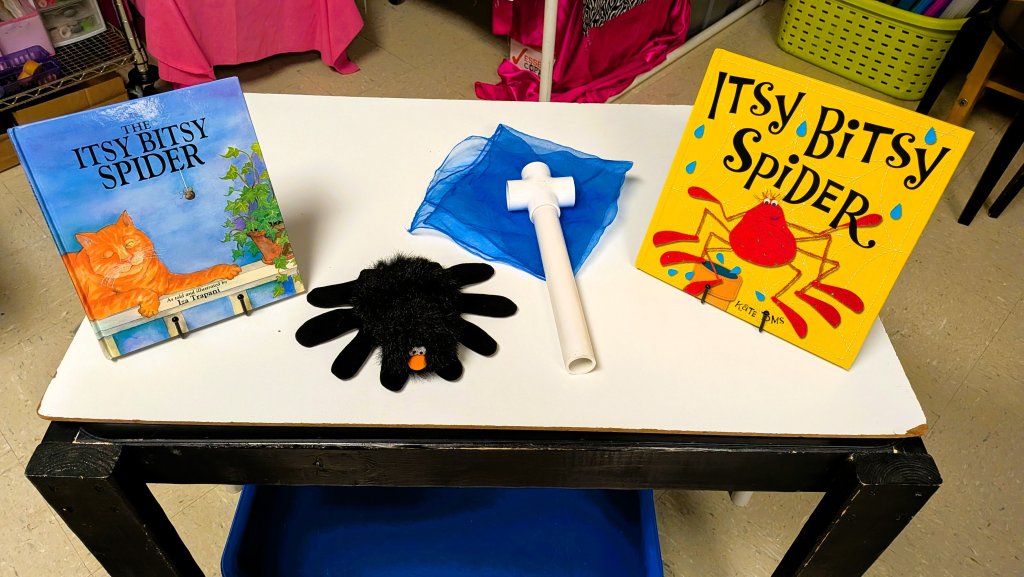
For example, our curriculum describes an oral language activity in which children identify and describe their favorite things to do outside in the winter. This suggestion was a perfect fit for the “share” portion of our morning meeting. In this way, I didn’t have to plan a separate question to answer as we passed our talking stick around the circle. Our curriculum provided a question that tied directly to our read-aloud book that day. As a result, this freed up time during our literacy block for hands-on application.
These three reflective questions help to plan a literacy block that includes all of the required literacy components, while also creating space for playful literacy exploration.
Playful Literacy Exploration
Using the planning method described above, we consistently find time for playful literacy exploration. This is the part of our literacy block when our 4K friends free-flow between teacher-designed stations throughout our classroom and actively practice foundational literacy skills through hands-on invitations.
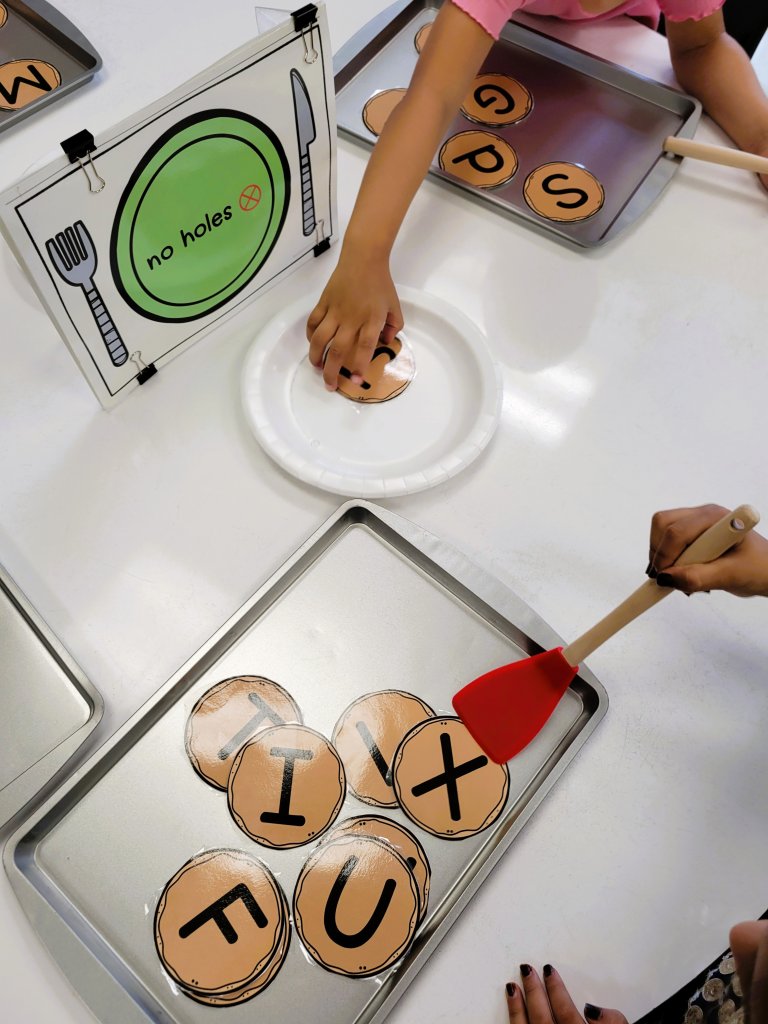
Literacy exploration allows our students to apply what they’re learning about letters, sounds, emergent writing, and early reading behaviors through meaningful, playful activities. For example, our students might dig through pom-pom balls in a sensory tub to pull out letter tiles and then identify the letters and their corresponding sounds. Children might write their name in shaving cream or use task cards as a guide to form letters with play dough. Our 4K friends might pretend to be chefs as they flip alphabet pancakes onto labeled plates to sort by letters that have holes versus letters that do not have holes (visual discrimination).
The ideas for playful literacy exploration are truly endless. These experiences help our students practice literacy skills in purposeful, multisensory ways that keep engagement high and learning embedded in joyful exploration.
Benefits in Finding the Balance
When play and academics are intentionally balanced, everyone benefits. Students experience literacy instruction that’s interactive and engaging without losing sight of foundational skills. Teachers are able to follow developmentally appropriate teaching methods while feeling confident that their instructional choices are purposeful and backed by research. Administrators can trust that mandated curriculum is being followed and reinforced through best practices. And families feel reassured knowing their children are getting the best of both worlds: meaningful learning and the freedom to play.
Play and academics need not compete for time or priority. When planned with intention, they strengthen one another. The hum of conversation, movement, joy, and deep engagement in my classroom aren’t the result of a perfect schedule. Rather, they’re the result of thoughtful planning and a belief that play belongs in serious learning.