
How to Set Up a Back-to-School Symposium
Administrators can use this framework to plan differentiated, conference-style professional learning days to empower teachers as they prepare for the year.
Your content has been saved!
Go to My Saved Content.
As we prepare for a new school year, administrators and instructional leaders share the daunting yet rewarding task of planning and delivering high-quality back-to-school professional learning.
These days of adult learning before students enter our schools carry the weight of all of the dichotomous needs our teachers bring to a new school year: Teachers need time to plan and collaborate, but they also need to hear about procedural updates and changes; they need the space to reconnect with their colleagues, but they also need to be welcomed with the sense of rigor and intentionality that sets the tone for a meaningful school year.
As we contended with legislative changes, the newest instructional best practices, and the social and emotional needs of adult learners, our school wanted a back-to-school professional learning model that would allow us to lean into all of the needs above. For this exact purpose, we decided to implement a back-to-school symposium.
Few, if any, instructional leaders would argue that all teachers have the same needs. Yet, traditional back-to-school professional development often ignores this reality, forcing a 20-year veteran teacher to sit through the exact same baseline classroom management presentation as a first-year teacher.
This isn’t just an inefficient use of precious contractual hours, it is a deeply demoralizing experience that inhibits the positive momentum that effective professional learning can create.
By implementing a back-to-school symposium, instructional leaders can effectively transform traditional, top-down professional learning into a differentiated, conference-style experience rooted in teacher choice.
How to Build a Back-to-School Symposium
Constructing a symposium requires administrators to intentionally create a menu of sessions organized by complexity, purpose, and the unique needs in their building. Instead of trapping teachers in one room all day, a symposium offers guided pathways where educators choose the sessions that align with their immediate needs and goals.
Determine and plan sessions. To launch our school year successfully, we decided to balance two types of sessions in our symposium: informative (sharing systemic updates) and work-based (collaborative creation). Our administrative team began with the informative sessions.
The process was the same as planning for any professional learning session: We broke down the items that would impact the upcoming school year, like legislative updates, compliance tasks, and any changes to teacher evaluation processes, and then turned to our instructional focus for the year.
Once we had these topics covered, we shifted our attention to the work-based sessions. Where the informative sessions were led by school leaders, these work-based sessions were led by teachers. We outlined the topics and then invited veteran teachers to facilitate the sessions, sharing their best practices, answering questions, and offering guidance as newer teachers worked through the topic.
For example, we held a session on assessments and had three different veteran teachers each lead one session. This allowed other teachers to choose the session that best aligned with their own subject and grade level, and ensured that the teachers leading the sessions would still have time for their own professional development.
Once we had determined the session topics and facilitators, we turned our attention to the schedule.
Create the schedule. We decided to repeat sessions in the afternoon to eliminate the frustrating choice that teachers usually have to make during those precious back-to-school professional development moments: Do I address my mandatory compliance training, or do I actually plan for the students coming next week?
We outlined the schedule for teachers, noting which sessions would be best suited for which teachers, which sessions were mandatory, and when and where the sessions would take place. Our afternoon schedule looked like this:
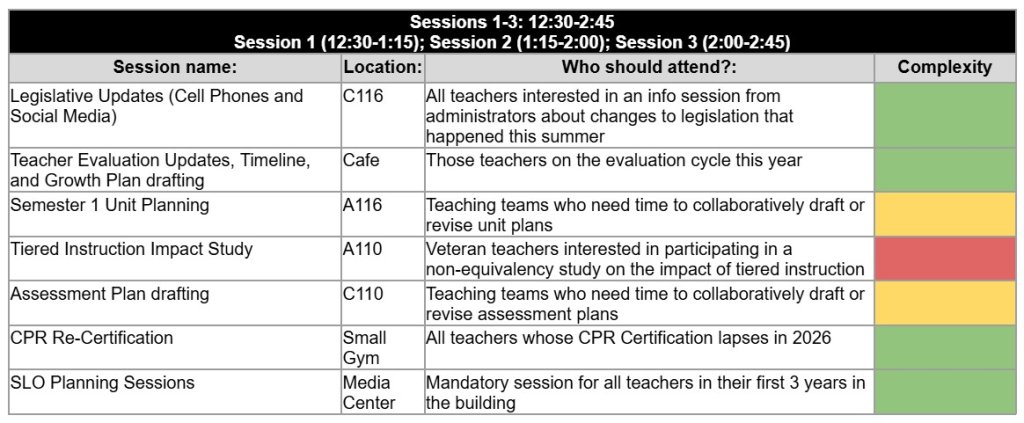
We shared the schedule and walked teachers through it. From there, we told them to choose their sessions for the day.
Whether you have a single afternoon or a three-day professional learning window, the architecture of the symposium-style learning remains the same. It is a flexible model that can work as your building needs it to work.
At our school, we typically run two full-day symposia over the course of a school year: one as a launch in August, and another in February.
Empower teachers and build community. By treating teachers like the professionals they are, we give them the commodity they actually need during back-to-school week: the structured time and space to do the work worth doing. Of course, there are mandatory sessions, but teachers get to determine when they want to attend those sessions in relation to the other work they know they need to address prior to the first day of school.
Because educators choose their own pathways and navigate them alongside their colleagues, a natural sense of shared purpose takes over. It changes the dynamic entirely: Teachers see right away that they aren’t expected to figure out the upcoming school year in isolation, but that they are leaning into the work together.
Ultimately, a back-to-school symposium shifts the mindset around August professional development. It moves the focus away from compliance tasks and puts it back on meaningful preparation that directly impacts student learning.
More than anything, it proves to teachers that we value their time, respect their autonomy, and view them as the primary architects of our students’ success.