
9 Simple Ways to Deter AI Use and Deepen Student Thinking
Activities that ask students to briefly pause and reflect before, during, and after they finish writing emphasize the importance of the process, rather than the final product.
Your content has been saved!
Go to My Saved Content.Increasingly, my colleagues have been stopping me in the hallway with the same exact question: “A student used AI on my writing assignment. What can I do?”
With AI detectors proving unreliable and even banned in some districts, teachers are feeling stuck. It’s frustrating when student work isn’t reflective of their learning. So I began to wonder: Are there simple, effective ways to capture student learning without adding more to our already full plates?
Building accountability measures into the writing process asks students to document their thinking as they work, creating layers of ownership and a clearer record of the thinking taking place. Used consistently, these strategies create a classroom culture where reflection and participation are an established norm—while naturally making inappropriate AI use much more difficult.
The best part? Many of these strategies are low-lift, tech-free, and easy to incorporate into what you’re already doing. Whether you use one strategy or several, each creates an additional opportunity for students to engage in thinking that leads to learning.
Go Graphic: Before students begin writing, have them complete a quick graphic organizer activity (like a flowchart or concept map) outlining their main idea and supporting points. This can be done as a checkpoint during class or submitted as a part of their final package.
Why it works: Graphic organizers provide a lens into how students are formulating their arguments and making connections, while giving them space to visually process their thinking before putting pen to paper. This early work is the backbone of the writing process, so it’s important that students do it themselves. While AI could generate a completed graphic organizer in seconds, that would deprive students of a critical opportunity to organize and clarify their ideas.
Two-Minute Idea Sort: Set a two-minute timer, then ask students to jot down every idea they have related to the writing task. Next, they’ll review their list and sort each idea into one of three categories: Good, Better, Best. Remind the class that this activity is just about getting their thinking down, not having everything figured out. Circulate and briefly check in with each student prior to moving forward.
Why it works: When students find themselves stuck or saddled with ideas they don’t think are good enough, that’s often when they turn to AI. This activity gives them permission to first lean into the messiness of brainstorming, then step back and decide which ideas are worth pursuing. Consistent reflection reveals how their initial ideas (even the imperfect ones) developed over time into stronger original work.
Explain It to Your Partner: Have students pair up and discuss a few guiding questions about their writing assignment. Then ask each student to quickly summarize what their partner just shared to the rest of the class. As students are talking, circulate and take quick notes on who seems confident, who may be struggling, and who could benefit from a follow-up.
Why it works: Students have to engage with the learning by verbalizing their thinking, listening to others closely, and accurately representing someone else’s work to their classmates. By observing and taking notes during this activity, you get a quick snapshot of who understands the process and who doesn’t. Intentional pairing can also create opportunities for students to help each other clarify misconceptions.
Screenshot Your Progress: If students are working on an assignment (like an essay or project) on their school-assigned device during class time, choose a random moment to have them screenshot and submit their progress. When submitting, ask them to include a caption explaining what they’ve completed so far and their next steps from here. You can have them drop it into your learning management system, email it, or upload it wherever you normally collect work.
Why it works: This gives you a time-stamped capture of where students are in their process. Creating these mini-moments of accountability can also surface a place to start a conversation if there are concerns about inappropriate AI use.
Progress Pit Stop: Pause class during work time and say, “Close your devices. Take two minutes and write about what you’ve done so far, where you are in the process, and anything you’re stuck on.” Collect the papers and quickly skim for patterns. Draw a star for students who are struggling and a check mark for those on the right track. Use the patterns to decide who you check in with first tomorrow. Keep the papers in a notebook or a file folder as a record of progress.
Why it works: Using progress checks consistently over the course of an assignment allows you to provide support before students get too far off course. These small check-ins along the way can prevent big surprises later on.
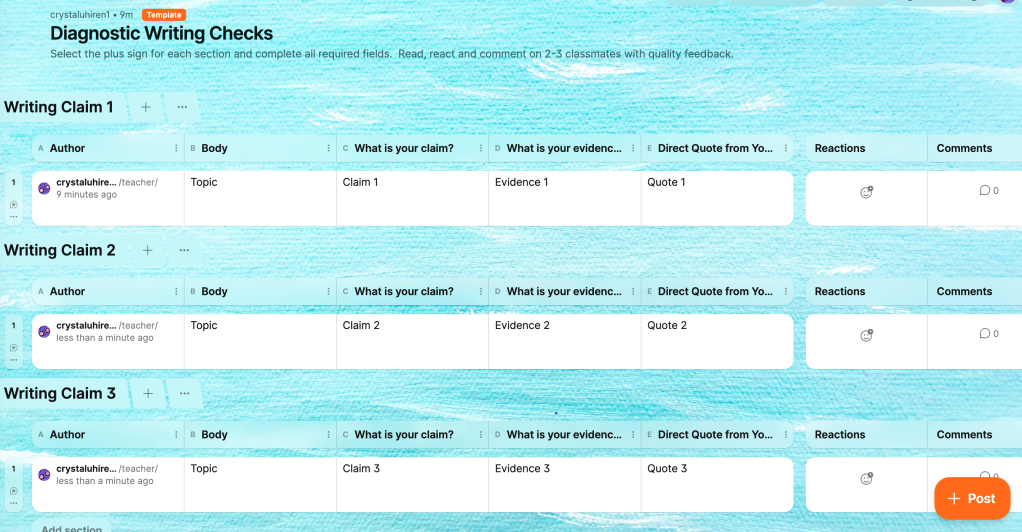
Diagnostic Check With Padlet: Set up a Padlet with a few focused prompts that target key components of their writing assignment. For example:
- What is your claim?
- What evidence are you using?
- Include one direct quote from your writing assignment.
Have students respond to each prompt, building in time for them to comment and respond to their peers.
Why it works: This activity creates space for students to collaborate and provide feedback on the work of their classmates, which can clear up confusion before you step in. Additionally, scanning these responses can surface areas for improvement: from weak claims or missing evidence to surface-level thinking. Here’s a link to the free Padlet template if you’re interested in trying this.
Accountability Journal: Have students keep a simple running journal where they record what they’re working on and the progress they make each day. This works well for research papers or end-of-unit projects that span multiple days or weeks. Having students occasionally turn these in allows you to quickly assess and comment, where needed. Schedule time at the end of class to have students review their log and create a short list of action items for the next day or week.
Why it works: Time management skills are valuable, even long after students leave your classroom. This practice holds students accountable for how their class time is being spent—revealing who is making steady progress, who is treading water, and who might be at a standstill. This journal also ensures that students walk into class each day with a plan (while reducing the temptation to use AI because they are procrastinating or falling behind).
Revision Receipts: During a writing task, have students keep a log of revisions. This can be as simple as jotting down three to five daily revisions, with some explanation of the thinking behind each change, which they can submit alongside their draft. Suggested prompts can be quick: “What did you revise?” or “Why did you make that change?”
Why it works: Instead of turning in a final product with no context, students are showing the thinking behind their revisions—creating a trail of how their work evolved while reinforcing the idea that they will be expected to explain and stand behind what they submit.
Source Tracker: Along with their final product, require students to complete a list of their sources. This idea was inspired by Jennifer Jones, a longtime dual-enrollment English teacher, who wanted a clearer way to see how students were using their sources.
For at least two sources used in their assignment, have students include the following:
- Full citation (MLA or APA).
- Where it appears in their writing (paragraph number or first few words).
- A short explanation of how they used the source (two to three sentences).
Why it works: Rather than locating, reading, and summarizing findings from sources they’ve curated themselves, many students outsource this effort to AI as a shortcut. This activity requires students to dig deeper, showing exactly how the source they chose supports their broader work.