
6 Ways to Center a Paper Notebook
As concerns about technology grow, a familiar tool promises to restore a sense of balance in the classroom.
Your content has been saved!
Go to My Saved Content.Paper notebooks are artifacts of a slower, more deliberate era—a fact that appeals to teachers struggling to get kids to focus, persist when the work gets hard, and be alone with their emerging thoughts.
Forced to rely on apps and Zoom meetings during the Covid emergency, librarian and high school history teacher Benjamin Barbour planned a return to paper notebooks in 2022. His students were rattled and sped up by technology; Barbour wanted to reestablish a more contemplative pace. “In a bid to reclaim some balance between digital and analog learning,” he wrote in 2021, with just a trace of defiance, “I will require students to use paper notebooks this coming year.”
For Barbour, slowing kids down was the point.
To other teachers, a change in velocity is also a kind of antidote. In rural Louisiana, science teacher Jennifer Bollich, who published her own study on nature journaling in 2023, insists that getting kids outside to take notes and sketch rudimentary images of leaves, beetles, or frogs “slows down the pace of life,” promotes “a sense of awe and wonder,” and gives overscheduled teens and tweens the time to relax and notice “the tiniest flowers in the grass and other bits of nature that usually go overlooked.”
The fear of missing out—FOMO in the idiom of Gen Z—is a concept from the digital age, but the heightened sensitivity to every buzz and ping of their cell phones may beget other kinds of obliviousness. Bollich’s students, like teens virtually everywhere, are increasingly indifferent to the presence of flowers, grass, and “other bits of nature.” In Selim Tlili’s middle and high school science classes, attention to the physical world “really began to change once everyone had a smartphone,” he told us in a podcast interview, and his efforts to captivate students by playing YouTube videos was “just making the problem that much worse.”
Today, Tlili’s kids use paper and pencil to sketch the growth stages of root stalks of celery or garlic bulbs, taking note of minute changes in the plants as they execute dozens of drawings in notebooks over a period of months.
“Learning to sit down, slow down, pay attention, and let your brain discover the beauty, especially the beauty in the mundane,” is ultimately what “makes life incredibly joyous and exciting,” Tlili says.
THE RULE OF PAPER
One-off paper assignments aren’t enough, according to advocates of paper notebooks. To put them back at the center of a classroom, or indeed of a whole discipline, educators model routines with students, then use the notebook as a persistent record of a student's progress. The notebook is the primary workspace: “I try to make our science notebooks the place where we put everything formative,” writes middle school science teacher Kelly Nelson. “This includes daily do-nows, records of important vocabulary words, data or observations collected during an investigation, notes taken while reading a science textbook, lab writeups, questions from stations around the room, etc.”
There are, as always, a few tips to keep in mind as educators get started:
Ownership: Students enjoy decorating their notebooks. Encourage kids to personalize their covers–or set aside a class period to do it–but keep the inside of the notebook clean and ready for writing, drawing, and annotating activities.
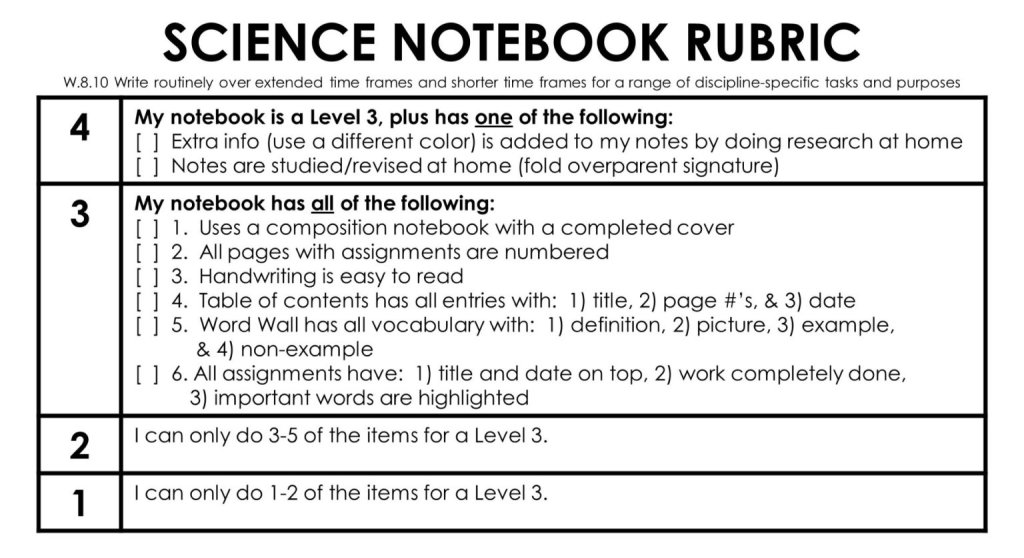
Organization: To make the notebook a more useful, organized record—and to signal its importance—most teachers require students to label and date every entry and write legibly, when applicable. Some teachers set aside the first 3-4 pages of the notebook for the index, where students record the academic activities and corresponding pages.
Grading: Nelson, Barbour, and Tlili all grade their notebooks. To keep the work manageable, educators typically collect notebooks during independent work, like test days; use a simple rubric; and focus on two or three pages to determine whether the student has carefully and thoughtfully executed the task.
Accommodations: Barbour works closely with special education teachers to determine when kids need technology, and makes accommodations as necessary. "If the student can write some notes by hand and some on a computer, an iPad," he says, he adjusts the rules.
EVIDENTIARY DOCUMENTS
By returning regularly to a set of pen-and–paper activities grounded in research, educators not only alter the pace of classrooms but drive better academic outcomes. Taking notes by hand activates fine motor skills and, by engaging both the brain and body, encodes learning more deeply than typing. Sketching, mind-mapping, and flow charting, can expose gaps in learning, according to a 2022 study—and also tend to elicit further inquiry as students reorganize information. A consistently updated glossary of critical terms at the back of a student’s notebook, meanwhile, (hint: start on the last page of the notebook, and work in, according to Nelson) provides students with opportunities to retrieve core concepts and connect them to new learning.
Mixing and matching evidence-based practices throughout the weeks and months, the humble notebook becomes a trusted and valued space students return to with purpose rather than obligation. The activities that follow offer a flexible range to draw from across subjects and grade levels.
1. Taking and Revising Notes: Good note-taking appears simple but actually requires students to juggle a number of cognitive tasks, explains researcher and psychology professor Daniel Willingham. During a lecture, students must attend to both the teacher and the notebook, listen to content “which is new to them—and usually quite complicated,” decide “what's important enough to write down,” and then figure out how to quickly record key points. Not surprisingly, research suggests that only 30 to 45 percent of the essential information is actually written down, rendering a student’s first draft of notes fragmented by nature.
To facilitate better note-taking, students should return to the notes to revise and complete them. More generally, educators can treat a notebook as a “living document,” asking students to review old, incomplete notes before turning to a new page to refine their thinking and add new insights, writes education researcher Jane Shore: “This might include merging information from different sources—lessons, books, websites—into a cohesive knowledge base that provides a broader perspective.”
Disordered notes “present an opportunity” to reorganize what they’ve written down, surfacing questions that require additional context, Barbour confirms. “Maybe they took down the name of an individual with whom they aren’t familiar or wrote a date without further explanation,” he says.
2. Weekly Review: Instead of every review session living in isolation, each can find its permanent home inside a notebook. This provides students with a visible record of learning and can reveal how their memory strengthens over time with consistent practice. High school English teacher Cathleen Beachboard regularly uses brain dumps to reinforce new concepts; for two to four minutes, students write down everything they can remember about a lesson. To consolidate loosely organized material, students can then pair up to compare and complete their work by highlighting “gaps, similarities, and differences,” suggests researcher Kripa Sundar.
Barbour’s students regularly revisit their notes and, on a fresh page of their notebooks, “identify the core concepts” from previous entries to reinforce them. “You might have them isolate different sections and create bullet-point lists or short summaries distilling the key information.”
3. Drawing, Mapping, and Annotating: In a well-designed 2018 study, researcher Myra Fernandes pitted drawing against other learning tactics like writing, looking at visuals, and listening to lectures, and determined that drawing produced the highest rates of recall—roughly double the impact of writing. In other studies, students who used mind-mapping to grapple with complex concepts, like the relationships between the three branches of the U.S. government, remembered more material and exposed critical gaps in their thinking.
Opportunities to draw are everywhere in science and math classes: data visualizations can turn an inert collection of observed measurements into revealing charts and graphs, while annotated diagrams of atoms, molecules, or the water system can be the capstone to a learning sequence which begins with taking notes about the phenomena.
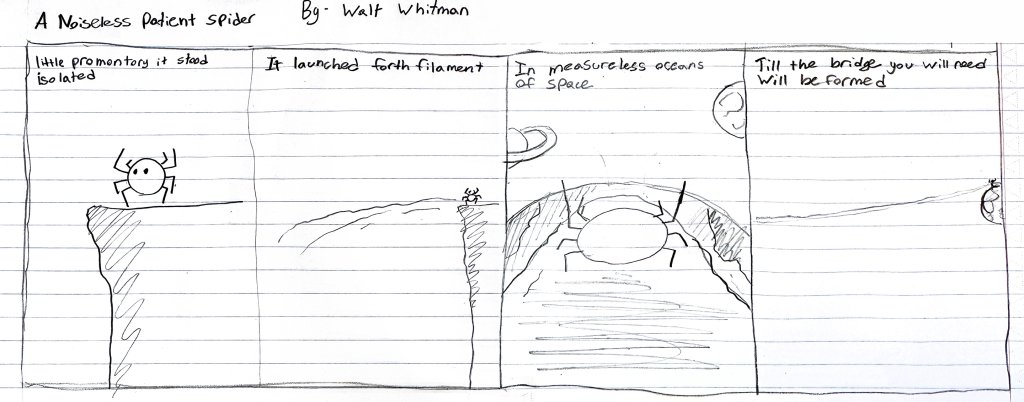
In Brett Vogelsinger’s ninth-grade English class, students draw four-panel comic strips of poems like Walt Whitman’s “A Noiseless Patient Spider”; the task incorporates both vocabulary review and requires students to demonstrate knowledge of story by distilling the poem into only four moments. Similarly, history students might be challenged to reduce a famous speech or historical event to four or eight quickly sketched frames, and then convene in small groups to discuss their thinking.
4. Quick Writes: “Writing by hand is a deliberate act, and it takes time,” according to Beth Pandolpho, an instructional coach and a high school English teacher, invoking, once again, the question of time. “As we craft each letter, our thoughts slowly unfold on the page.”
The research confirms her assertion: Writing both records and generates thought, leaping forward in sudden bursts of inspiration before doubt emerges and the author senses the need to loop back and revise, close gaps, and clarify their thinking.
Asking kids to “quick write” for 3- to 10-minutes gives students a low-stakes space to put pen to paper in response to a prompt. Quick writes are versatile, simple, and repeatable; they can be assigned several times a week, and can become a staple of paper notebooks across subject areas.
Middle school English teacher Meghan Rosa uses 7-minute writes “almost daily” as an “idea generator.” Students write the date and provocative statement like “homework should be banned” at the top of notebook paper, then share and refine the resulting written work in pairs. In social studies or history classes, students might engage in a 5-minute, written reflection about the importance of a towering figure like Frederick Douglass, or quickly respond to a prompt like “Was the U.S. Civil War avoidable?” to commit some initial thinking to paper.
5. Reflection: If it happens too rarely, students can form the impression that reflection is a secondary concern rather than a helpful habit. Increasing the frequency—along with collecting and organizing reflections in one place—not only allows students to “consider their own learning and perception of their own learning over time,” but “return to previous reflections and look for both patterns and shifts,” writes high school English teacher Marcus Luther.
Upon revisiting past pages, the paper notebook reveals what grades alone can’t always capture: how a student’s thinking has changed over time, from asking sharper questions, to identifying areas of confusion more quickly, to taking notes with greater precision. Consider asking students to return to their notes with a more critical eye before writing about whether they’re getting better at distilling key concepts.
Following the completion of a task, Luther asks students to get metacognitive and add a few sentences explaining “their level of confidence” on a scale of 1-5 (5 being “super confident in what you just did,” 1 being “not confident at all”). Looking back on these reflections reveals the arc of a student’s confidence and how it evolved as the class became more familiar and more challenging.
6. Self-Testing: Students can periodically use notebooks to test themselves, writing lists of concepts they think might show up on an end-of-the-unit test and defending their choices in a teacher-led discussion, for example—before posing a set of questions they answer from memory in written form. Alternatively, teachers can lead the development of a list of high-quality questions, then let students answer from memory in their notebooks.
In a 2020 study, students who studied material and then created their own test questions scored 33 percent better on a follow-up test than students who simply restudied the textbook material.
“Question generation promotes a deeper elaboration of the learning content,” lead researcher Mirjam Ebersbach told Edutopia in an interview. “One has to reflect on what one has learned” and then determine “how an appropriate knowledge question” can be inferred from their learning.
To teach students how to ask good questions, ask them to think about some of the tougher or more important concepts they encountered during the lesson, and have them propose questions that use “explain” and “how or why” framing. Students can road-test questions by answering them themselves: Do the questions lead to longer, more substantive answers, or can they be answered with a simple “yes” or “no”?