5 Ways to Make Assessments More Accessible Without Lowering Expectations
Teachers can remove unnecessary barriers in designing assessments that will give them solid information about what students know.
Your content has been saved!
Go to My Saved Content.
Over the years, I’ve often worked with students who could explain an idea clearly in conversation but could not show the same understanding in a formal assessment. They knew more than the paper suggested, but the task asked more of them than the curriculum skill itself. They had to read dense instructions, hold several steps in working memory, manage time pressure, write quickly, and stay calm in a setting that already felt high-stakes.
Teachers may think they are assessing understanding, but a task may also be assessing reading stamina, handwriting speed, executive function, sensory tolerance, and confidence with the format.
However, teachers can take steps to better align the assessments they give with the skills they are trying to assess and create assessments that are more accessible for students without lowering expectations.
STRATEGIES for MAKing ASSESSMENTS MORE ACCESSIBLE
Here are the strategies I’ve used in my own teaching practice that can help teachers better set students up to show what they know.
1. Start with the skill you want to assess. Before I give an assessment, I find it helpful to ask one simple question: What am I actually trying to find out?
For example, a science assessment may be intended to check understanding of a concept, but the student may also have to interpret unfamiliar vocabulary, decode a diagram, and know how much detail to include in the answer.
I use a simple assessment accessibility grid to make those hidden demands more visible. In one column, I write the skill or knowledge being assessed. In the other, I list what else the task asks students to manage. These demands might include reading load, writing load, speed, memory, organization, sensory pressure, or uncertainty about what a successful answer looks like.
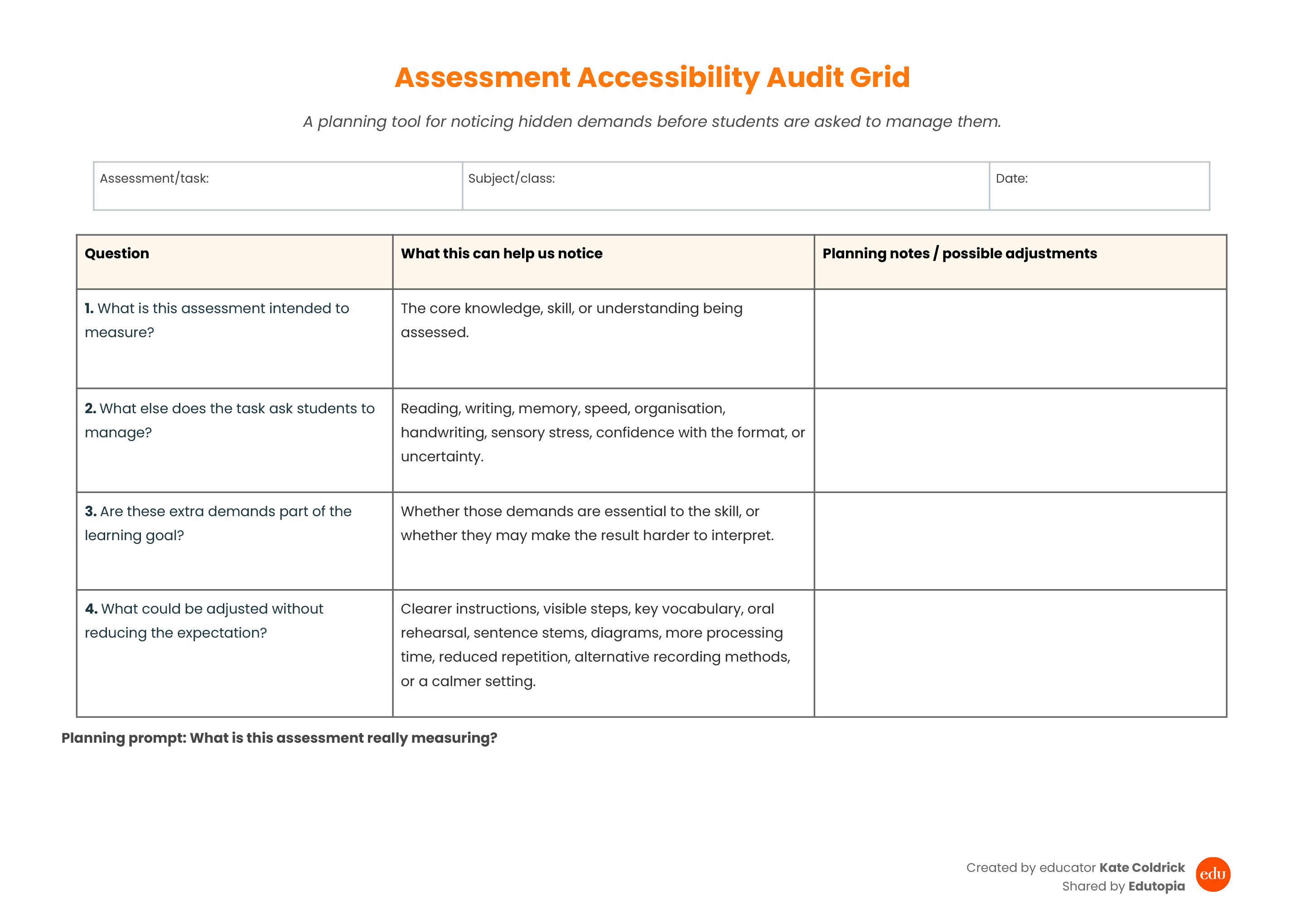
Once those demands are visible, it is easier to decide which ones are essential and which ones can be reduced. If the aim is to assess scientific understanding, for example, a teacher might read the instructions aloud, provide a vocabulary box, or allow a labeled diagram as part of the answer. The learning goal stays the same, but the barriers around it are clearer.
2. Make instructions easier to hold on to. Some students understand the lesson but lose points on an assessment because they misread, forget, or misunderstand the instructions. I have seen students answer only the first part of a question, miss a key word, or write far too much because they are not sure what is being asked.
To reduce that hidden demand, I break instructions into short, numbered steps. For example, for a writing task, I might say, “1. Write one paragraph. 2. Include three facts. 3. Use one quotation.” That is much easier to act on than “Write a detailed response.”
Clear instructions do not make the task easier. They help students put their effort into the learning rather than into guessing what the teacher means.
3. Teach the format before the assessment counts. Some students struggle because the assessment format is unfamiliar. They may know the content, but they do not know how to show it in that particular form.
At the start of the year, I use low-stakes practice tasks to teach common formats before they are used formally. We might practice multiple-choice questions, short written answers, longer explanations, labeled diagrams, word problems, or timed tasks. The aim is not to rehearse the exact assessment, but to make the structure more predictable.
For example, with extended writing, I often show students what a complete answer looks like and then give them a simple frame to follow. With short-answer questions, I teach them how to spot whether the question is asking for a definition, an example, a reason, or a comparison.
When the format feels familiar, students have more capacity to think about the content.
4. Separate knowledge from the recording method. A written answer does not always show everything a student knows. Some students can explain an idea clearly out loud but struggle to write it down. Others lose their train of thought while spelling, handwriting, or organizing sentences.
When I suspect that writing is getting in the way, I use a “tell me first, then write” approach. A student explains the idea orally, and then we decide how to record it. That might mean using sentence stems, a labeled diagram, bullet points, a graphic organizer, or scribing where appropriate.
In a whole class setting, this is easiest when another adult is available, so that the teacher can briefly conference with an individual student while the rest of the class continues with the assessment.
This is especially useful when I need to know whether the student understands the concept. If a student can explain the water cycle orally but writes only three disconnected words, I know the barrier may be written expression rather than scientific understanding. That changes what I teach next.
5. Reduce unnecessary time pressure. Some assessments unintentionally measure speed as much as understanding. Time pressure can be especially difficult for students with slower processing speed, dyslexia, ADHD, autism, motor difficulties, or anxiety.
Where speed is not the skill being assessed, I try to reduce that pressure. I might give students thinking time before they start, shorten repetitive tasks while keeping the same learning goal, or use a smaller number of carefully chosen questions. I also distinguish between fluency tasks, where speed may be relevant, and understanding tasks, where the quality of thinking is more important.
For some students, even knowing that they can have extra time reduces panic. They may not need much longer, but the pressure eases enough for them to begin.
For students with an individualized education program or a 504 plan, teachers should always follow the accommodations that are already in place. Those plans may include supports such as extended time, assistive technology, a reduced-distraction setting, or alternative ways to record answers. But accessible assessment design can also support students whose needs are emerging, students who do not yet have a formal plan, and students who benefit from clearer routines as part of everyday teaching.
When teachers reduce unnecessary barriers, they get better information about what students know, and students have a fairer chance to show what they can do.