3 Books That Support Teacher Mindset Going Into the School Year
These books help new educators gain insight into the emotional labor of the profession and prepare for the first day of school and beyond.
Your content has been saved!
Go to My Saved Content.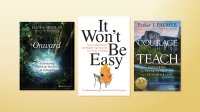
Summer break is essential preparation time for teachers, not only to get some well-deserved rest, but also to have the opportunity to consider our practice and reflect on the kind of teacher we want to be and the student spaces we want to create.
There are plenty of practical recommendations for teachers looking to create or revamp their curriculum or hone their classroom culture as they prepare for a new year. Something that is occasionally overlooked, though, is the time we spend preparing our mindsets as educators.
Teaching is a beautiful but often emotionally draining job; many teachers carry meaningful connections, care, and a sense of identity tied to their work. This deep attachment to our profession is incredibly valuable, but it also means that we need to tend to ourselves as well as our students. The emotional labor that comes with teaching is just as important as the intellectual component, and teachers can benefit if they prepare for that internal work.
So, as teachers consider the upcoming school year, here are a few books about teacher mindset and emotional work that can help you enter the school year feeling thoughtful, strong, and prepared.
‘It Won’t Be Easy,’ by Tom Rademacher
Rademacher’s book, amusingly subtitled “An Exceedingly Honest (and Slightly Unprofessional) Love Letter to Teaching,” is exactly as described. He is unflinching about the real struggles of this profession:
“Each year’s class is a whole new group of humans, complete with all the mess of humans. Their lives are not static, so we can’t be static. We can ask the same questions every year… the questions that have helped us help kids, but we can’t expect the same answers...”
It Won’t Be Easy details the author’s struggles and successes in ways that provide meaningful models of real teacher experiences. Make no mistake, the book is absolutely a love letter to the profession; it only asks that we approach it with respect and find the joy in our work that makes sure we don’t always take every decision—and ourselves—too seriously. The “Am I a Terrible Teacher?” quiz made me laugh and got me through bad days, and I now keep an extra pair of pants at school. It Won’t Be Easy is an excellent book to get teachers prepared for the realities of teaching, both the silly and the serious.
‘Onward: Cultivating Emotional Resilience in Educators,’ by Elena Aguilar
Aguilar’s book on emotional resilience has produced an entire movement of teacher self-care work, including a popular workbook. She focuses on mindset, but her approach is incredibly practical. Aguilar not only breaks up her work into a calendar timeline with an explanation of why she places particular skills in a particular month, but also provides dispositions and reflections for the end of each chapter.
Aguilar is willing to look at the struggles of the profession head-on by calling out problematic teacher mindsets: “Martyrdom is also problematic because it kills you, and usually pretty fast. You may have internalized some messages about suffering (there are institutions and mindsets that promote such ideology), but it’s usually optional. Teachers can do amazing work and transform the lives of kids and also have their own families and hobbies and eight hours of sleep every night.”
The book spends considerable time looking at how to cultivate joy, optimism, and awe as a practice, providing practical cognitive skills to help us grow our capabilities to find positive moments in difficult times. Aguilar’s book is an excellent mix of practical and emotional ways that teachers can build clear skills to help support their mental health.
‘The Courage to Teach,’ by Parker Palmer
Palmer’s book rests on an idea that reframes almost everything else teachers are told to work on. Good teaching cannot be reduced to technique; it comes instead from the identity and integrity of the teacher. Or, as he puts it more plainly, “We teach who we are”: “If identity and integrity are more fundamental to good teaching than technique, and if we want to grow as teachers, we must do something alien to academic culture: we must talk to each other about our inner lives; risky stuff in a profession that fears the personal and seeks safety in the technical, the distant, the abstract.”
Palmer writes about fear, about the pressure to perform, and about the space between the person we are in front of students and the person we actually are. He makes a case for teachers talking with each other about that inner work, and for treating it as part of the job rather than something separate from it.
The Courage to Teach: Exploring the Inner Landscape of a Teacher’s Life asks you to reflect rather than implement, and it gives teachers language for the parts of the work that are hardest to name. That alone can make a new school year feel more manageable.
Reading is often framed as enrichment for teachers. It’s the thing we get to if there’s time after the unit planning and classroom setup are done. I’ve come to see it as preparation—the kind that comes to mind when I least expect it but actually need it the most. These books don’t tell me where to put my desks, but each one shapes how I walk into a room in August.
The reading we do before the school year may not seem as urgent, but it can shape how we show up on the first day just as much as our lesson plans do. When we make room for it, we give ourselves a clearer sense of who we want to be in the year ahead, and our students feel that too.