
17 Ways to End Class That Make Tomorrow Easier
The final minutes of class can be future-oriented—use these closing activities to consolidate learning, gather feedback, or spark curiosity about tomorrow.
Your content has been saved!
Go to My Saved Content.Teachers put plenty of thought into how a lesson begins and how its central activities should unfold. But by the final few minutes of class—when students are zipping up backpacks and watching the clock—class time can quickly devolve into chatter, last-second reminders, and waiting around for the bell to ring.
Those minutes are more valuable than they look and present a ripe opportunity to “close the loop” on learning, says high school economics teacher Sarrah Saasa. “We don’t want kids to abruptly go onto the next class,” she explains. “We want to understand whether they’ve understood the concepts.”
Saasa accomplishes this in 10 minutes or less, relying on a set of activities that ask students to distill key takeaways, reflect on what they understand and where they’re stuck, and identify areas for further support. The modest time investment pays off, she says: “Closing the loop helps me in terms of understanding my students, and also how to plan my next session.”
Purposeful closers can also help students surface misconceptions and lingering questions, reflect on their progress, or prepare mentally for what comes next. Many of the following closing activities require very little setup and can be used as needed, rather than assigned every day.
LOCK IN NEW LEARNING
1. Brain Dump, Then Compare: Students get two minutes to record everything they remember about the day’s learning—using bullet points, doodles, or even mind maps—before comparing responses with partners. Retrieving and expressing information in their own words strengthens student learning, says English teacher Cathleen Beachboard and reveals to teachers how students are “organizing and understanding knowledge.” Follow up with a brief teacher-led recap—either in the moment, or at the start of next class—to ensure that students have retained accurate information.
2. Two-Dollar Summary: Give students a “budget” of two dollars (or any amount you’d like) to summarize the day’s lesson, with each word costing 10 cents. Increase the challenge by requiring specific vocabulary. Alternative formats: a tweet, haiku, or six-word headline—all of which push students to consolidate learning and “think about what is most crucial to say,” writes educator Sarah Cook.
3. Teach It to a First Grader: In small groups, have students explain a recently learned concept or procedure in language simple enough for a first grader to understand, such as how checks and balances work, or what the Pythagorean theorem is meant to help find. Circulate through the class and quickly share out a few of the most promising explanations. Stripping away technical language can reveal whether students truly understand underlying ideas, writes Todd Finley, a professor of English education at East Carolina University.
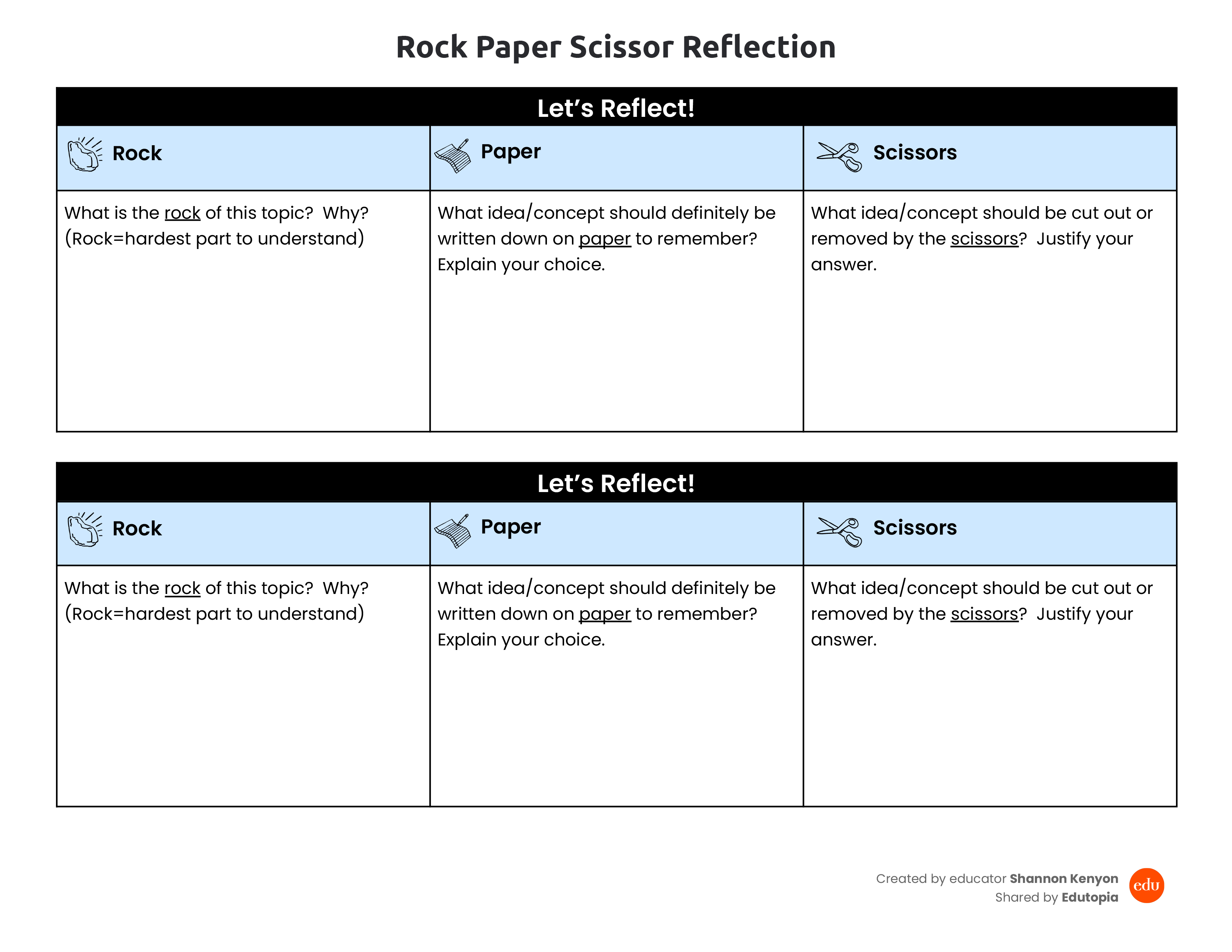
4. Rank What Matters: Shannon Kenyon puts students’ metacognitive skills to work with a twist on rock, paper, scissors. Using this worksheet, students identify the lesson’s “rock,” or its most challenging element; its “paper,” something worth recording; and its “scissors,” a detail they feel they can safely cut out. Educator Ann Sipe suggests an alternative: Periodically let students “cheat” on an upcoming quiz by creating a cheat sheet that prioritizes the most useful facts, formulas, or vocabulary words from recently learned material.
5. Quick Draw: Ask students to select a few central ideas from a recent lesson or unit and represent them visually—as a comic strip, concept map, or other diagram. Research suggests these visual sense-making activities can help expose knowledge gaps students couldn’t detect while thinking abstractly, and therefore improve comprehension. Instructional leader Shveta Miller uses prompts like “Draw an image that represents gravity” or “Use circles, squares, and triangles to show the relationships between characters.” She also makes it clear that artistic skill is an afterthought; the most valuable insights derive from how students choose to represent ideas—and what misconceptions pop up as a result.
6. Build Tomorrow’s Quiz: Let students spend the last five minutes in groups or individually generating several true-or-false or multiple-choice questions about the day’s learning for classmates tomorrow to answer as a bell-ringer. Generating questions pushes students to examine material from new angles, strengthening understanding and memory. A 2020 study found that students who studied material and created their own test questions scored 33 percent higher on a follow-up test than students who simply restudied the material. “Question generation promotes a deeper elaboration of the learning content,” said the study’s lead author Mirjam Ebersbach.
REVEAL WHAT NEEDS ANOTHER PASS
7. Clear, Cloudy, and Why: To quickly diagnose what is landing and what isn’t, have students name one idea that feels clear and one that remains cloudy. For a twist that does the sorting for you, third-grade teacher Erika Savage has students place their responses in one of three folders—“Got It,” “More Practice, Please,” or “I Need Some Help”—giving her a starting point for grouping students or planning next-day check-ins. If time permits, ask students what might bring a cloudy idea into focus: another example, clearer vocabulary, additional practice, or a peer explanation.
8. Correct a Misconception: To see whether students can apply what they’ve recently learned, present them with a common misconception to untangle. They might revise a flawed explanation of a scientific process like cellular respiration, correct an inaccurate definition of a civic term like federalism, or identify the misstep in an incorrectly solved math problem. Diagnosing and repairing an error can reveal far more about their understanding than simply asking, “Does everyone get it?”
9. Human Bar Graph: Gauge students’ understanding while getting them moving. Begin by labeling opposite sides of the room “I’m confused” and “I understand and can explain this.” Ask students to position themselves along the continuum, then confer with classmates who feel more confident. If time permits, have them reposition themselves afterward to see whether the balance shifts.
10. Tiny, No-Stakes Quizzes: End class with a few ungraded questions that get students to retrieve earlier learning, apply new material, or both. Fourth-grade teacher Leah McGinnity uses this routine with current topics as well as concepts students haven’t encountered in months. Students work independently before sharing their strategies, giving her insight into their thinking while strengthening key knowledge and procedures.
PLANT SEEDS FOR TOMORROW
11. Park Lingering Questions: Before students leave, invite them to post unresolved questions in a designated “question parking lot,” such as a whiteboard or box for folded submissions. Beachboard reviews these herself or has students revisit them in groups, gaining “insight into where students are struggling” while identifying ideas to clarify, revisit, or explore more deeply in upcoming lessons.
12. Tease What’s Coming Next: Spark curiosity about an upcoming reading, historical period, or scientific process by sharing an intriguing image, quote, headline, podcast clip, or short video, suggests Curtis Chandler, an education professor at Brigham Young University. Ask students to predict the connection or record a question, creating a ready-made entry point for tomorrow. Alternatively, Chandler recommends a “bait and switch”: Present several plausible true-or-false statements about the content to come—including common misconceptions—and have students guess, but withhold the answers until the next lesson.
13. Quiz Them Before You Teach Them: Give students a few questions about material they haven’t learned yet. Correct answers aren’t the goal: Research suggests that mistakes on a pretest can focus students’ attention on the right information when they encounter it later—a phenomenon known as the pretesting effect.
TURN REFLECTION INTO A NEXT STEP
14. Capture, Schedule, Remind: Reserve the final minutes of class for students to plan for upcoming assignments, exams, and deadlines. Education specialist and executive-function coach Sarah Kesty suggests letting them choose a workable system—a planner, calendar, LMS list, photo of the board, alarm, or sticky note—while explicitly teaching three moves: record what they need to do, schedule when they’ll do it, and create a reminder.
15. Leave a Breadcrumb Trail: During multiday work—such as a science lab, argumentative essay, or research project—have students end class by noting what they completed, where they got stuck or still have questions, and where they should resume tomorrow. These “progress pit stops” help students “document their thinking as they work,” writes educator Crystal Uhiren, strengthening metacognitive and executive-function skills while “creating layers of ownership and a clearer record of the thinking taking place.”
16. Set a Goal: Have students complete a quick goal-setting sentence stem, such as “Tomorrow, in class I will be ready to…,” “Tonight, I will…,” or “The next step I need to take is….” The goal can relate to a unit of study or even students’ lives outside the classroom, notes educator and UCLA instructor Rebecca Alber. Especially early in the school year, she writes, the activity can be a “wonderful way to get to know your students.”
17. A Pulse Check: Not every closer needs to focus on academic content. Occasionally, Peterson suggests using an exit ticket or small-group discussion to gauge how students are experiencing both the work and classroom culture. Ask questions like: Do you feel supported? Do you feel confident asking for help? Or, what is one thing that would make you feel more comfortable in this classroom? Adjust the format by age: older students can reflect in writing, for example, while younger ones might use a rating scale, choose from multiple-choice options, or select an emoji that captures how they felt during the lesson.