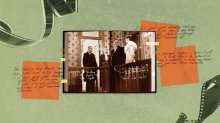
Teaching Students How to Read Films Like Literature
High school students can benefit from lessons on how films use visual language to express classic devices like characterization and symbolism.
Your content has been saved!
Go to My Saved Content.For as long as schools have had A/V equipment, teachers have asked students to compare literature with film adaptations. While this is common, I think there is a more effective way to teach students that film has its own unique visual language: by seeking out films that cover many of the same themes as a literary work but are not themselves adaptations of literary works.
This is because film adaptations often sag under the weight of their loyalty to the written language of the original work. For years I watched as students would scratch their heads viewing the 1970s adaptation of The Great Gatsby when Nick, upon first meeting Gatsby, claims that Gatsby has a smile that “understood you just as far as you wanted to be understood, believed in you as you would like to believe in yourself, and assured you that it had precisely the impression of you that, at your best, you hoped to convey” only to see Robert Redford’s Gatsby and his wan smile.
Many years later, when Baz Luhrmann adapted Gatsby, he wisely leaned on visual methods to convey the effect of Gatsby’s smile, using slow motion as Gatsby smiles at Nick and fireworks explode in the background, birthing one of the iconic memes of the 21st century.
While finding effective literature/film pairings requires work, it is worthwhile, as it can help students see how the best films use visual language to enhance their meaning in the same way that the great written works use classic devices like characterization and symbolism.
To illustrate this, I have constructed two literature/film comparison activities all built around the pairing of The Great Gatsby and Orson Welles’s iconic film Citizen Kane. The latter covers many of the same themes as Gatsby—the corrupting influence of wealth, a famous but enigmatic central character, etc.—and yet was written for the screen and therefore relies heavily on visual language to convey its themes.
ACTIVITY 1: SYMBOLISM IN LITERATURE VS. SHOT COMPOSITION IN FILM
The joy of symbolism in literature is the way that it enhances the story without telling the reader exactly what it “should” mean. The famous green light on the end of Daisy Buchanan’s dock in Gatsby is so memorable because its meaning is not fixed.
Early in the novel, the green might symbolize Gatsby’s hope for the future, just like the first appearance of green in nature inspires us with hope after a long winter. While the green light has no real bearing on the plot, it enriches our understanding of the story and its themes.
Filmmakers do this same thing with shot composition and how they juxtapose characters against various other visual aspects of the shot. Consider the shot of Susan Alexander telling Kane that she is leaving him toward the end of the film. As she stands face-to-face with Kane, Welles composes the shot so that a porcelain doll with blond hair, just like Susan’s, sits in the foreground just off to the left of Susan herself. Why is it that Kane and Susan cannot get along? It’s because Kane, who is used to “using money to buy things,” sees people like Susan as just things he can add to his collection the way one might buy a doll and put it on a shelf.
To help teach this to students, I ask them to track what else appears in the frame with the characters during significant moments in a film. I encourage students to concentrate on visual elements that are not a part of the plot, just as many of the most iconic symbols in literature do not have a direct bearing on the plot.
Moments after Susan leaves Kane, Kane trashes Susan’s room and then walks slowly past his assembled help and past mirrors in his hallway that create near-infinite reflections of Kane. While there are millions of “reflections of Kane” in the minds of all the people who know of him, we, the viewers, just like the general public of the film, never get to see the “real” Kane.
Here, attentive students hopefully will point out that this is not the first time we have seen a visual reflection of Kane. Earlier in the film, when Kane’s closest friends wonder about the true motivation for Kane spending lavishly on his struggling newspaper, we see those friends debate while Kane is reflected in a windowpane behind them. Kane is, even to the people who know him best, always a mystery, a person seen in reflection rather than as he truly is.
ACTIVITY 2: CHARACTERIZATION IN LITERATURE VS. CAMERA PLACEMENT IN FILM
Literature uses language to establish characters. Our first indication that old-money Tom Buchanan is arrogant and cruel in The Great Gatsby is the way Fitzgerald describes his muscles bulging underneath his tight riding outfit and the way he sits with his legs spread wide as Nick, his guest, approaches to greet him.
While costumes and gestures in film can simulate the same effect, camera placement is a much subtler form of characterization. When young Charlie Kane celebrates his first Christmas with his new guardian, the stodgy Wall Street banker Walter P. Thatcher, Welles places the camera extremely low as young Charlie unwraps Thatcher’s gift to him and then pans up Thatcher, creating the feeling that Thatcher is a giant next to the young Charlie and will control the course of Kane’s young life for the time being.
As students watch, I ask them to consider how camera placement influences their feelings about characters and their relationships to one another. For additional film clips, you can explore the YouTube series StudioBinder, which offers concrete examples of camera placements in popular films and how they influence our feelings about characters.
WHY STUDENTS SHOULD LEARN THE VISUAL LANGUAGE OF FILM
While the high school English language arts curriculum is jam-packed with important skills beyond just reading and writing, film is not always included. I believe it deserves a place in the classroom, since it both complements the core curriculum and, in many ways, better reflects the kind of media our students consume most often.
Building a bridge between the devices of literature and the visual language of film should, at the very least, help students appreciate how art in any medium uses the features particular to that medium to subtly influence our experience of story.