
How to Make Sure Teachers Know They Matter
Mattering is about more than teachers’ sense of purpose, says author and researcher Zach Mercurio—it’s about feeling significant to their colleagues. And principals can help foster that feeling.
Your content has been saved!
Go to My Saved Content.
There’s an innate sense of purpose to working in education that isn’t necessarily found in other fields. But that sense of purpose isn’t enough on its own to sustain a teaching career: Polls show that teachers are less satisfied with their jobs than other workers, and they tend to believe the public views them negatively.
The same polls provide plenty of insights into the sources of teachers’ dissatisfaction. In 2024, 77 percent of Pew respondents categorized their teaching job as stressful, while 68 percent referred to their job as overwhelming. Just 15 percent of teachers were “extremely or very satisfied” with their pay. The majority of teachers say that their schools are understaffed, and as a result, their jobs require long hours.
Principals, too, have stressful jobs and long hours. Among their responsibilities: unlocking funds for their schools and supporting educators so that they don’t burn out. School leaders have spoken to me about how they try to free up time for teachers in service of a healthier work-life balance.
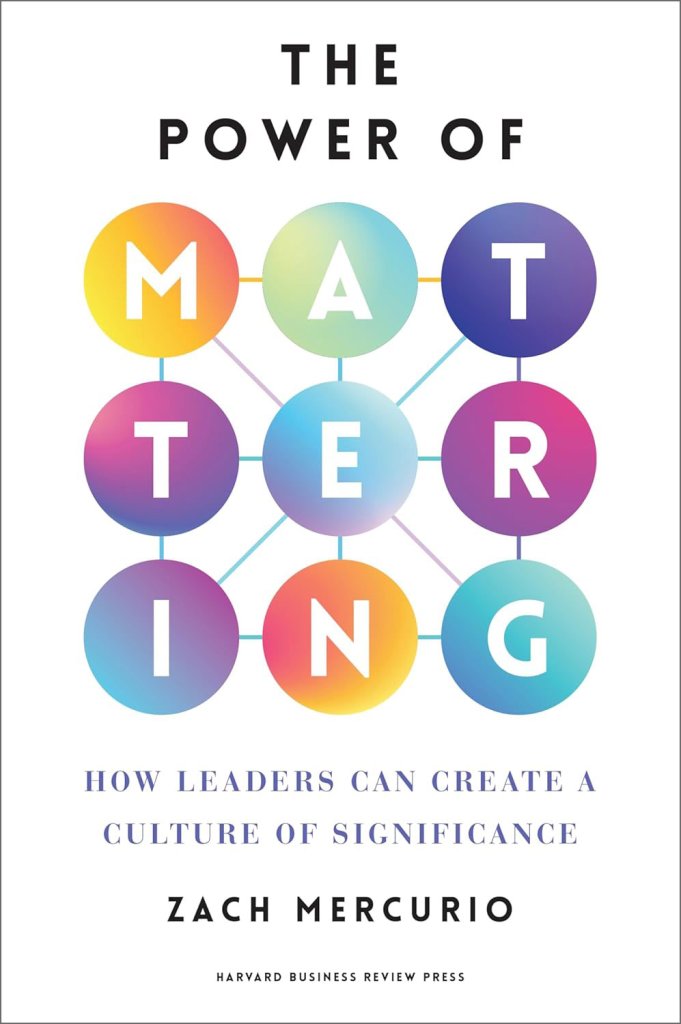
These crucial efforts are more successful when teachers feel not just a sense of purpose but also that they really matter to their school, both interpersonally and individually. So says researcher and author Zach Mercurio, who’s written extensively about how leaders should promote the importance of “mattering.” In 2025, Mercurio released The Power of Mattering: How Leaders Can Create a Culture of Significance. The book examines what Mercurio says is a “primal need” to matter at work. By that, he doesn’t mean simply achieving a feeling of belonging. Mattering is something deeper: “Belonging is feeling welcomed and accepted in a group, whereas mattering is feeling significant to the group’s individual members,” he wrote for Harvard Business Review.
I recently reached out to Mercurio because I wanted to know how he thinks about the concept of mattering in professions that, like teaching, have a strong sense of built-in purpose.
“What’s happened in fields like health care and education is that, for so long, we’ve relied on the bigger purpose to carry people through, instead of rigorously making sure the people who love their jobs feel loved in their jobs,” he told me during a phone interview. He cited trauma surgeons who save lives all day, every day, but still burn out. “Much of their time is eaten up doing paperwork and inputting records, or they’re with leaders who never check in on them, never actually show them how they’re valued,” he said.
Mercurio offered up insights for school leaders who want to help prevent burnout among their staffers. Reminding them of their individual importance to their larger team of educators, he says, is one place to start.
Improve Your Interpersonal Interactions
Composer Claude Debussy asserted that music is the space between the notes. Mercurio invoked this famous saying to draw a useful parallel: For big organizations, including schools, the notes are meetings and emails, and the music comes from everything in between.
Put simply, mattering is affirmed through interpersonal interactions. “There’s no symbol, award, perk, or well-worded email message that can make up for a daily experience where you feel unseen, unheard, or unvalued,” Mercurio said.
He clarified that he’s not calling for more interactions, which isn’t a viable plan for already-busy school leaders. Rather, he suggested that principals find ways to optimize the interactions they already have on a day-to-day basis. While walking down the hallway, for instance, principals should greet staffers by name rather than breezing by or nodding in greeting. Checking in on how staffers are doing, even if it’s brief, makes a huge difference—especially during stressful points in the school year. Being around to chat for a few minutes before or after a meeting is another small but sincere gesture.
The proof is in Mercurio’s research. When he quizzed employees in a variety of industries about times they felt like they most mattered in their work, their responses tended not to be about big accomplishments. “They talked about things like, ‘My leader remembered something that I was struggling with and proactively checked in with me,’ or, ‘Someone asked about my energy levels and if there was anything I needed from them,’” Mercurio said.
For leaders who want to do their own mattering research, Mercurio advises against generic engagement surveys. Instead, he encourages them to pay attention to observable behaviors when they survey their reports—things that can be measured, like how frequently teachers say they’re getting check-ins from administrators.
Be Proactive and Transformational, Not Reactive and Transactional
A major component of mattering is being noticed. It’s incumbent on leaders to not just “see and hear somebody,” Mercurio said, “but then close the loop and offer an action to show that they’re thought about.”
Closing the loop is made much easier through proactive communication. It’s common for leaders in many fields to reach out to employees only when they need something or they’re seeking an update. Mercurio often asks leaders what would happen if they called one of their staff out of the blue. During one workshop, a leader not-so-jokingly replied that a staff member would be taken aback and nervous.
For Mercurio, that doesn’t necessarily signal bad leadership, but it does mean the leader isn’t proactively communicating. They’re only connecting with employees when something is wrong, rather than briefly but consistently checking in on how they’re doing.
Mercurio recommended that school leaders examine the interactions they have on a weekly basis. How many involve transactional questions, as opposed to transformational questions? By transformational, he means clear, not vague (there should be an objective and a time frame); open, not closed (“What’s taking most of your energy today?” versus “Are you having a good day?”); and exploratory, not evaluative (digging into someone’s experience).
Here are some examples of transformational questions:
- “What’s been taking most of your energy lately?”
- “Where are you feeling stuck right now?”
- “What’s something you’re proud of that hasn’t been acknowledged?”
- “What’s felt harder than it should lately?”
- “Where are you feeling momentum right now?”
- “What kind of support would be most helpful right now?”
The goal is to keep an eye on staffers’ “energy and emotions,” Mercurio said. If someone is frustrated after a meeting, don’t ignore it. “Call that person up and say, ‘Hey, I sensed that you were frustrated in that meeting. Is that right?’ Those little cues can open up a communication line and foster the sense that someone’s noticed instead of overlooked,” Mercurio added.
Noticing Is a Skill
Paying attention to the people who work for you sounds like a given, but Mercurio doesn’t want to diminish the fact that “it’s a skill to see somebody, to listen for deeper meaning, to pay attention and remember a detail and follow up,” he said. It takes real discipline to show others that they matter—especially in the digital age, when emails and other forms of communication have reduced many people’s interpersonal skills, he noted.
In the education realm, Mercurio has heard many complaints about “uncaring leaders,” whom he’s discovered are sometimes “really good people—and untrained to be in a leadership position.” They tend to have been excellent teachers and were hired as assistant principals or principals on the assumption that they’d be able to transition easily to the new role. But administration is a different job, and principals should work to equip interested teachers with the skills they’ll need to succeed if they do make the transition.
“Unfortunately, a lot of organizations across sectors leave that up to chance,” Mercurio said. “They rely on a couple of in-service days a year and intuition—just doing the right thing or hoping somebody will be a good person or a good leader. But intuition doesn’t scale very well in school systems and organizations. Expected practices, habits, and skills scale.”
In other words, principals need to model the practices, habits, and skills that they expect of others, including aspiring administrators—in part through a schoolwide culture of noticing and reinforcing people’s understanding that they matter. “It should be a very clear expectation that during interactions, everyone should feel noticed, affirmed, and needed,” Mercurio said. He recommends that principals use a simple five-word phrase: “If it wasn’t for you...”
Not only is the phrase a helpful reminder and expectation-setter—it also opens up countless conversations so that principals and staffers can continue to hone their noticing skills. Mercurio provided a few examples:
- “I noticed how you stayed after to help that student finish their work. I just saw them walking down the hall smiling. If it wasn’t for you, I don’t think they’d feel as supported.”
- “A lot of people were thinking about what you brought up in that meeting. If it wasn’t for you sharing your perspective, I don’t think we would have had such a good discussion.”
Mercurio added, “It’s very hard for anything to matter to someone who doesn’t believe that they matter. People tend to add value once they feel valued.”