Sentence-Level Scaffolds That Foster English Learners’ Independence and Growth
Teachers can structure supports to guide English learners to speak and write using grade-level, discipline-specific language.
Your content has been saved!
Go to My Saved Content.
Most educators are familiar with the saying “All teachers are teachers of language.” Although we wholeheartedly agree, we know that not all teachers have been taught to be language teachers.
Unless multilingual learners are explicitly taught to write in an academic register, they will default to more casual, social language to express themselves in academic settings. Because much of the writing at school and in business requires extensive formal language, multilingual learners with underdeveloped academic language can be disadvantaged in many ways. In this article, we share one way that all teachers can embed language instruction into their content lessons so that all students can learn how to speak and write using grade-level, discipline-specific academic language.
Rethinking sentence Scaffolds
To meet the need for support in academic writing, well-intended teachers often provide various scaffolds, including word banks and sentence frames, to develop students’ writing in their grade-level and content classes. While these scaffolds do offer some in-the-moment support, they can also create dependence rather than build students’ independence and skills. After years of this kind of support, we have seen that many experienced multilingual students still struggle to use academic vocabulary without a word bank or start a response without a sentence starter.
Because sentence frames and word banks do not always develop students’ independence and skill in using academic language, we propose something different: embedded scaffolds, a concept described in our forthcoming book. Embedded scaffolds prompt students to express their ideas using a specific sentence structure. These language structures teach students how to speak and write using academic language. For example, if students are asked to explain a cause-and-effect relationship, we might ask them to begin the sentence with “Since.”
While there are many ways to express academic ideas, we suggest some frequently used expressions and language features associated with high-utility command terms. This table lists a few of these high-utility language features that teachers may choose to explicitly teach in their grade-level or content-area classrooms to help multilingual learners express themselves academically.
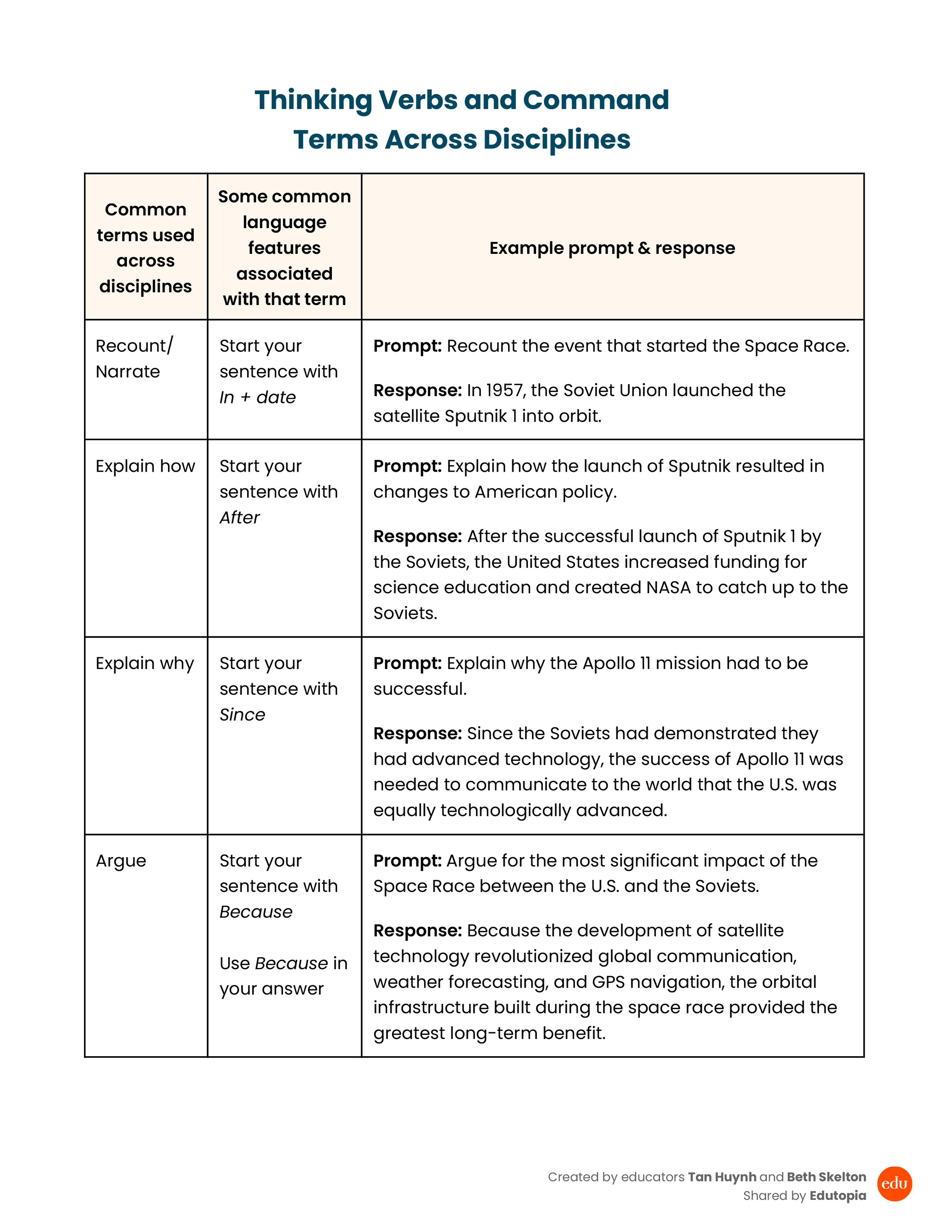
The following steps describe how to determine which scaffold to embed in the prompt.
Write a prompt. Example: Explain how the industrial revolution impacted society.
We encourage teachers to write a prompt that begins with a command term, as these verbs give students a purpose for their writing. The term also determines the language students will use in their answer. For example, the prompt asks students, “Explain how the industrial revolution impacted society,” which requires a description of the process. However, if the prompt asked students, “Explain why cities were polluted during the industrial revolution,” they would answer with different language, such as the conjunction because to show cause and effect. The verb at the start of the prompt determines the language students need to use to respond academically.
Provide a model response. Example: When farmers moved to cities to work in factories, society shifted from most jobs being in farming to most being in factories.
Writing a model response to the prompt reveals the expected academic language. While there are many ways to respond to any prompt, the teacher’s response should include grade-level content, concepts, and academic language. When teachers analyze the content and sentence structures in the model response, they will discover the language features that match the command term. These language features are the ones to teach explicitly.
Analyze the sentence structures used in the response. Example: This is a complex sentence starting with a subordinating conjunction (When).
The command term “Explain how” asks students to communicate details about a specific process. The model response uses “When” in the answer, which marks the beginning of an explanation that communicates a process. Of course, other sentence structures would also work to answer this prompt. The goal of writing the model response is to identify a sentence structure that will develop students’ academic writing skills in the content area.
Add the embedded scaffold. Example: Explain how the industrial revolution impacted society. Start your sentence with “When.” Make sure to identify a group of people whose lives were changed.
The command term “Explain how” asks students to communicate details about a specific process. The model response uses “When” in the answer, which marks the beginning of an explanation that communicates a process. Of course, other sentence structures would also work to answer this prompt. The goal of writing the model response is to identify a sentence structure that will develop students’ academic writing skills in the content area.
After analyzing the model response, teachers can embed the scaffold. In the example, the teacher intentionally chose to embed the scaffold, “Start your sentence with ‘When.’” This embedded scaffold in the prompt helps students think about the process that initiated the societal change. Additionally, teachers can provide another form of support that reminds students of the content they need to provide. One way to answer the example prompt is to identify the group of people whose lives were affected by the industrial revolution. This reminder, coupled with the word “When,” scaffolds the output while still giving students the responsibility for generating the answer rather than completing a sentence starter.
Differentiation
Embedded scaffolds are highly effective when students already know how to structure a sentence that starts with the embedded scaffold, like “When.” However, if multilingual learners have not yet learned how to start a sentence with the suggested structure, they will need explicit small group instruction on how to use it. This differentiated instruction can happen while other students are working independently or when a co-teacher is in the classroom. During this small group instruction, students should have multiple opportunities to construct sentences using the targeted language structure.
After repeated use of these sentence structures, teachers can gradually remove the embedded scaffolds so that students are more independent. However, this is done only after successful repeated demonstrations of using a particular sentence structure with particular command terms. When students are provided with embedded scaffolds, they will gradually acquire these academic sentence structures. However, before embedded scaffolds are removed, students should be able to identify the command term in the prompt and recall the sentence structures that express that kind of thinking.
We do not expect all content teachers to serve as part-time grammar teachers. Instead, we know that every discipline has academic ways to express ideas. Therefore, we ask educators to analyze the language that a person in their field would use to effectively express discipline-specific ideas. After the analysis, teachers can show students these language features. When content teachers reveal and teach the language of their discipline, they embody the spirit of an educator who, regardless of their content area, teaches language.