5 Ways to Build Respect in Early Childhood Classrooms
Instead of just telling students to “be respectful,” these activities help them explore what that looks like in their classroom communities.
Your content has been saved!
Go to My Saved Content.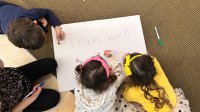
We often ask young children to “be respectful,” but we don’t provide concrete opportunities to practice what that actually means in early childhood classrooms. Respect in early childhood isn’t a rule, it’s a skill. And like any skill, it needs to be taught and experienced.
5 ways to build the skill of respect
1. Same/different game. Young children are naturally curious about differences. They notice who speaks another language, who has different hair, who brings different foods for lunch. At the same time, they are constantly seeking connection. So instead of just reminding children to “be kind,” I try to make respect for differences visible and interactive.
One of the simplest ways I’ve found to do this is through a same/different game. Children gather in a circle, and I call out prompts like, “Who has brown hair?” “Who has a sister?” or “Who likes broccoli?” Students who match step into the circle, then step back out. Children start to see that while we are different in many ways, we also share a lot of similarities. These small but powerful moments help children understand that difference doesn’t mean disconnection.
2. Self portraits. Another activity that always sparks conversation is self-portrait drawing. Children create pictures of themselves, their hair, their clothes, and their faces, and we display them around the classroom.
Then we talk. What do you notice? What is the same? What is different?
The conversations that come from this are always rich. Children begin to see that everyone brings something unique to the classroom, and that those differences are something to value. I’ve found that when children feel proud of who they are, they are much more open to appreciating others, too.
3. Exploring communication. Respect also means understanding that people communicate in different ways. In one lesson, we learn simple American Sign Language greetings like “hello,” “thank you,” and “I love you.” The children love this. It opens up a conversation about how not everyone uses their voice to communicate.
If children speak another language at home, they are invited to share words with the class. Sometimes we spend a week practicing how to say “good morning” in a classmate’s language. Other times, we learn words connected to what we’re studying. These moments show children that their identities belong in the classroom.
4. Respect for others—especially animals like Little Dude. In our classroom, the values we practice grow from shared conversations and experiences as we discover together what respect looks like in our community. Before we write anything down, we talk it through:
- “What does helping feel like?”
- “What does kindness look like?”
- “How do we know someone is listening?”
In some lessons, Little Dude, my therapy dog and canine co-teacher, joins us. Before he enters, we always pause and ask: What does respect look like for Little Dude? The children are very clear: quiet voices, calm bodies, gentle hands, giving space.
Then we connect it back to ourselves. “These are the same ways we show respect to each other.” And when Little Dude comes in, you can see it. The children adjust immediately. Their bodies slow down. Their voices soften. They are intentional. His presence makes respect visible in a way that words alone can’t.
We also act it out. Using puppets or role-play, we show both sides: what respect looks like and what it doesn’t. The children are very quick to point it out.
5. Building a Community Cube. Before the activity begins, I prepare six large poster-board panels that will eventually form the sides of a cube. The class is divided into small teams; each group chooses a respect word (such as kindness, listening, helping, teamwork, trust, etc.), they explore its meaning through discussion, and then they decorate one panel with drawings that show the value in action.
- Kindness might be helping a friend zip a coat.
- Listening might be eyes watching and bodies still.
- Helping might look like cleaning up together.
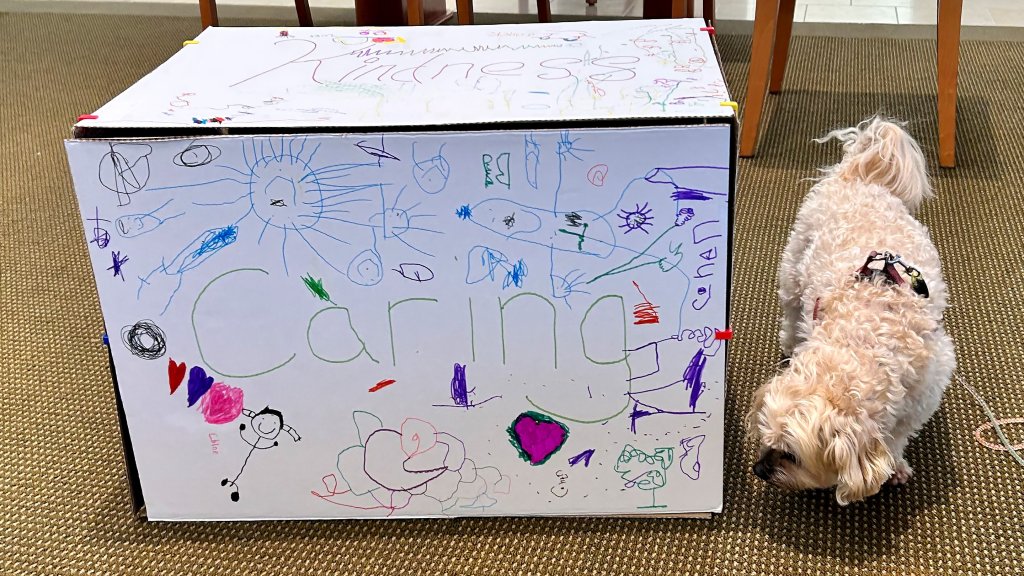
When we bring the panels together to form the Community Cube, we pause after each side is added. Each group shares their word and their drawings. The cube stays in the classroom, and we come back to it often, especially during tricky moments. “Which side of our cube can help us right now?”
When respect is taught this way, the children start using the language themselves, and remind each other to use it as well. Children begin feeling like they belong. They participate more. They cooperate more. They are more willing to try. Respect isn’t separate from learning: It creates the conditions for it.