
How Do I Carve Out Time for What I Need to Do as a Leader?
Administrators can take an intentional pause to ensure that most of their time is spent being proactive rather than reactive.
Your content has been saved!
Go to My Saved Content.
“I don’t remember this being part of my role.” We’ve all had this thought as leaders, where we find ourselves getting busy and supporting others in multifaceted ways, but at the same time, we might wonder if some of what we do is the best use of our time. When I began the year, I would do anything to offer support. I covered teacher duties as needed, created a schedule for an important event for our activities team, and did a speech off campus. These were supportive, helpful, and needed actions—but none of it was in my job description. None of it was what I was called to put my core energy and time into. In fact, leadership isn’t always the job description, it’s also what the school demands in the moment.
To be clear, it is a leader’s job to provide support as much as possible. It’s important to take that impromptu parent meeting, meet with a student with a behavior issue, or put together a lesson for a teacher who needs that support. Performing these actions fills gaps in the system, builds relationships and trust, and helps us familiarize ourselves with the school as a whole—including systems, reporting structures, student activities, parent communication, and other protocols.
By jumping in to assist whenever we receive requests, we run the risk of creating an urgency culture where we’re constantly putting out fires as leaders. If we’re constantly in this cycle, we risk role drift, where we end up with no time available to spend on the essential elements of being a school leader. Personally, I realized that I needed a “leadership reset,” where I could address this dilemma head-on in a proactive way.
I asked myself, “If I continue in this way for six months, who will I become as a leader?” In my reflection, I came to the conclusion that it wasn’t what I hoped for and not what I believed the school needed in the long term.
The Leadership Reset Protocol
I realized that I needed to take control and define my leadership role for myself so that I could navigate these tensions and be more strategic in my approach.
I created a protocol to help me do this. The first step in the protocol is to identify the key leadership roles you occupy—the roles you are currently doing and the roles you should be doing but aren’t getting to. Estimate the current time and the desired amount of time that you spend doing those roles. Laying everything out gives you a clear perspective and awareness of your current state as a leader.
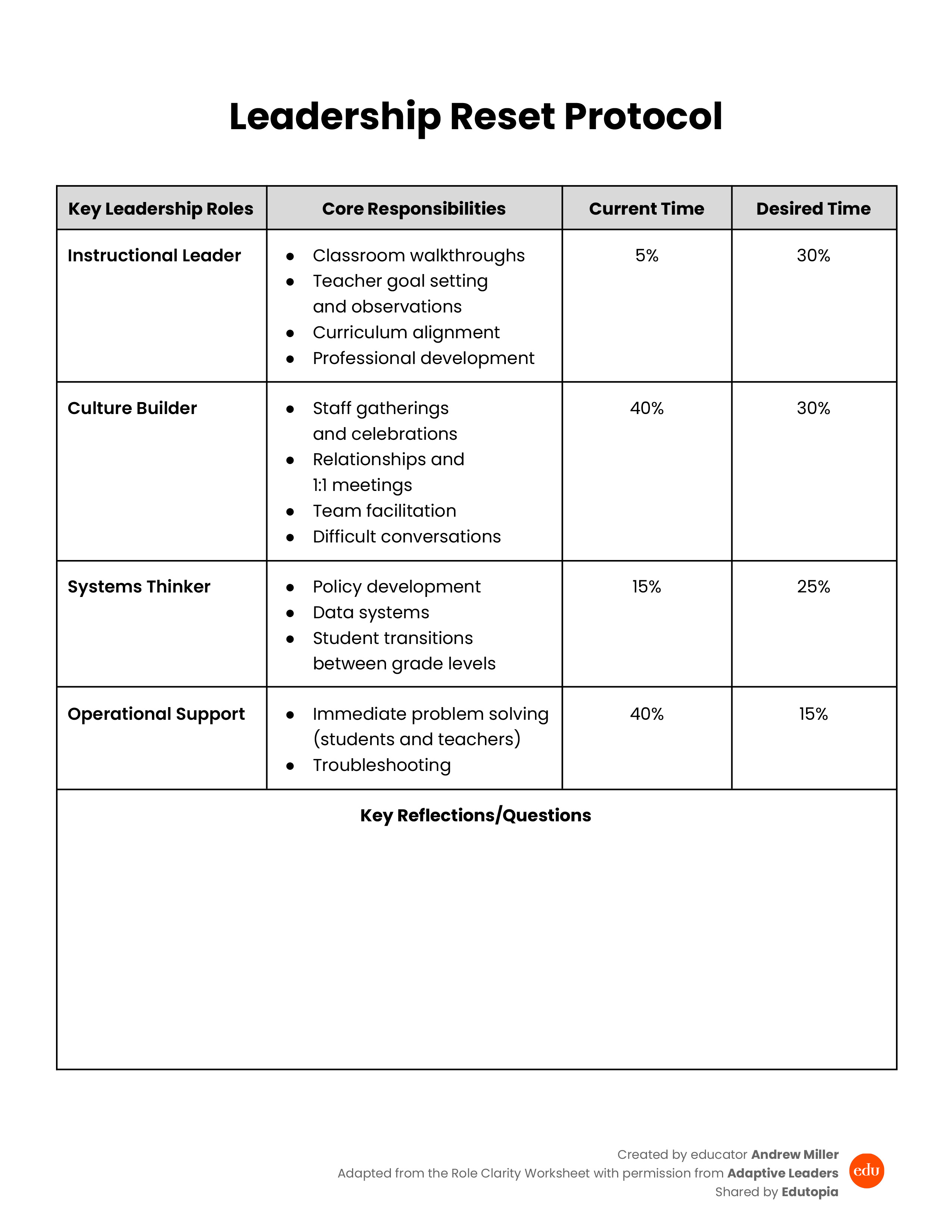
The second step is to reflect and consider the following questions:
- Where are you over-investing your time?
- Where are you under-investing your time?
- What have you neglected entirely?
The third step is to determine the strategic shifts that you’ll make. You might consider doing this through a stoplight activity or start-stop-continue exercise. You can also consider taking the following actions:
- Stop. Be intentional and stop work that doesn’t align with your leadership priorities.
- Delegate. With support, transfer responsibility and ownership of a task to another person.
- Systematize. Create a repeatable process, structure, or effective tool that reduces the need for ongoing leader intervention.
- Protect. Reserve and defend your time for high-impact work.
The fourth and final step is to communicate your next steps. I’ve found that doing this as a school email to faculty and staff, as an in-person reflection, or even as small team conversations allows me to be vulnerable and ask for feedback and build clarity. It’s also important to do the same thing with your supervisor.
Applying the Reset to Advocate for Your Staff
This protocol can support you as a leader and support the other leaders in your school, such as coordinators, assistant principals, department heads, and more. This reflection tool also works in small team meetings or during individual or group conversations. Administering this protocol allows you as a leader to be aware of the tensions that your staff is experiencing and identify ways to support them and provide clarity.
This protocol isn’t about eliminating work altogether. Emergencies will still happen, and we’ll step in to provide support.
The shift you’re making is from a default of constant urgent responsiveness to intentional, proactive allocation. Your goal is to no longer live in a state of crisis or emergency. When done well, this reflection tool can help reduce cognitive overload and fatigue, and creates appropriate boundaries. It clarifies what success looks like for you and informs teachers of how you intend to support them. Finally, it allows you to share the lessons you’ve learned and demonstrate your commitment to personal growth. By reflecting on how we spend our time as leaders, we can define our leadership rather than emergencies and urgency defining it for us.