
AI Isn’t the Main Problem—It Just Shows Us What That Problem Is
Students are chasing points and grades because that’s what the education system prioritizes, but we can guide them to focus on learning.
Your content has been saved!
Go to My Saved Content.The human brain is lazy. That’s not a flaw—it’s how the brain is intended to work. It’s designed to be efficient, to save energy, and so it’s constantly looking for the most energy efficient route to a goal.
This makes biological sense. Let’s say you lived during the Paleolithic period. If you needed to get from your cave to a food source and back, your brain would identify the most energy efficient route to get there. If you took an energy inefficient route, what would happen if you ran into a predator on your way home and had no energy left?
Having a lazy brain has allowed us to accomplish our goals and survive. The key for schools at the moment—and this is where AI joins the conversation—is to think about students’ goals.
We’re not so different from our ancestors, and our brains are still wired to take the most energy efficient route to the goal. If students are using AI to accomplish a goal, the real problem is that their goal isn’t learning—it’s accumulating points to achieve a grade.
Generative AI just demonstrates that schools have gotten so caught up in the points-grades-GPA game that students have lost sight of the real goal: learning. I can’t use AI to skip all the work if learning is my goal, but it’s really easy to do so if my goal is getting the highest number of points I can get on an assignment.
The question we need to ask first isn’t whether teachers should or shouldn’t use AI, nor is it whether to use AI in the classroom with students. Those questions can’t even be asked until we’ve addressed the foundational question: Are my students focused on learning?
Goodhart’s Law
A big problem for schools—one of the toughest problems—is our grading system. Grades are supposed to be a measure of learning, and as Goodhart’s law states, “When a measure becomes a target, it ceases to be a good measure.” For a variety of reasons—not all under our control—students are working to get a grade, not to learn.
To change that, I believe we have to shift away from traditional grading practices and implement standards-focused approaches. When I began reporting out students’ success on learning standards, it was the most important change I have ever made in my classroom.
But truthfully, it also was one of the hardest changes I ever made.
However, there are ways to center learning more prominently in your classroom without entirely revamping your grading system, and you can start these changes tomorrow without overburdening yourself.
1. Attach Learning Memos to Assignments
A learning memo is a tool I started using well before generative AI rose to prominence because I found it to be really helpful in having students focus on their learning.
Below is an example of a learning memo, which essentially asks students to provide additional information about how they demonstrated our learning objectives in their task. They could identify examples from their work, select a problem they solved and explain it in detail, or argue for how they met the objective.
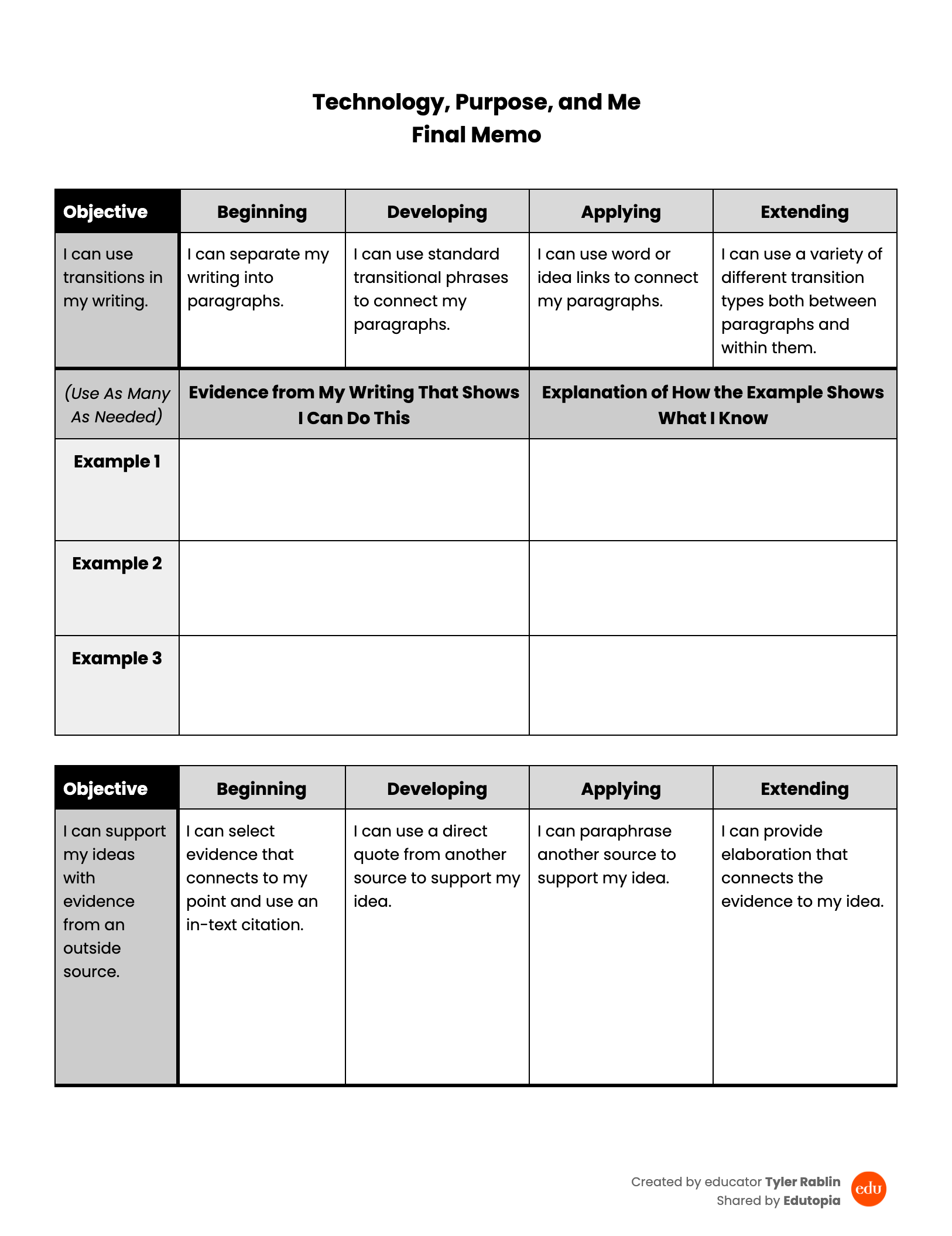
I would use learning memos to have students explain how a piece of their writing demonstrated (or didn’t demonstrate) an objective. You can see how this could be beneficial in the era of generative AI: Even if a student didn’t do the writing, this still pushes them to think clearly about the qualities of the writing. Not as good as if they worked on writing for themselves, but they’re still going to learn something about how writing works, or doesn’t.
2. Redesign Assessments to Clarify Levels of Understanding
One of the best changes I ever made in how I design assessments was to align them with a learning progression that helps students identify what they already know and what they should focus on next. I call this a mastery check, and you can see an example below.
A key point is that each section corresponds to a clearly stated, concrete step the student could take toward success. This helps each student be able to identify more precisely what they need to learn next.
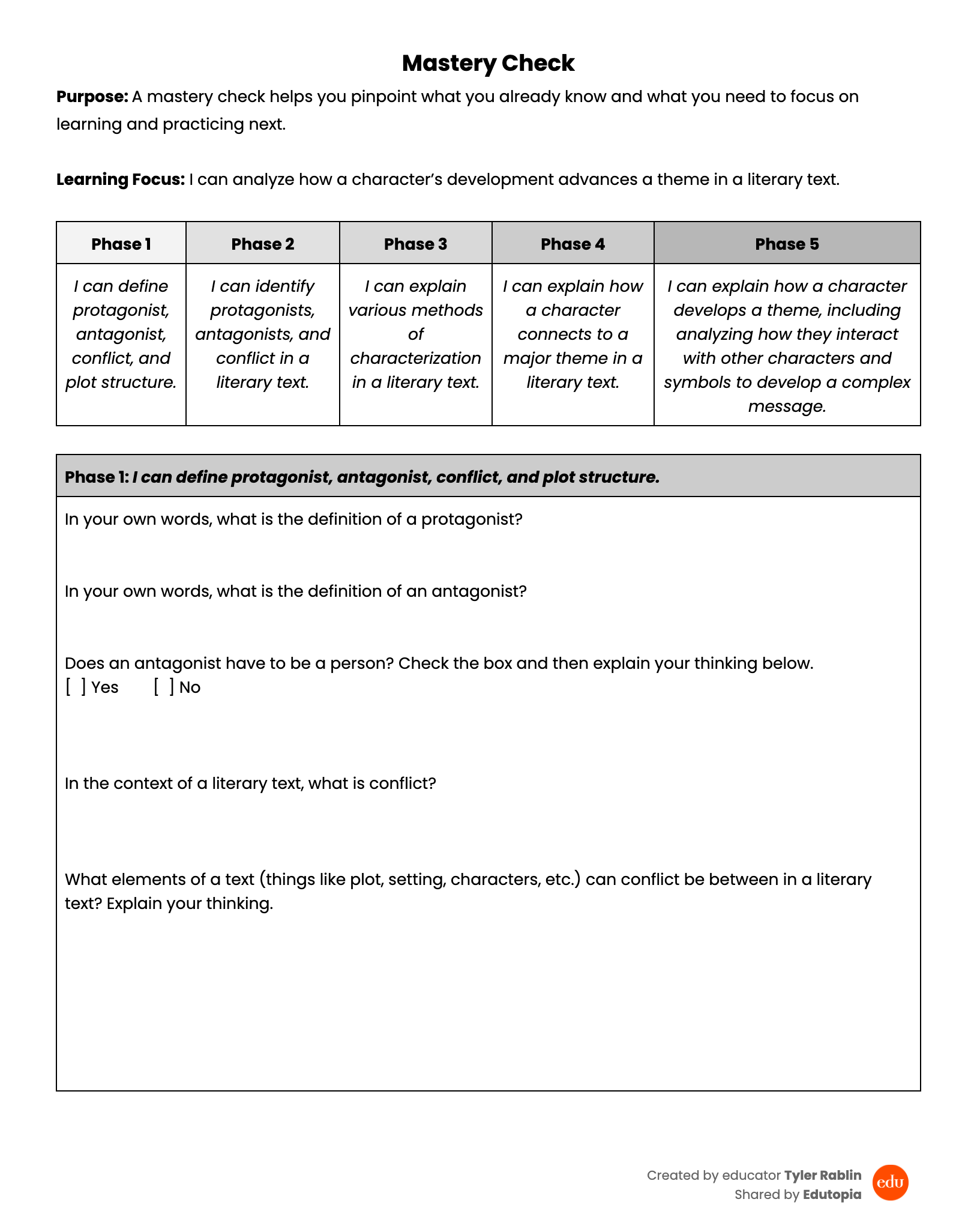
This clarity not only helps focus students on the learning—I found that it made them more willing to engage in future tasks on their own instead of using AI. Many of my students who used AI to complete assignments were pretty transparent that they either (a) felt like they couldn’t be successful or (b) didn’t even realize the task was connected to some concept they needed to practice. Using learning progressions met both needs: It helped students build some self-efficacy after seeing elements they were already successful with, and it pinpointed a learning need they could pursue in the future.
3. Build In Intentional Reflection About Learning
At the end of the mastery check template above, there is a reflection page. This is something I would have students complete after they got their results. In a moment that so often is focused on points and scores, my goal was to quickly pivot back to learning and help them set learning goals in the moment.
An assessment isn’t the only time this can be done. In my debate class, students finish their debate and then sit down to write a reflection about what they were successful with during the debate and areas for future growth. When students complete a draft of a project, they write a reflection to identify how well their project demonstrates their understanding of the learning outcomes (as opposed to reflecting on the quality of the project or how many points it would score on a rubric).
These activities may be small and quick, but using them persistently helps reinforce an understanding that the goal is always learning, not points and grades.
4. Prioritize Conversations About Learning
Oral assessment is something I’ve had a lot of success with, and you don’t necessarily need a new approach to it. Rather, think about how often you can have quick one-on-one conversations with students about their learning.
My favorite question to ask students was, “What’s going to be your next win?” The positive framing made them more receptive, and it required them to really think about where they were at in their understanding and set a micro-goal that they could work toward.
Similarly, one of my favorite whole group discussions was something I called “My Unexpected Win.” We would do it after any type of assessment, and it was just a quick share-out where students would answer some variation of this basic question: “What was something you weren’t sure you understood before but you now know you do?” Again, it lets students celebrate their wins, with the added benefit of reinforcing the idea that this is a classroom where the focus is on learning and growth, not points and grades.
Looking Ahead
I understand why teachers might want to remove technology from the classroom right now. It’s frustrating to constantly wonder whether a student actually did an assignment or used AI. I believe the desire to get technology out of the classroom comes from a place of wanting to help students grow as learners.
However, generative AI isn’t going away, and even if we get it out of our classrooms, we can’t get rid of the reality that it highlights. Generative AI shined a light on the fact that, for many students, the goal of school has nothing to do with learning. If we solve the problem of AI use but never address that bigger problem, are we missing out on a chance to make our schools the best possible place for learners and their learning?