
A Long-Term Process for Onboarding New Principals
District leaders should plan on a multi-year process for helping new principals adapt to their positions.
Your content has been saved!
Go to My Saved Content.
Every school is like another country, each one featuring a unique constellation of history, cultural norms, values, belief systems, political dynamics, social relationships, etc. That’s why the task of onboarding new principals is both daunting and idiosyncratic: A one-size-fits-all template is not possible. For the administrator, the curriculum they must learn and the tests they will face are markedly different in every school.
Research demonstrates the stakes of a principal’s leadership. The Wallace Foundation’s meta-analysis of six studies analyzing the impact of more than 15,000 principals concluded, “Principals really matter. Indeed, it is difficult to envision an investment with a higher ceiling on its potential return.” It stands to reason that onboarding new principals and launching them on a successful trajectory is critical to educational outcomes and to the stakeholders—children and adults—who rely on effective school leaders.
The challenge
Newly minted physicians begin their careers in a three-to-four-year residency, and novice attorneys in a large firm are initially assigned to legal research and less consequential cases. Because school organizations are flat (there aren’t many levels of hierarchy) and funding is limited, principals typically miss the benefits of a break-in or apprenticeship period. In a perfect world, weeks would be spent observing school days, shadowing experienced administrators, engaging in extensive entry interviews, and incrementally gaining responsibility for higher-stakes decisions. Unfortunately, there isn’t a gradual release of administrative responsibility: Most of the time, a principal’s job description is identical from their first workday to the day they retire!
Of course, there are steps that newly hired administrators can take to get ready, such as creating an entry plan describing their initial goals and tasks, and a timeline. The district plays a vital role preparing and supporting new principals in the critical early years. A principal’s job becomes more complex over time: Expectations from the community rise when the administrator is no longer considered a newbie, and self-expectations likely grow as the leader increasingly realizes the school’s needs and daily tasks that must be accomplished. (On Seth’s first day on the job as an assistant principal, he had time in the morning to sharpen—and in the afternoon, resharpen—the pencil collection on his desk, an unimaginable exercise a few days later.)
First, Make a Plan
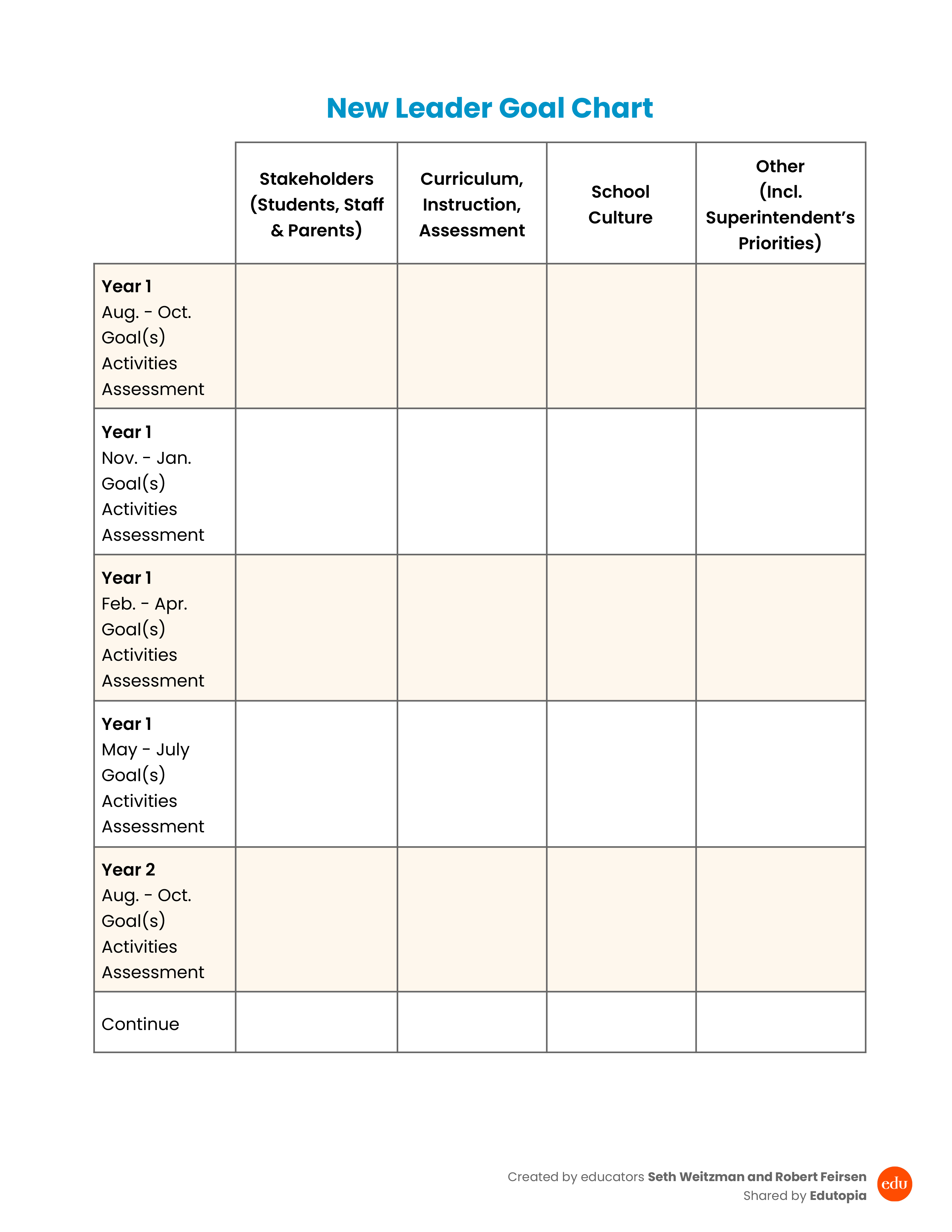
The first element is to have a written plan: a series of objectives, benchmarks, deadlines, and strategies for the new leader’s induction period.
We suggest creating a chronology in chart form, beginning with the period immediately after hiring and before the start date, and then every three months for a period of two to three years. In each cell, specify the new leader’s goals or takeaways, actions, and benchmarks or means of assessment. For example, in the first three months on the job, three goals related to parents are introductions, communicating the new principal’s accessibility, and a preliminary understanding of parent perspectives; actions include open office hours, interviewing PTA leadership, and scheduling parent coffees in the fall.
How can schools protect vulnerable and relatively ill-equipped new leaders, affording them a period of gradual release? Ample time for visitations to the new school before the formal transition would allow the incoming principal to become familiar with programs, personalities, policies, and school culture. However, we recognize that schools rarely have the luxury of time, and even when they do, having the newly appointed and current principal on-site for extended periods might create confusion and awkwardness. As an alternative, a school leader from the district level could be asked to relocate offices and serve as temporary administrator in charge, managing day-to-day affairs while the new appointee developed a deeper understanding of the school and stronger ties with the school community.
Psychological ownership. The field of organizational psychology provides an explanation of how new employees build a sense of connection, motivation, and obligation.
- Agency: “I can exert control of the work environment.”
- Identity: “This job is a substantial part of my self-concept; it’s who I am.”
- Belonging: “I feel connected to this school, its purposes, community, and culture.”
- Expertise: “I am capable of performing this job at a high level.”
- Accountability: “I am responsible for my own growth and on-the-job outcomes.”
Whether principals agree with these statements about themselves determines how they feel about the job. A school leader with high levels of psychological ownership is often the first to enter the building and last to leave every day, while the principal down the road with low levels of ownership might repeatedly check for retirement eligibility.
How can school districts accelerate the development of psychological ownership? The key is to emphasize individual “choice and voice,” supplemented by opportunities for continuous reflection through professional learning communities, personal journals, and effective mentoring. Districts should also provide room and opportunity for sustained professional learning that builds expertise in the multidimensional world of the principalship.
For mentors, leadership coaches, and supervisors, interactions with new leaders should be guided by this question: Am I promoting psychological ownership?
What Comes Next: Ongoing Support
A Wallace Foundation study found two related challenges in planning onboarding programs. First are contrasting issues faced by new administrators hired from within versus outside the school district. Small and midsize districts tend to recruit candidates from other districts; large schools are more likely to hire from inside. For the induction process, internal and external hires have distinct advantages and disadvantages. Promotion from within shortens the learning curve, but recalibrating relationships from colleague to the supervisor is fraught. An outsider’s viewpoint may lend itself to a healthy questioning of school practices, but trust must be built from scratch. Either way, internal and external candidates need support and consultation to navigate the complexities and perils they confront.
The Wallace report also discovered that school districts have a propensity to plan identical professional development for novice and experienced administrators. Mentoring, coaching, and supervision must be individualized and account for variation in the unique needs of every new leader. For example, novice principals need a range of assistance, from becoming familiar with management systems, such as purchasing, to honing skills they simply haven’t had the opportunity to practice, such as providing effective feedback following classroom observations.
Professional learning communities (PLCs). Districts should create PLCs and incentivize new leaders to participate, providing an ongoing forum for sharing best practices, problem-solving collaboratively, and, perhaps of most value, demonstrating that each administrator is hardly the only one feeling frustration and agitation: A PLC’s “We’re in it together” ethos is inexpensive therapy. Referring back to psychological ownership, a body of literature elucidates the concept of collective psychological ownership as a powerful group dynamic. Together as a professional learning community, members coalesce to acquire the characteristics of psychological ownership as a group. We have agency in improving our own and each other’s leadership capabilities; we identify with and feel a sense of belonging to the PLC; our expertise is helpful and enabling; and we hold ourselves accountable to each other.
Onboarding programs tend to focus on acquiring essential information needed to address the managerial tasks that accompany the principalship. But it’s important to remember that the leadership journey is deeply personal, as all administrators embark on a new job with both aspirations and anxieties. Principal onboarding should therefore be organized as a coherent, developmental process that addresses both individual and organizational needs, rather than a compliance checklist. Such an approach is key to facilitating smooth transitions, promoting psychological ownership, and building organizational capacity.