Making Student Thinking Visible During Writing Assignments
This update on the old-school strategy of using index cards to collect textual evidence helps students slow down and focus on each stage of the writing process.
Your content has been saved!
Go to My Saved Content.Early in my teaching career, I worked with a student who tried very hard to write a research paper. The skills didn’t come easily to him, so he was ecstatic when the due date arrived and he turned in his essay. But when I looked closer, I saw that his brainstorming, outline, and rough draft were all missing. When I asked what happened, he shrugged and said he wanted to “skip the extra stuff” so he could “get to the writing part.”
Many of us have likely experienced this scenario. In our writing courses, students sometimes rush through or even skip the early stages of the writing process, often because they see a more direct path to producing the essay: sitting in front of a computer and waiting for ideas to come or outsourcing the thinking to AI. As a result, brainstorming, outlining, and drafting feel like disconnected tasks rather than meaningful opportunities to develop ideas, and their impact on the final draft is often minimal.
I wanted my students to see these early stages differently. That meant finding a way to encourage them to reassess and reorganize their thinking in real time through an activity that was low-stakes, collaborative, and engaging. To address this, I developed a strategy I call interactive clustering, which makes student thinking visible as it develops.
FINDING EVIDENCE IN TEXTS
Students begin by selecting the texts they’ll use in their essay. If the assignment is a literary analysis, this might be a single text. Or, for an argumentative essay, this might be several informational sources. As students read their texts, I ask them to focus on what they notice, especially key details, meaningful passages, or any other element that seems noteworthy. At this stage, I intentionally lower the stakes. We’re not interpreting; we’re simply gathering data.
Each time students notice something meaningful, they record it on an index card. Each card includes the author’s name at the top, a quoted passage from the text, and a brief note about how the passage might serve their writing (e.g., support their claim, complicate an idea, challenge an argument, or connect to another source).
I encourage students to generate more cards than they think they’ll need. A typical target might be five to seven cards per source, or 15 to 20 if they’re working with a single literary text. The goal is to generate more pieces of evidence than will appear in the final essay. Students complete this part of the process both in and outside of the classroom, leading up to the next phase in the process.
ORGANIZING EVIDENCE INTO CLUSTERS
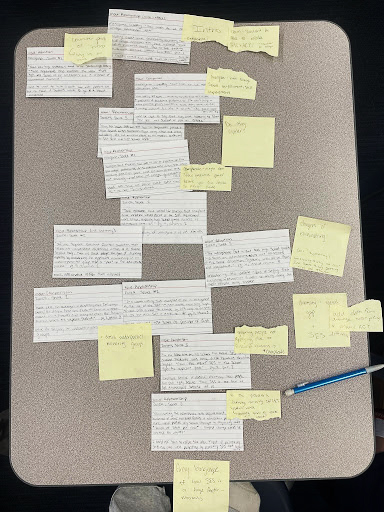
Once students have completed their index cards, the physical work begins. Students collect all of their cards and bring them to class on an assigned day. They spread their cards across a desk and begin grouping them into clusters based on patterns they recognize. Some examples might include cards that illustrate an idea, challenge an argument, define a key term, or make a comparison. I remind students that anything can be a cluster.
As clusters begin to take shape, students share their work with their neighbors, observing one another’s thinking and asking questions. Writers then explain their reasoning. Why do certain cards belong together? Why were some left out? How does one cluster logically follow another? What patterns are becoming visible?
Then they do it again.
Students reshuffle their cards and create a new set of clusters, reconsidering their earlier choices. Comparing the two versions becomes part of the learning. I invite them to consider what changed and why. Which organization feels more effective? Which cluster map best addresses the essay prompt?
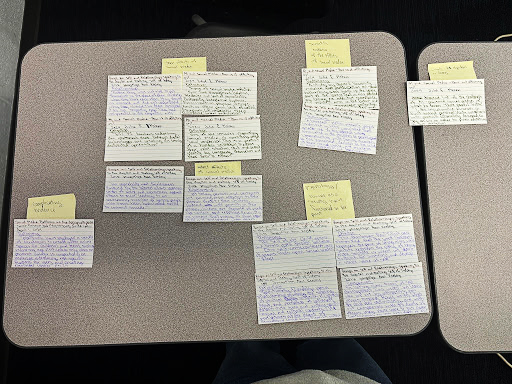
Throughout the process, students take photos of their clusters. These snapshots capture their thinking at different stages and give them a reference point as they move into drafting.
Instead of arriving quickly at a single “correct” outline, the goal is to explore possibilities, play with ideas, and make decisions visible. Revision happens as students move their cards and rethink groupings, responding to peer feedback and adjusting as needed.
MOVING FROM CLUSTERS TO DRAFTS
After experimenting with different card arrangements, students select the arrangement that works best and share the photo with the class through a shared slide deck. This gives them a chance to see how their classmates approached the same task and to continue conversations about organization and structure.
From there, students can translate their clusters into a more formal outline or move directly into drafting, using their card arrangement as a flexible guide for what will become the body sections of their essay.
MAKING THINKING VISIBLE WITH CLUSTERS
Interactive clustering accomplishes something that traditional outlining often doesn’t: It makes thinking visible. Instead of committing early to a fixed structure, students stay engaged in an ongoing process of organizing, questioning, and revising their ideas.
Because the work is physical and collaborative, it also invites flexibility. Moving a card is easier than rewriting an entire outline, and that small shift lowers the barrier to revision. Students are more willing to rethink their choices because the process feels active and responsive, rather than fixed.
Most important, the activity turns organization into a form of reasoning. Instead of filling in a template, students decide what matters in a text, how those moments speak to one another, and how to sequence their thinking in response to the essay prompt.
If I want my students to see themselves as writers, I need to create opportunities for them to work the way writers do. Interactive clustering reflects what researchers Jal Mehta and Sarah Fine describe as giving students access to the “whole game” of a discipline—not just isolated skills, but the full set of decisions that shape a finished piece.
Many professional writers rely on similar strategies. Author Susan Orlean, for example, has described creating hundreds of note cards for a single project and physically rearranging them to find structure. Interactive clustering brings that same kind of decision-making into the classroom, giving students a way to see early-stage writing as the place where their ideas take shape.