
Why Your Students Need (Some) Extrinsic Motivation
Extrinsic motivation gets a bad rap, but middle and high school teachers can use it judiciously early in an activity to encourage students to get started.
Your content has been saved!
Go to My Saved Content.The messaging that educators are often subjected to around intrinsic and extrinsic motivation is a false dichotomy. I can’t tell you how many times I’ve sat in some sort of professional learning where the message is clear, even when it’s implicit: Using extrinsic motivators—things like prizes and punishments—is lazy, ineffective, and somehow morally wrong, and activating students’ intrinsic motivators—passions and interests, choice, and mastery—is what we should always strive for.
Sure, I want students to engage in learning for their own reasons, not because they are scared of a consequence or chasing a reward. However, this definitely oversimplifies the reality of motivation in the classroom.
Does Extrinsic Motivation Work?
Let’s start with mice.
Back in the early 1900s, the researchers Robert Yerkes and John Dodson had a theory that if you increased what they called mental arousal by using specific extrinsic motivators, you could increase performance. While mental arousal can be influenced by positive motivators like food and rewards, they tested this by setting up two boxes and training mice by using small electrical shocks to go into one of the two boxes. Essentially, if the mouse moved toward the wrong box, it would get a little shock. Move toward the correct box, no shock.
Initially, increasing the level of the shock improved the speed and accuracy of the mice. With a stronger shock, the mice learned what to do more quickly. But at a certain point something shifted: As Yerkes and Dodson turned up the level again, suddenly the mice performed terribly. They took longer to learn, made more wrong decisions, and demonstrated more signs of distress. If the researchers made the task more difficult, the drop in performance would happen earlier.
Yerkes and Dodson uncovered a few things:
- Extrinsic motivators do help improve performance, but there is a point beyond which any additional extrinsic motivation will hinder performance.
- The more complex the task, the sooner extrinsic motivation will hinder performance.
- Extremely low levels of extrinsic motivation can also negatively impact performance.
That’s Mice, but What About Humans?
To the extent that students are like mice, this means that extrinsic motivation is helpful at certain points in the learning process, especially in moments when a task might be less complex, but you do need to activate intrinsic motivation for students to reach their potential for learning complex concepts.
Let’s say I’m having students write an outline for their debate. I could leverage grades as an extrinsic motivator by adding a point value to the assignment and then reminding students how important this assignment is for their grade.
Once students completed an early phase of brainstorming, I could come around and give a fist bump or a sticker—don’t underestimate how much even your oldest students like stickers—or provide other positive feedback.
Grade points and fist bumps are both extrinsic motivators. So how do they differ?
1. Timing of the Motivator
Extrinsic motivators are especially effective at supporting students in getting started in a task, especially if the task might be low-interest, as this stage rewards effort more than quality. Positive reinforcement early in the process also helps to build students’ self-efficacy, a major factor in their success because identifying a successful step helps them believe more success is in their future.
Early motivators that have worked well for me include having students write down three possible opening lines for an essay and getting a sticker on my favorite one, giving out fist bumps as students come in for answering a question about the previous day’s lesson, and using checkboxes for steps in a task and intentionally marking off the opening step with them.
I have used the checkbox motivator publicly at times, and that’s a mistake. I posted a progress-tracking chart for an essay and put stickers on the chart when students completed a step. The problem was that this introduced an element of comparison between students that ended up having a negative impact.
2. Amount of the Motivator
The goal is to use the smallest amount of the motivator possible—one tricky thing with extrinsic motivators is that their effectiveness diminishes, requiring ever more and more. But the presence of a large motivator can shift students’ focus away from the task. If I tell students that their outline brainstorm is worth 100 points, their attention shifts to the points themselves over the task.
I’ve had success with interpersonal elements like high-fives and fist bumps, but I’ve also had success with adding just a single point in the grade book that students get for completing an assignment.
A mistake I’ve made in this realm is to assume that everything needs at least a little extrinsic motivator. Constantly giving my students a point for tasks convinced them that any task that didn’t earn a point wasn’t worth doing. Essentially, if we always offer an extrinsic motivator, we condition students to expect one.
3. Type of Motivator
This section is going to get pretty nerdy. There are intangible extrinsic motivators that cannot be used to pursue secondary goals (think fist bumps and stickers, which cannot be used to buy anything) and tangible extrinsic motivators that can be used to pursue secondary goals (things like grades and PBIS tickets). The difference is that tangible extrinsic motivators can decrease the value of the activity the reward is connected to.
This is why prioritizing grades as a motivator is somewhat self-defeating in terms of guiding students to focus on learning. If high school students perceive grades as something they need for college applications, they’re going to focus on grades instead of the learning that grades attempt to measure. Systems like standards-based grading—ones that allow more room for mistakes and more clearly connect grades to learning outcomes—can help minimize this concern.
My favorite motivators are intangible and interpersonal—things like an encouraging note or positive feedback, a high-five or a fist bump.
But be careful if you seek to reduce the importance of grades: Students are conditioned to view them as a central part of school. Removing those tangible motivators too quickly or without communication can lead to confusion and a drop in productivity, as I learned by experience. It’s best to move slowly, with lots of classroom conversations about what you’re doing and why.
4. Persistence of the Motivator
At some point, if we want students to really focus on the task itself, the presence of the extrinsic motivator needs to fade. Fortunately, if the extrinsic motivator has been used to help students start and feel successful, a feeling of self-efficacy can take the place of the extrinsic motivator to help students move forward—that is best done with explicit conversations and encouragement.
If we don’t intentionally wean students off the extrinsic motivators that we use, we will inevitably need to escalate either the rewards or the consequences because they lose their effectiveness over time.
One of the best ways I have found to help students shift their motivation from being extrinsically focused on rewards and punishments to being intrinsically focused on their growth and success is through the use of a reflection portfolio. This simple tool allows students to record strengths and areas for growth after each assessment. Many students then get to see their areas for growth become areas of success a few lines down. I cannot overstate the value of that realization for a student in terms of their motivation to continue growing.
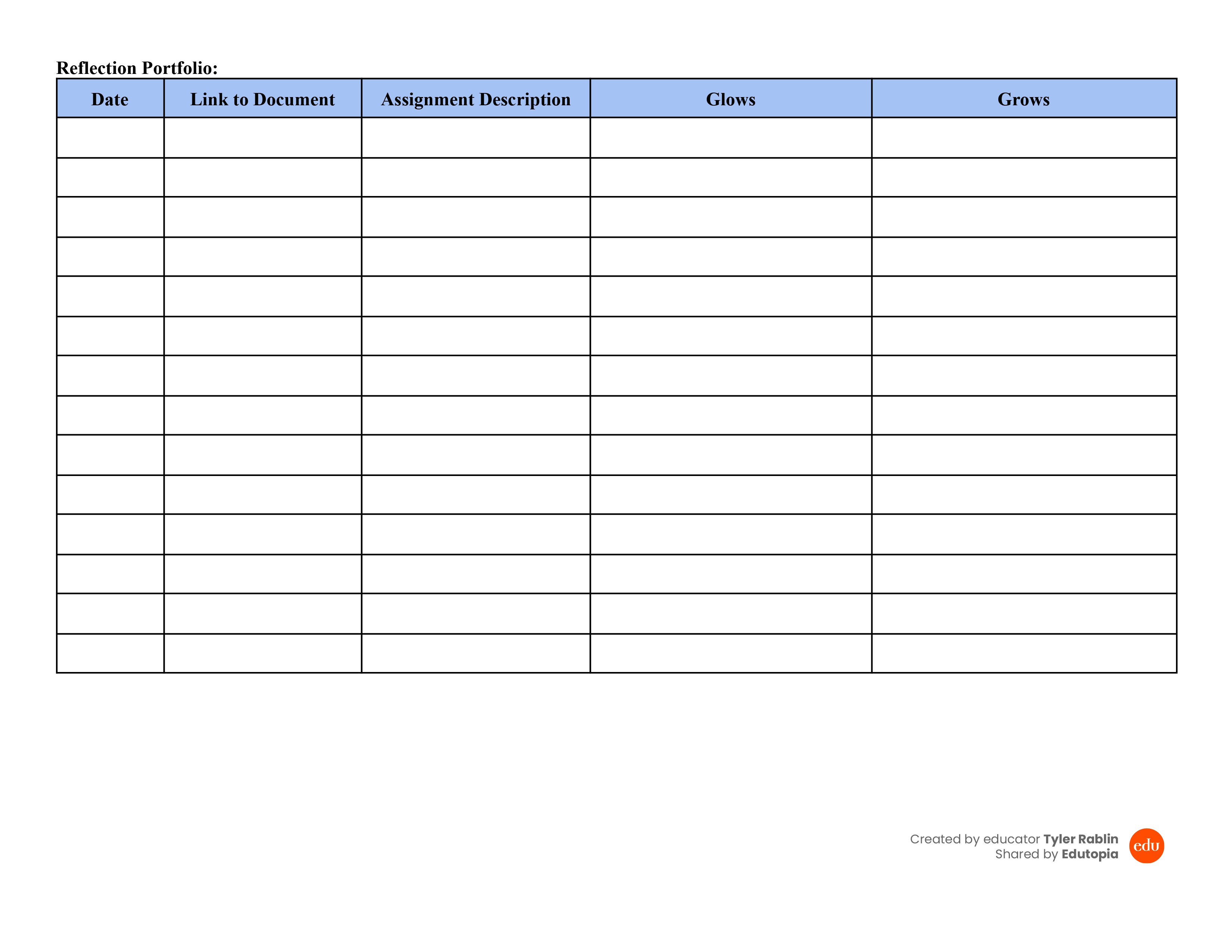
Extrinsic motivators can help get students started and point them in the right direction, but at some point our job as educators is to shift the focus away from carrots and sticks and start helping students reflect on the things they’ve already accomplished, the progress they’ve made, and the belief in where they can go.
Are extrinsic motivators important? Absolutely—they can be an essential piece in a student’s early success.
But are extrinsic motivators enough on their own? Not at all.