
How to Cocreate AI Agreements With Students
By adapting the familiar practice of co-creating classroom norms, teachers can help students make more thoughtful decisions about when—and when not—to use AI.
Your content has been saved!
Go to My Saved Content.Teachers who have assigned any writing recently know that sinking feeling of starting to read a student essay and noticing perfectly placed commas, three-adjective descriptions, or an ending that lands on a bittersweet insight using words like delve, tapestry, or spectral. The conclusion lands with a thud: “AI wrote this.”
More than half of teens admit using AI for schoolwork, according to Pew Research. When they rely on it to generate text as if it were their own, it’s considered plagiarism—even in districts with the most lenient AI policies. But even when students aren’t using AI to write essays for them or do their math homework, research shows that an overreliance on the tool can lead to reduced learning and a decline in critical thinking.
This makes sense to me as an English teacher: My students must practice both writing stamina and writing to explore and concretize thought—two things that using generative AI explicitly circumvents.
Early last school year, I tried to “AI-proof” my middle school classroom by requiring all writing and revision to happen in class, either on paper or on school-managed Chromebooks. But that approach could not control what happened at home—where students could still consult AI for ideas or arrive with handwritten, AI-assisted responses to anticipated prompts. Leery of teetering between being a warden of a surveillance state and a random catcher of plagiarists, I instead invited students to discuss their AI use and co-design classroom rules around it.
Teachers around the country are making similar pivots. With little clear or consistent guidance—and school policies that range from embracing AI to banning it or ignoring it altogether—many are adapting a familiar practice: cocreating classroom norms around learning and behavior. By expanding that process to AI, we can help students grapple with what AI does, how it works, and where it may—or may never—be useful or acceptable.
Research suggests that the more students understand how AI works, the more complex and nuanced their views of its role in school become. Even AI-skeptical educators like me recognize that prohibition alone is more likely to drive student use underground than to stop it.
“The more you criminalize it, the more they hide it,” says Philadelphia high school art and technology teacher Mary Beth Hertz. By bringing students into the conversation, she argues, teachers can help them “understand the limitations of tools”—and encourage more thoughtful use.
Build Shared Knowledge About AI
Before students can create meaningful classroom norms around AI use, they need a solid grounding in what researchers and educators are learning about these tools—including their tendency to flatter users, reproduce biases, and confidently invent information.
Hertz, for example, teaches her students about “AI sycophancy”—or a chatbot’s tendency to affirm a user’s ideas rather than challenge them. She also shares screenshots of fabricated information and citations to demonstrate how AI can frequently hallucinate and produce false or made-up information that seems credible.
Heather Richards, an AP Psychology teacher in San Diego, says an important starting point for creating norms is to “lift up the hood” on tools that students may assume are better at important skills than they are—or even capable of performing magic.
She does this through lessons that make AI’s limitations visible. When students used Canva to generate an image of a lawyer, for example, the tool produced only older white men—an “eye-opening” demonstration of algorithmic bias. In another exercise, her creative writing students compared their responses to a prompt with AI-generated versions, quickly noticing the repetitiveness and predictability of the AI writing—and ultimately preferring their own.
Start With the Rules You Already Have
I’ve found it helpful to begin the process of creating norms by starting from my own district’s policy—while also giving students a glimpse of the approaches other educators and institutions are trying. After all, any classroom agreement needs to work within school and district requirements.
In the New Jersey district where I teach, for example, our guidance prohibits students from using AI for plagiarism. But last year, several AI tools remained accessible on student Chromebooks, leaving many of my students with thorny questions: Did that mean they should use those tools—and, if so, how?
To help them get a sense of how other school systems are approaching AI use, we reviewed a sampling of policies from higher-ed institutions like Stanford and Georgetown, as well as New York City’s then-draft traffic-light guidance, which broadly permitted students to use AI for “research, exploration, and creative projects.” New York City has since adopted stricter rules for this school year, banning student use of generative AI in elementary and middle schools, with limited exceptions—a reminder of how quickly guidance can change.
With a range of model policies in mind—and a better understanding of the inherent limitations of AI—my students were prepared to discuss in small groups what they considered acceptable and unacceptable uses, and under what conditions.
Turn Discussion Into an Agreement
In my classroom, the goal with our discussions wasn’t simply to surface students’ opinions but to turn them into a policy we could actually use. In small groups, my students created traffic-light posters sorting AI uses into red, yellow, and green categories. They then displayed their posters and circulated around the room, comparing where each group had placed different uses.
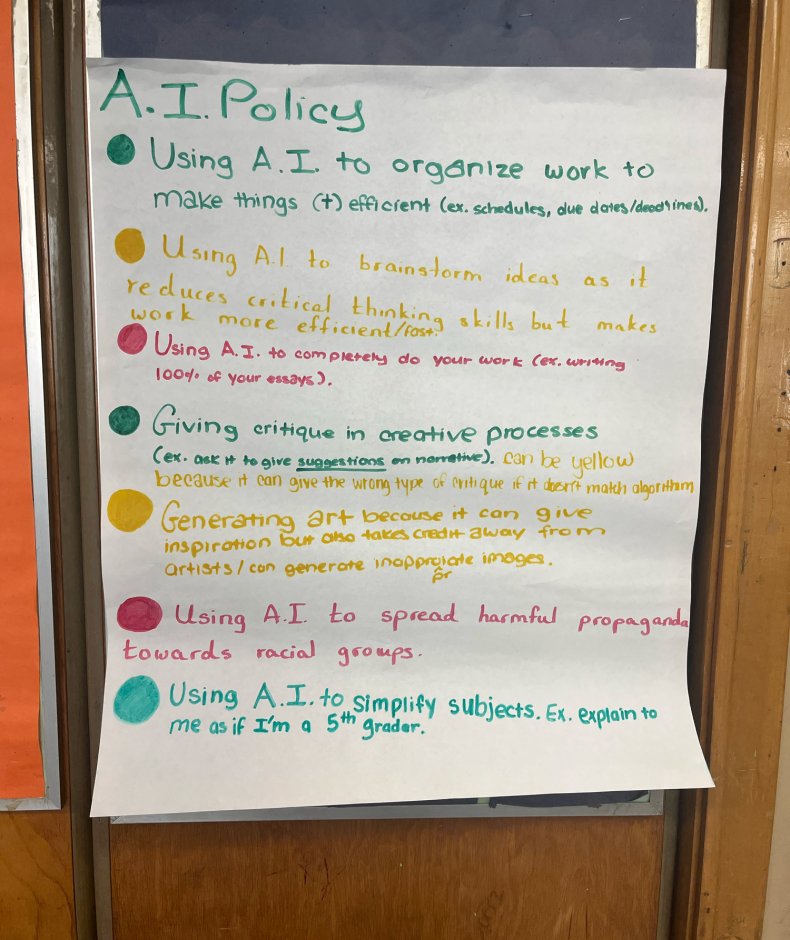
Once students were familiar with each other’s thinking, we collectively looked for shared areas of agreement. On a Google Slide, I collected our thoughts.
In the green zone, we settled on tasks like schedule-making, re-explaining difficult concepts, and study guide creation—as long as creating the study guide was not itself the assignment. Absolutely forbidden, said all groups, were plagiarism and copying and pasting generative AI text, as well as teachers’ use of AI to grade assignments and generate comments. Students also identified two unacceptable uses of AI I hadn’t previously considered: spreading propaganda and exposing personal information.
The yellow zone generated the most debate. Students placed brainstorming, receiving feedback on their work, and teachers using AI alongside a rubric in this category. But we agreed to leave some uses open-ended, dependent on an assignment-by-assignment discussion. For instance, an AI-generated video for an independent reading presentation might not be appropriate because it was unlikely to be very engaging, but AI-generated art for a podcast might pass muster.
The traffic-light approach is only one way to turn these conversations into shared agreements. Other educators are trying strategies such as these:
- Center student perspectives: Chicago middle school English language arts teacher Comfort Agboola asks students to identify when it is especially important to hear their own voices rather than generative AI’s to inform their classroom policy. Her students have chosen three areas in which to prohibit AI use: brainstorming, personal narratives, and reflection.
- Start with shared values: Teacher Stacy Kratochvil asks students to name the values that should guide their AI use, such as integrity, which, she told Edutopia, they define as being “honest about when and how we use AI.” Using a worksheet, her students consider how AI might support or undermine the values they collectively generate and propose a policy dictating what uses should be allowed, prohibited, or further discussed.
- Create a common code of ethics: College lecturer Sydney Sharkey replaces a lecture about AI misuse with a discussion about which use cases students consider ethical, helpful, or appropriate. Students share ideas on a Padlet, respond to classmates, and raise questions about what “counts” as cheating. Sharkey then synthesizes their responses into a shared policy outlining acceptable and inappropriate uses.
Model the Practices You’re Asking For
A shared agreement becomes more meaningful when students see their teacher following it, too. Just as I model my human writing in class to students—responding to prompts in real time or sharing with them the (often extensive) edits I receive on my own writing—I also show them how and why I use AI, and when I choose to rely on my own thinking.
For example, I write my own vocabulary quizzes and include stories for students to fill in blanks using recently learned words. When students are absent or want a retake, I might use AI to create a new quiz and new stories. Coincidentally, when I ask students which version is more fun, mine usually wins, though it is possible they are humoring me. This kind of transparency models the same honesty about AI use that our agreement asks of students.
I’m also clear with students that I don’t use AI for my own writing or brainstorming. I show students my own first drafts and more polished efforts—not as exemplars but as possibilities—and explain that writing helps me make sense of the world and represents thinking on the page, even if sometimes that thinking is messy or unclear. Even when I share anonymous student work, I include pieces with missteps to demonstrate that writing can be strong without being flawless. I compare it to sports or music: Sustained practice builds confidence and skill.
Modeling an agreement can also mean explaining why certain assignments are designed the way they are. Caroline Cooper, a high school English teacher in Massachusetts, relies heavily on Socratic seminar–style discussions and counts them as significant grades, as part of her approach to handling AI use. She’s explicit with students about the thinking behind her choice: “I’m interested in productive struggle and their process, and I remain focused on their own minds,” she says.
Uphold the Agreement—Without Becoming the AI Police
Even with clear agreements and consistent modeling in place, suspicions about student AI use will still arise.
When I do think a student might not have written something themselves, I check the version history and usually ask them to conference with me on their writing process. I point out which particular canned phrases or clichéd summations made me look twice. Even if there is no clear confirmation of whether they used AI inappropriately or not, the conversation becomes an opportunity for them to receive writing instruction—and a reminder that I am examining their work closely and want to hear their own voice.
Other teachers similarly try to hold students accountable while emphasizing learning over what author and writing teacher John Warner calls a “culture of suspicion.”
Agboola, who teaches at a largely Black school on Chicago’s South Side, is wary of creating a punitive dynamic with students who already experience overpolicing, for example. “I want their voices to be heard and seen, and I don’t want them to be oversurveilled,” she says. She and her students agreed on other methods to keep them accountable, such as “AI receipts” that explain whether, how, and why they used AI—sometimes with the help of sentence stems that Agboola provides.
Revisit and Revise the Agreement
Last year, our cocreated agreement remained a living document, displayed on classroom posters and included in the online syllabus so that students could revisit it. At the end of the year, students completed a simple Google Form reflecting on how well they—and the class—upheld it.
Several students said the agreement had helped them limit their AI use and more critically investigate things like Google’s AI-generated search results. I also felt liberated from constantly wondering whether every strong piece of work had come from a chatbot. With shared expectations in place, we could return more of our attention to writing and thinking together.
Of course, as AI tools and district policies change, classroom agreements will need to evolve. As this school year begins, my principal has told us that updated district guidance is likely coming. In the meantime, I’ll continue to cocreate agreements within our current guidelines and bring new policy examples—like New York City’s recent decision—into our discussions.
The truth is that no matter what schools and districts decide, students will likely continue to use AI at home or when not on school-monitored devices. They benefit from the opportunity to think through how and why AI does—or does not—aid them and their learning.