How to Help Middle School Students Navigate Challenging Texts
Engaging interactive tasks can help middle school students more easily understand complex informational and literary works.
Your content has been saved!
Go to My Saved Content.
A few months ago, a Facebook teaser for an article in The Atlantic caught my eye: “Stop Meeting Students Where They Are.” It was followed by an intriguing subheading: “What I learned when I finally started assigning the hard reading again.”
The author, Walt Hunter, a literature professor at Case Western Reserve University, went on to argue that despite our age of technology-fueled quick bites and 30-second reels, students are better equipped for the challenge of reading complex texts than we educators have come to believe.
As I read about his new approach to an old teaching method, I thought about my own middle school teaching practice. Had I fallen into the trap of expecting too little from a technology-smitten generation? And, if so, what were some ways of upping the rigor while accepting the realities of our 21st-century mindsets?
I’ll share what I learned from reexamining some of my assumptions about my students and their learning, along with practical ideas for how to help your students grapple with challenging texts.
Inviting Students Into the Struggle: Informational Text
Like most of us living in the digital age, my students often look for quick information. They want to skim the text, find the answer, and be done.
So, how can I get them into that productive struggle that comes with high-level text? Hunter suggests starting with short snippets of text to be analyzed and discussed. Among my middle school students, I find that this approach is even more successful if I offer choices. For example, I recently gave my students six snippets from primary sources in social studies class and had them pick two to analyze.
For longer passages, I find that partner reads are effective. Students read sentence to sentence rather than paragraph to paragraph, have quick chats, and create one-word summaries of each paragraph, to keep the conversation and the exploration going.
Our school’s academically and intellectually gifted specialist gave me another idea for breaking up longer texts: mind-mapping. The process combines vocabulary, note-taking, and connection-building all in one.
We begin by scanning the text to find unfamiliar vocabulary. I keep this part limited to three to five words to keep our pace brisk. This should take no longer than 10 minutes. Next, we take out blank paper and drawing pens. We start by writing a central question in a bubble at the center of the paper. As we read, we add bubbles for the different topics we find in the text and draw arrows to show connections between different facts and observations. I tell students to use their favorite color pen to add ideas that come from their own experiences or prior knowledge.
Mind-mapping works best when I model it for students. After we complete two texts as a class, students are typically ready to try one on their own. This can also be a partner activity, as each of them takes turns reading aloud and adding to the map.
Inviting Students Into the Struggle: Literary Text
When it comes to literary text, I like Hunter’s suggestion to offer passages that may contain arduous, highly detailed descriptions but with big rewards embedded here and there. In the middle school English language arts classroom, for example, I’ve found that science-fiction classics such as Frankenstein and Fahrenheit 451 work well with my eighth graders as they trudge through detailed descriptions of the setting to wonderfully grotesque descriptions of the doctor’s unfortunate creation.
Readers’ theater gives students a chance to step into the narrative with the added bonus of supporting struggling readers by having the text read out loud to them. It also untangles the dialogue and makes it easier for students to hear the difference between what a character is thinking and what a character is saying. In my classes, readers’ theater happens in small groups instead of as a class. I find that students become more comfortable with each other as they read and often fall into discussing their questions about the material as they come up.
Inviting Students Into Discussion
Socratic seminars remain a solid choice for class discussions, but I find I get more participation—and deeper thinking—when I use a strategy I call “the talk box.” The talk box is a small box with a stack of questions printed out on little cards. Students work in groups of four or five and begin by passing out the cards without looking at them. The cards come with discussion questions, but also with suggestions for follow-up questions. Students go around the circle, selecting a question from their pile to ask. It is the asker’s responsibility to make sure that everyone in the circle participates.
Another variation of this is to give each group a bag of discussion questions, but this time, one student draws a question to read out loud to the group. Then, everyone does an independent three-minute free-write. The free-write is followed by a four-minute sharing session. The bag is then passed to the next person to ask a new question. This version really supports students who might be reluctant to speak up, since it builds in an opportunity for them to write about the question before sharing. The time limits keep the momentum going.
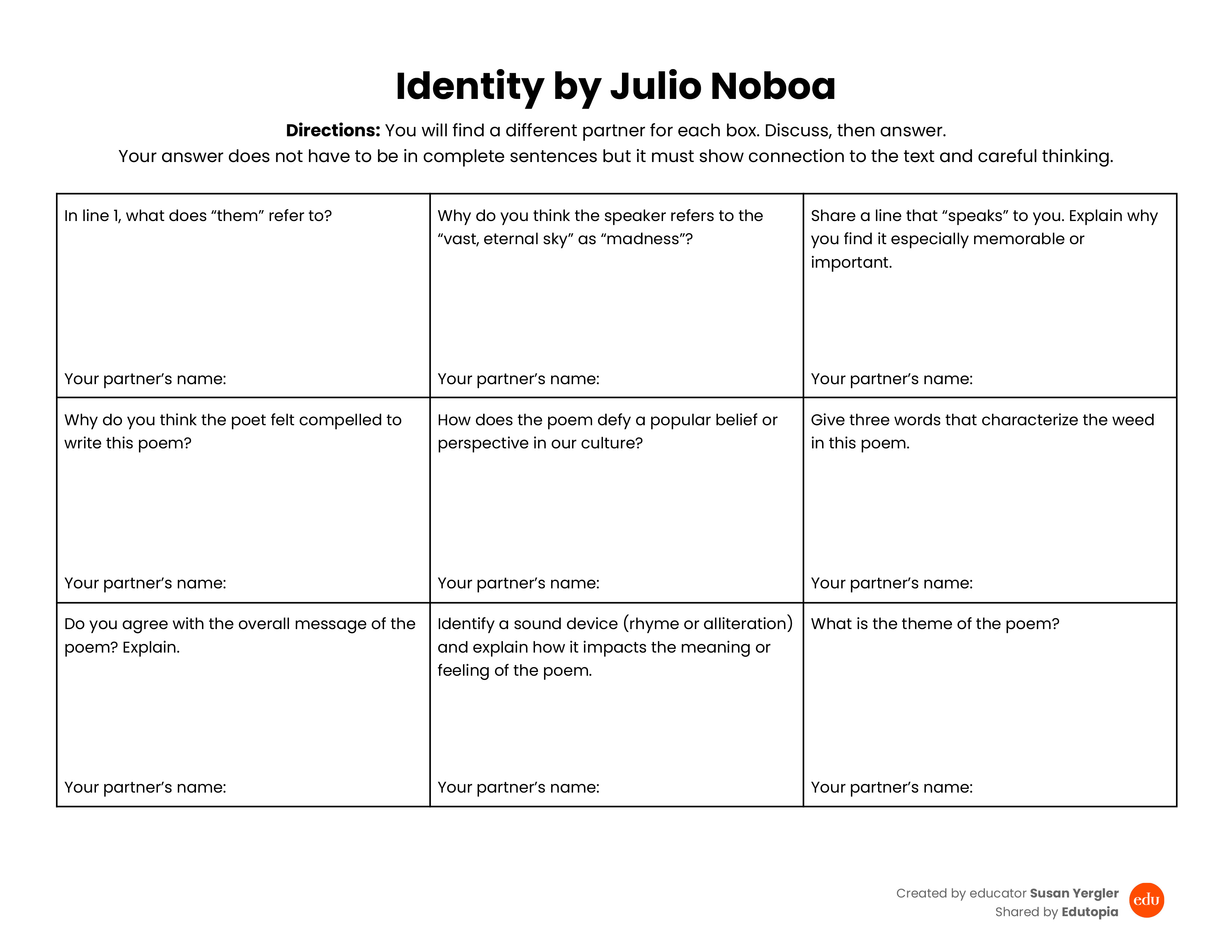
For a poetry study on Julio Noboa Polanco’s poem “Identity,” I found that providing a 3 x 3 grid and having students find a different partner to respond to each box is another great strategy for supporting students’ learning through quick discussions. The boxes contain either a discussion question or a tiny snippet of the text for them to analyze. This activity gets students moving around the room, and since they need to find a total of nine partners, they’ll interact with peers they typically don’t talk to.
Through finding success with these exercises, I had to admit to myself that I had drifted into “meeting students where they are” instead of truly challenging them. With careful planning and artful scaffolding that supports students without bogging them down, true engagement with difficult reading material is possible.