5 Strategies to Help Students End the Year With Calm Confidence
Elementary teachers can help ease the stress of the final weeks of school by teaching students SEL skills they can use anywhere.
Your content has been saved!
Go to My Saved Content.
The end of the school year brings a wave of emotions for teachers and students alike. Between performances, finals, presentations, and games, what should feel exciting can quickly become overwhelming. The pressure to demonstrate a full year of growth in a short window can weigh heavily on students, often manifesting as difficulty maintaining stamina, persistence, and emotional control.
This showed up in my own classroom. As spring arrived and the end of the year approached, I watched students who had thrived all year begin to unravel—losing confidence, feeling overwhelmed, and struggling to meet expectations that had seemed manageable just months before. After asking myself what was going on with my students, and trying to decide what I could do to help, I found my answer in social and emotional learning (SEL) skills.
FOCUSING ON SEL TO END THE SCHOOL YEAR
As the school year winds down, teachers often feel pressure to cover more content, but this can backfire. While cramming before end-of-year tests, performances, or projects feels supportive, it’s not necessarily what students need most. Instead, teachers can shift their focus to teaching and practicing SEL strategies to help students stay confident, manage stress, and perform their best when it matters most.
I wanted to shift my approach to end-of-year lessons to explicitly teach SEL skills. I knew that this would build students’ self-regulation, self-management, self-awareness, and decision-making skills, which would positively impact their performance across all areas of school life.
My approach to these SEL lessons unfolded in two intentional phases. In the first phase, I taught students how to recognize the physical and emotional signs of anxiety, dread, and overwhelm—helping them develop an awareness of what stress feels like in both their body and their mind. In the second phase, I equipped them with concrete strategies to draw upon the moment those feelings surfaced during high-pressure situations. I knew that for these tools to be truly effective, they needed to be discrete, nondisruptive, and accessible anywhere, at any time.
5 TOOLS FOR STUDENTS TO ADD TO THEIR SEL TOOLBOX
These five strategies are designed to support students in their ability to recognize and control their emotions. Not only can they be used during the high-stakes moments of the end of the year, but also they can be used year round to boost students’ performance, confidence, and emotional control.
1. Noticing and naming the feeling. This is a dialectical behavior therapy (DBT) skill that helps students identify what they are truly feeling. I taught students how to recognize anxiety, frustration, nervousness, fear, etc. in their body. We began by brainstorming sensations they noticed in their mind and body for each feeling: fast thoughts, inability to concentrate, upset stomach, restless feet, feeling hot, trouble breathing, quick eye movements.
From there, we linked these sensations to the emotions so that students could recognize what they were feeling when they felt these symptoms. Once students could recognize that they were feeling hot or having trouble breathing because of anxiety, they could feel more in control of the moment and themselves. Understanding what was going on empowered students to be able to reset when needed.
2. Visualizing using your five senses. For this strategy, students think of a calming place and then use all five senses to build a vivid visualization of that safe space. Then, when anxiety strikes, they can close their eyes and return to their calm, safe space.
After introducing the idea to students, I had them practice this strategy in pairs and share their visualizations. By intentionally trying to picture what that place would sound, smell, feel, taste, and look like, students will naturally have to slow down their mind, which helps to regulate the nervous system.
3. Activating your muscles. Anxiety and stress often create bursts of physical energy. I taught my students how to use progressive muscle relaxation to combat the anxious feelings in their body. Students think about different muscles in their body and actively hold tension in those muscles and then release it. For example, I introduce this idea to students by encouraging them to curl their toes really tight, and then release with a big exhale.
This strategy is a great way for students to calm their body when they can’t leave the physical space they are in (if a student is in the middle of an end-of-year exam, they can’t just go for a walk, but they can discreetly tighten and release their muscles).
4. Practicing trace breathing. In this breathing exercise, students find something they can trace with their finger (they could trace their other hand if nothing else is available), and breathe in as they trace up, and breathe out as they trace down. Students pause at the top and bottom before repeating the process over again. Students can complete as many rounds as they need to feel calmer, lowering their heart rate and refocusing their mind.
This exercise can be completed anywhere, anytime, and offers students a way to gain control over their emotions by controlling their breathing. I introduce the idea to students and then have them practice three to five rounds.
5. Using a mantra or affirmation. This strategy, similar to strategy one, draws on DBT and mindfulness techniques to help students shift their thinking. Rather than defaulting to “I can’t do this,” students craft a personal mantra that first acknowledges their feeling, then reframes it in a positive light.
By replacing negative self-talk with affirming language, students build confidence and a growth mindset. Many students already have experience with mantras or affirmations, but it is helpful to provide some examples specific to the classroom and end-of-year activities to make it more concrete. For example, this test feels hard, and I have prepared for it.
In the classroom, we practice our mantras aloud first, and then I encourage students to repeat them silently in their own head. This offers them a way to use their mantras anytime they need to.
Below is the toolbox as a visual for students to keep as a go-to tool when anxiety hits.
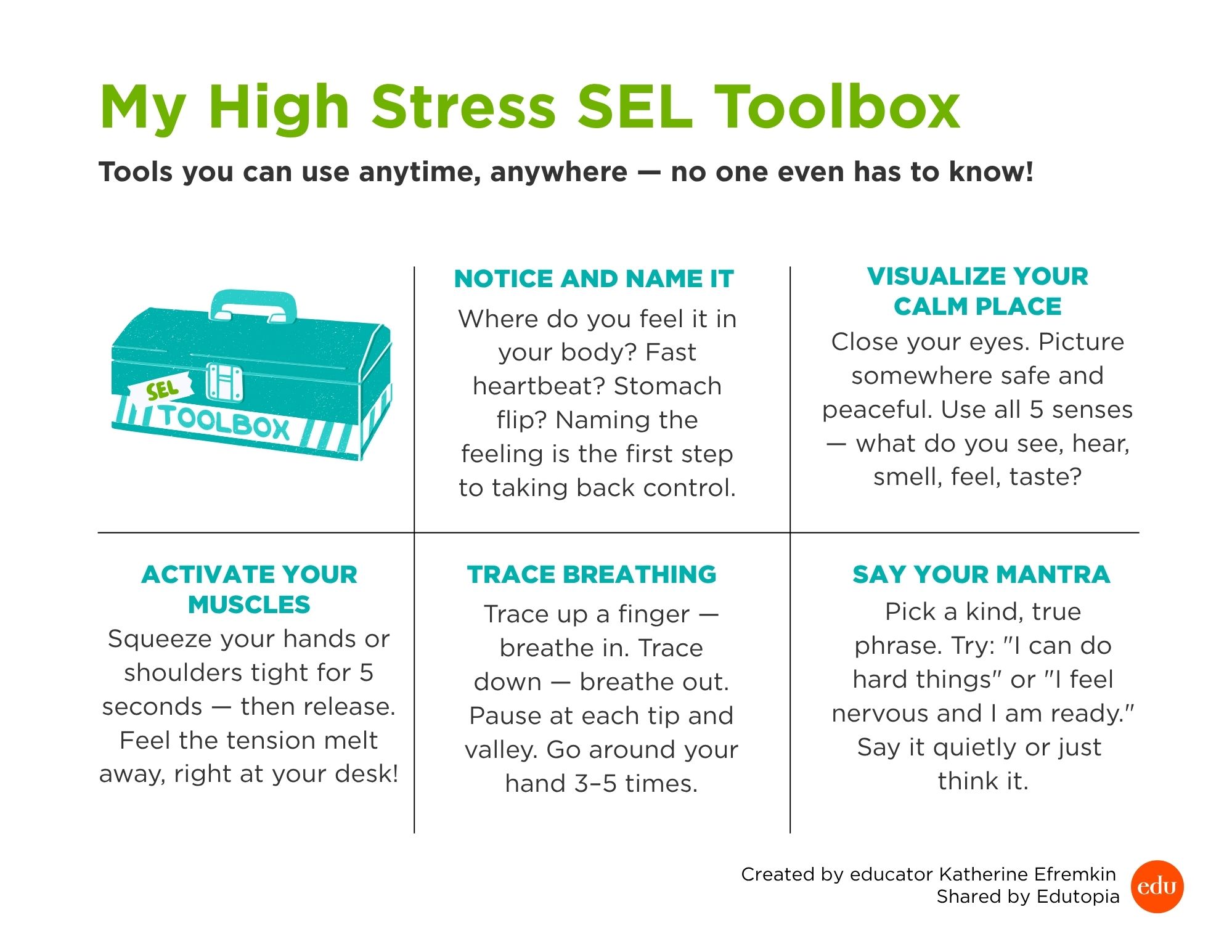
I framed this work as building a personal toolbox filled with SEL strategies they could reach for whenever anxiety struck. The results spoke for themselves: Not only did test scores improve, but students became more resilient and independent learners who were able to regain their emotional control during high-stress environments.