Encouraging Creativity and Deep Reflection Through Annotation
Tips and real-life examples show how teachers can guide students to create genuinely useful artifacts of analysis and interpretation.
Your content has been saved!
Go to My Saved Content.It’s not always clear or obvious to students why annotation is important, or how it’s a useful skill that’s representative of the learning process. Many of my high school students have told me that annotation is a hurdle they must jump over, rather than a tool for processing, understanding, and organizing their thoughts. And for students who struggle with written expression, the use of text-based annotation is especially daunting.
In my own classroom, I’ve tried to expand the notion of what annotation can be. Instead of just highlighters and notes, I encourage creative visual expression, intertextual connection, and personal reflection on the page. These “sketchnotes,” as they’re also known, can be a liberating force in an English or humanities classroom.
I have one sketchnotes rule: Fill the page! In doing so, students are able to create artifacts of analysis, interpretation, and thinking that can reveal nuanced understandings of written text. Reviewing their work (and talking about it) also allows for reflection and connection-making.
Below are tips for helping students produce—and then utilize—great notes.
The Facilitation Guide
I have three guiding ideas for incorporating creative annotation.
Encourage creativity: Move beyond highlighters, pens, and sticky notes by breaking out markers and colored pencils, paper tape, and construction paper. In addition to writing, I explicitly ask students to draw, use symbols, experiment with colors, and create imagery. By encouraging creativity, I find that even my most reluctant students are more willing to engage with annotations.
Provide scaffolded support: I always prepare prompts for students who are struggling to get started. They include:
- Identify key words or vocabulary.
- Identify examples of figurative language (symbols, poetic devices, etc.).
- Express your own reactions to the text.
- Create questions or wonderings.
- Label the thesis statement or claim(s).
These prompts come in handy when engaging with targeted skill supports. For example, when I’m working with students on rhetoric, I might bring up prompts specifically about identifying and explicating pathos, ethos, and logos.
Nurture connection: Annotations are always completed in an “open note” fashion. In other words, not only do students have access to notes, research tools, and other course texts—they’re instructed to actually use them. I facilitate opportunities for students to think deeply and reason beyond an isolated text; from their readings, writings, and general learnings, I want students to consider the larger context. When students have access to additional materials, they’re prompted to do the following:
- Locate and use direct quotations from other texts within their notes.
- Identify examples of class concepts and ideas.
- Explain references to historical events, people, and places.
Assessing Student Work
Below are three of my students’ sketchnotes.
Example No. 1
In the example below, an English student analyzes a panel from Thi Bui’s The Best We Could Do, a graphic memoir that explores her family’s immigration story after they became refugees following the fall of Saigon in 1975.
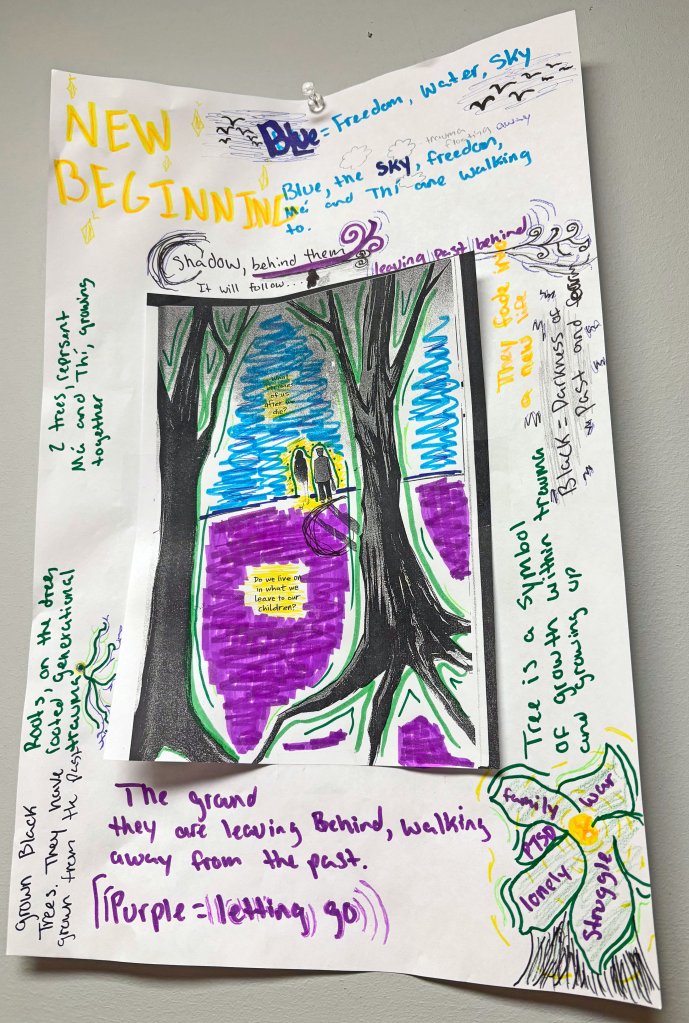
The student mixes in colors to emphasize and isolate specific elements of the panel. She also ties together her thoughts, ideas, and themes from the novel, such as trees representing “growth and growing up.” Her employment of boldfacing, underlining, and visual imagery help to clearly track her thought process. For example, as an extension of growth, the flower connects to other motifs of the novel: loneliness, war, and family. In this instance, we can read and see her interpretations.
Example No. 2
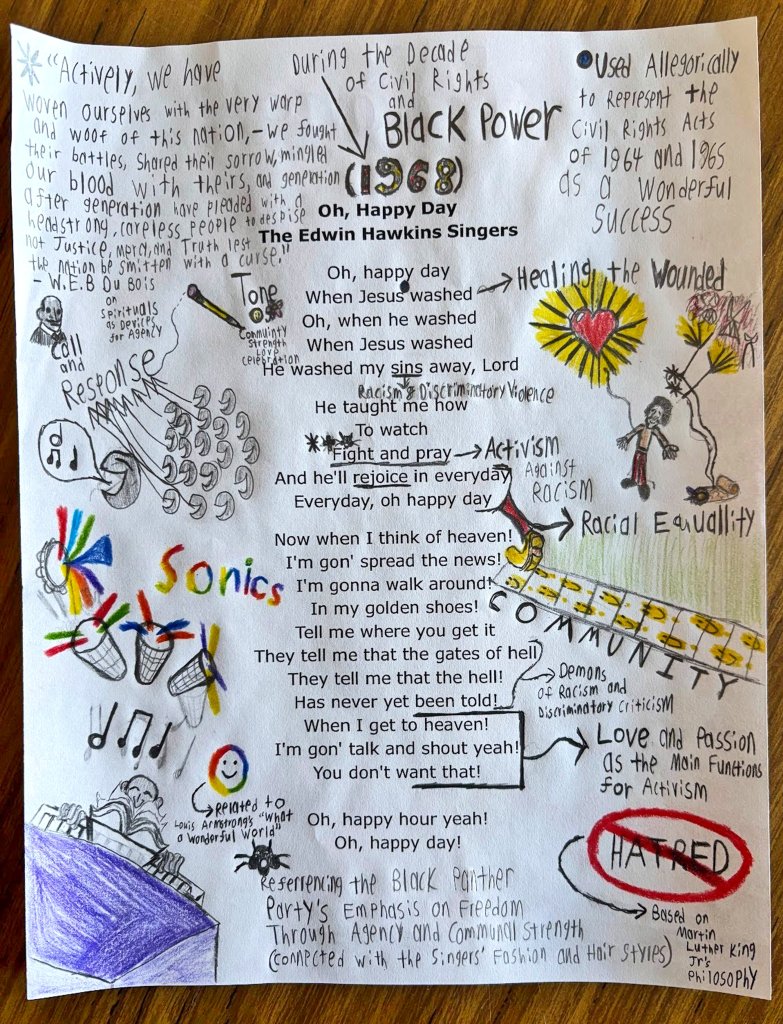
This student’s sketchnotes from an AP African American Studies course show a strong grasp of synthesis-based analysis. He examines the gospel song “Oh Happy Day” in conjunction with our reading of W.E.B. Du Bois’s The Souls of Black Folk. The initial thematic analysis of the lyrics is clear; the student identifies concepts like healing and community. Impressively, the student also situates this analysis within Du Bois’s conception of memory and music.
The imagery in this annotation does a nice job of articulating the themes and structures of the song. The student visually represents what a call and response—a critical element in Black music—might look like. He shows the instruments that are used in the song: a piano, drums, and a tambourine, which he amplifies with bright colors.
Example No. 3
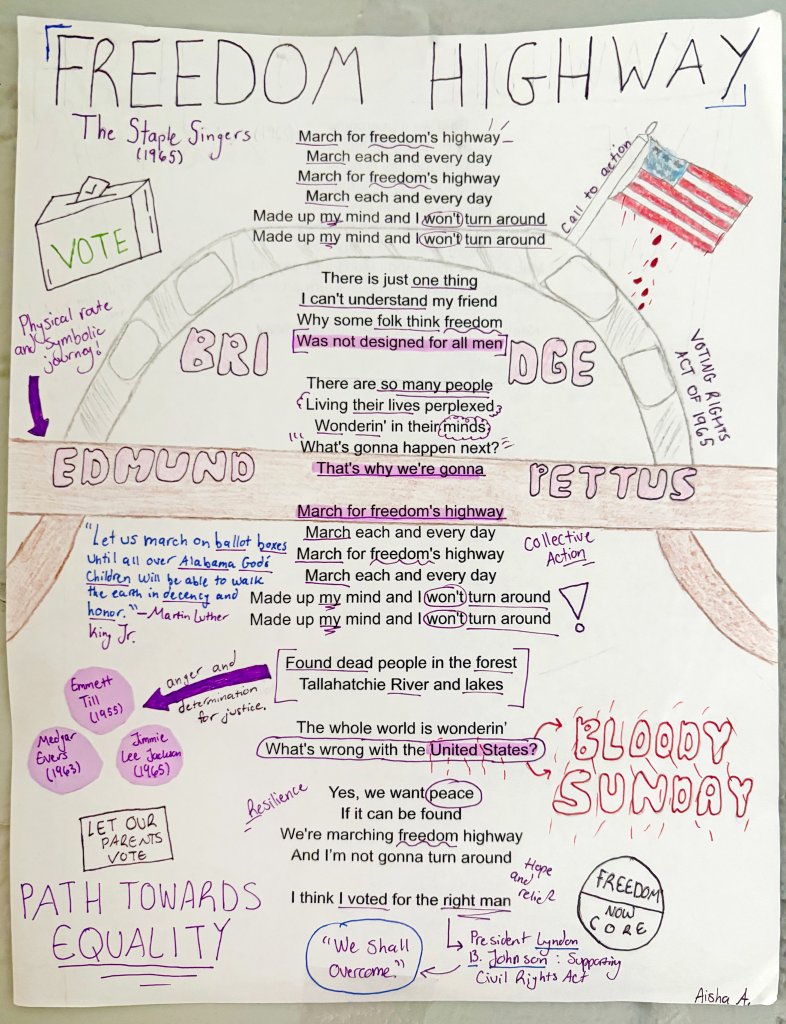
In a History of Rock and Soul class, this student’s analysis of the Staple Singers’ song “Freedom Highway” models how sketchnotes can support historical contextualization and grounding. The student demonstrates her growing knowledge of major people, events, and organizations, as well as the philosophy of the modern Civil Rights Movement. She connects explicit lyrics like “Found dead people in the forest/Tallahatchie River and lakes” to specific reference points: the murders of Emmett Till, Medgar Evers, and Jimmie Lee Jackson. Additionally, she uses iconography such as the Congress of Racial Equality (CORE) button to acknowledge the role that community organization plays in addressing racial inequality.
Student Discourse
After students complete their sketchnotes, I always ask them to consider what they’ve created. Which sections of the text are the most heavily marked up? Which words recur or are most prominent? What tone does a student’s color choices, symbols, or imagery elicit? These questions are a great foundation for a larger class discussion.
Then, I have students check out their peers’ notes. They look for commonalities, differences, and points of contention with their words, symbols, colors, and other imagery. In this way, their work becomes the source of class discussion and can lead to more fruitful reflection.
I find that students enjoy the freedom of this approach, which broadens their notions of note-taking and annotation. Consequently, they’re better able to articulate and represent their thoughts and ideas—both on paper and during discussions with their peers.