A Cross-Age Environmental Education Project
Inspired by Jane Goodall, elementary and high school students are participating in the revitalization of lands impacted by wildfires.
Your content has been saved!
Go to My Saved Content.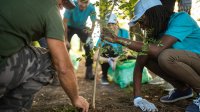
A year after wildfires swept through Southern California, destroying homes and schools and scarring the landscape, local students are taking the lead to cultivate a greener future. Their collaborative efforts offer a model for other communities affected by climate change and a reminder that, as a fifth-grade volunteer named Devika said, “even small acts can lead to big differences.”
The cross-age learning initiative is called the TREEAMS project. Its name is a mashup of trees and dreams, and its long-term goal is planting 5,000 trees across the region. That goal was inspired by conservationist Jane Goodall, who recognized the power of nature to heal. Tragically, news of Goodall’s death came on the same day last October when students were launching the project. Students responded by rolling up their sleeves and planting their first tree in her honor.
Learning by doing is at the heart of the TREEAMS model, which has quickly grown to include elementary and secondary students from public and private schools.
Build a Network
Tackling a major environmental education project requires input from a variety of partners. Expert insights help to determine which trees to grow, where to plant them, how to engage community allies, and how to connect hands-on learning with academic goals.
EF Academy, an international school in Pasadena, stepped into the role of convener after narrowly escaping fire damage to its new campus. In a unique partnership, the high school has become the temporary home for Saint Mark’s School, a historic K–6 school in Altadena devastated by fire. Bringing younger students onto the secondary campus has set the stage for cross-age learning. For EF students, many of whom come from abroad, the collaboration “has taught them about service learning and giving back to the community,” said EF Vice President Shawna Marino.
Margarita Pagliai, head of school at Seven Arrows Elementary, was inspired to cofound TREEAMS as a vehicle for student action. She drew on the advice of Jane Goodall, with whom she had a decades-long association, “to listen to kids because sometimes you need to remember their wisdom,” she said. One 12-year-old, for example, said he was not interested in researching which trees to plant. “Someone out there knows the right trees,” he told Pagliai. “I just want to plant them.”
The TREEAMS model, committed to student-led action, was developed in partnership with the Jane Goodall Institute, UCLA School of Education, and a national nonprofit called EcoRise, along with landscapers, school maintenance staff, and community organizations.
“Every community has people who care and want to help. It’s just a matter of finding one another,” said Sarah Bang, director of P–12 public school partnerships at UCLA School of Education. The goal then is collaborating to meet the needs of the local environment, she said: “It’s not one size fits all.”
Effective partnerships require clear communication. When experts explained that the fire-damaged soil needed time to recover, the TREEAMS team decided to start with tree nurseries, which could double as low-cost learning labs until community sites were ready for replanting. Although landscapers offered to set up the nurseries, educators insisted that students take the lead.
Start Small, Think Big
The first nursery on the EF campus includes 30 young sycamores and California coast live oaks, native to the region. In April, high school students teamed up with fifth-graders to spread mulch and plant saplings in five-gallon pots in an outdoor spot near the school garden. Students will water and monitor their growth, replanting them into larger pots when ready. Mature trees will eventually grace local parks and rebuilt neighborhoods, starting with donations to families of Saint Mark’s students in Altadena.
After starting their own tree nursery, students helped children at a nearby elementary school start another, using their leadership skills to grow the initiative organically.
Students are learning patience along with horticulture. Saint Mark’s fifth-grader Devika said she realizes that the project “may not benefit us in the next month or even year, but it’s going to benefit future generations. That’s pretty exciting.”
Let Students Lead
Reforestation projects create multiple opportunities for students to apply their learning. Whether that happens during the regular school day in science, math, or literacy, or through clubs or volunteer activities, benefits grow when students take the lead.
Liam, a junior at EF Academy, got interested in worm farms as a class project, collecting cafeteria debris to feed the wriggly recyclers. When TREEAMS was getting underway, he saw an opportunity to use worm castings “to help these trees grow as big as they can.” It was an idea that adults had not imagined.
“Anything that is student-led rather than adult-led has so much more energy,” said Rick Duque, an English teacher at EF Academy who also advises the school’s outdoor club. “That’s my role—let them lead with a little bit of help and support.” Supporting student-led learning means teachers need to be “more of a manager,” he said, stepping in to help as needed.
Inspire Hope
Students in communities across the U.S. have witnessed damage from wildfires, floods, powerful storms, and extreme temperatures. The majority of young people feel more worried than hopeful when it comes to the environment, according to a National 4-H Council survey.
The best strategy to turn climate anxiety into hope is to take action. That’s the message Jane Goodall shared repeatedly in her public speaking, writing, and work with young people, and it’s continuing to echo across Southern California.
Seventh-grader Elle can see the fire damage from her home. Some of her neighbors lost their houses. Growing trees for her community generates “such a sense of belonging. We’re not only helping the planet, we’re helping bring people together, too.” The project is teaching her “how to lead with empathy and kindness,” she said.
Jennifer Tolbert, principal of Saint Mark’s, said her young students are witnessing the power of resilience and partnership as their community rebuilds. “They’re understanding what it looks like to come through a difficult time,” Tolbert said.
For Pagliai, TREEAMS cofounder, the project offers hope to adults as well as children. “Adults who were born here, who created this community, need to see what this younger generation can do,” she said.
High school student Liam is already imagining coming back to Southern California as an adult “and telling my children these are trees that I helped plant,” he said. “That will just be so special.”
As the project grows, members plan to continue to add resources to the TREEAMS website, including how-to videos, curriculum, and strategies for building partnerships.