Keeping Parents in the Loop With Student-Written Emails
A strategy for guiding high school students to send home regular updates about their assignments and progress in school.
Your content has been saved!
Go to My Saved Content.
As a secondary teacher, I struggle to meet the needs of over 100 students. For years, communicating with home adults (I use this term because some students aren’t raised by their parents) felt like a second job. The breaking point came during my maternity leave in 2022: While trying to focus on keeping myself, my preschooler, and a newborn alive, I was overwhelmed with emails from students and their families. I returned to the classroom committed to finding a better system to empower students, inform parents, and preserve my sanity.
The solution has been a game changer: Every few weeks, my students write a structured email update to their home adults. This practice has eased my communication workload, nurtured student accountability, and built stronger home-school connections.
Start With an Established Format
Before asking students to email their parents, I teach them how to write a professional email. One of our first classroom assignments is a low-stakes email in which they introduce themselves to me by writing about a topic they are passionate about. This allows me to assess and correct their use of email components: a clear subject line, a proper greeting, a concise body, a polite closing, and a signature as a basis for email communication with anyone.
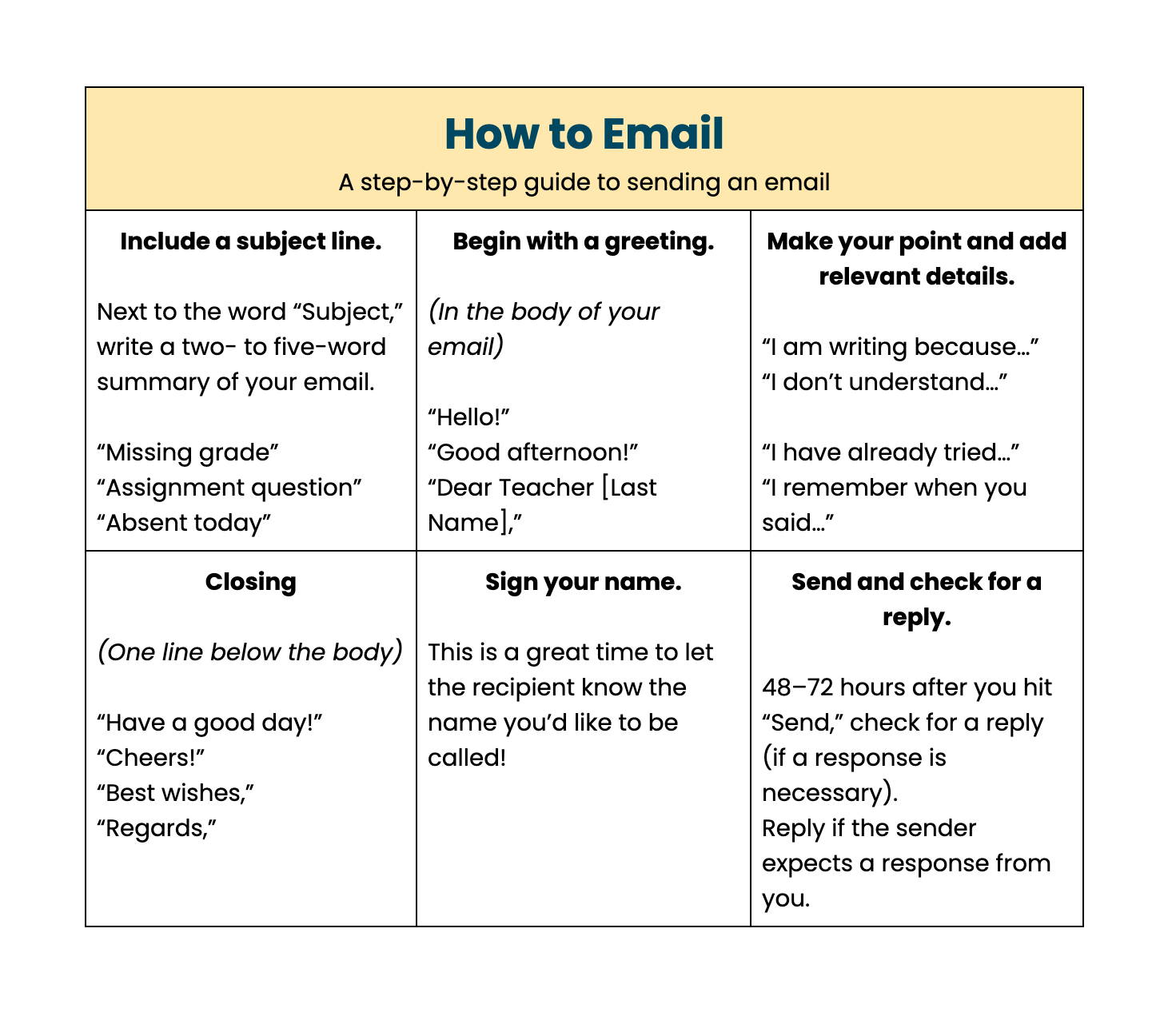
I began with a straightforward template that focused on academic progress. In the first email, students were required to include five key things:
- Their current grade, pulled from our school’s online portal.
- A list of any missing assignments.
- A concrete plan to maintain or improve their grade.
- Their number of absences and a plan to make up for missed time.
- One specific achievement from the week they were proud of (this does not have to be academic).
I immediately recognized this as a metacognitive strategy. Students couldn’t just report a grade; they had to analyze why they had that grade and articulate an actionable plan for the future. This reflective process shifts the ownership of learning directly onto them.
How Emails Evolve Over Time
To meet my students’ evolving needs, the prompts I gave them grew and shifted throughout the year. While the core structure of an email remains the same, the body of the email adapts to include more information about what we study, what students like and dislike about our curriculum, and how students connect the texts we read to their world outside of school.
For example, an October email asked students to update their home adults on their mental, physical, and emotional well-being before diving into an explanation of our poetry unit. Students were encouraged to write about not only what’s happening in English class, but also what’s happening in their other classes, in extracurriculars, and at home. Next, students named their favorite poem, explained its meaning, described a challenge they faced during the unit, and shared an accomplishment.
In April, the focus shifted to a major research project. Students emailed about a project overview, including their topic, why they chose it, their progress finding sources, and their planned presentation format. Not only does this practice keep parents informed on long-term assignments, but the email requires students to synthesize their academic work and name places of discomfort or misunderstanding.
Handle Areas of Concern and Growth With Care
Every student sends the email directly to their home adult and puts my email address in the CC line. I assess the emails for completion, not content. Grading is based on the structure: subject, greeting, body, closing, and signature. This keeps the focus on the act of communication and reflection.
Over the course of a grading period, home adult emails make up approximately 10–15 percent of a student’s overall grade because written communication is an essential skill, and professional email writing is necessary for college, in careers, and throughout adulthood.
As with everything, this practice has some pitfalls.
Some students come from sensitive home situations. It is imperative to handle this with care. For these students, I ask them to send an email to a trusted school adult: a counselor, another teacher, or a coach. I follow up with this trusted school adult so we can both work together to support that student in achieving their goals.
For students who need to share difficult news like a failing grade, I work through a plan with them to improve their grade before they send an email about it, and I offer to review the email with them. Once the email is sent and the plan is in motion, I follow up with the home adults of these students as they make progress toward improving their grade.
Maintain Your Focus and Stay Organized
This process also means that I have to be on my A game. Knowing that students are sending information detailing their work in my class means I have to keep up with grading, be intentional about the assignments we spend time on, give students standards-based feedback so they can work on grade improvement, and, most important, give students time: for email drafting and to make up work that may impact their grade. It is neither equitable nor sensible to ask students to be accountable for their work while refusing to give them an opportunity for improvement.
This practice has fundamentally changed my classroom dynamics. It builds essential life skills, fosters metacognitive thinking, and turns communication from a teacher’s responsibility into a tool for student agency and voice. Looking into the future, my goal is that these emails grow into long-form reflective pieces—essentially a digital portfolio—that show students’ learning throughout high school.