
Who Will Your Students Be in 2040?
Guiding English learners to imagine their future selves and role-play a class reunion promotes research and speaking skills.
Your content has been saved!
Go to My Saved Content.In February 2025 I was returning to school from my second maternity leave as a veteran teacher and novice mom of two babies under 2. Running on three to five hours of sleep per night, I needed an English language arts (ELA) unit that not only was going to reengage my students, but would excite me as well.
In The Success Principles, Jack Canfield describes a role-play activity in which he asks his clients to show up as their future self. Who would you be married to? Where would you live? Where would you work?
This activity allows people to envision their goals and speak them into reality. While many students approach career research as an abstract idea of what their futures might hold, vocational students such as mine are living much of what their future might look like on a daily basis. They are working side-by-side with master carpenters to construct homes. They are taking the blood pressure of elderly individuals at nursing homes during their co-op. These hands-on-learning experiences set them apart from other academic high school students who are not afforded this opportunity. As I imagined what my students would say, inspiration struck. The first annual 2040 high school reunion was planned… for March 2025.
launching the 2040 Career Reunion Project
The intro. On launch day, I scuttled into the room in a black blazer and glasses, apologizing for my lateness, as I had just flown in from California that morning to see them. It was quite a challenge to avoid laughing at their confused looks. I asked them how many children they had and where they were living, and they giggled like I was crazy. “Mrs. Espinola, what are you talking about?!”
As the laughter died down, I shared a Canva with the goals, vision, major dates, and responsibilities of the 2040 Career Reunion Project. Students would have to imagine themselves in 2040 by researching their career path, planning a monthly budget correlated to their income, analyzing future job market trends and education needs in their field, and so on. Would they have children? Where would they live? The room was buzzing.
I explained to students that I had requested the auditorium two weeks from that day, where we would gather for our 2040 reunion. They would come dressed as the 2040 version of themselves and participate in informal interviews with their peers to learn what they were up to “now.” To help get the students ready, I scaffolded the assignment in small chunks of research.
The language objectives. As a Sheltered English Immersion licensed teacher, I wanted to narrow in on my language objectives for speaking. Students with a lower affective filter are more likely to hold a high sense of self-efficacy and motivation. I imagine the affective filter as two types of walls. A student with a high affective filter has a high brick wall impairing their progress. This brick wall can take the form of isolation, anxiety, embarrassment, or constantly being corrected for their errors. A student with a low affective filter has a very weak wall, perhaps something like netting, that allows new knowledge through for processing. To create a lower affective filter, I knew my students needed multiple opportunities prior to our reunion day to practice speaking.
Multilingual learners often struggle with register and tense, so I knew it would be challenging. This career project might require some students to use specific vocabulary to talk about their vocation, such as plumbing or cosmetology, while others might need language geared toward college readiness. The format of interviewing one-on-one with their peers would also take a specific language set. This type of Cognitive Academic Language Proficiency takes much longer to develop and requires intentional, modeled instruction.
Applications of Lev Vygotsky’s research to second-language learning highlights a Zone of Proximal Development where students learn language at the greatest rate when the content is challenging but not out of reach. The high-stakes aspect of speaking with their peers, combined with the high-interest aspect of career research, resulted in immediate buy-in. Students felt challenged and simultaneously supported.
The career possibilities. Students used the 16 Personalities Quiz and Holland Code Career Quiz with graphic organizers to generate possible career options. Either the results aligned perfectly, or the students were exposed to ideas they had never thought of before. One student’s results confirmed that she would be an outstanding nurse, while another student, who came from generations of HVAC technicians, was told he might thrive as a digital media creator.
The research. I wanted to focus on research as a core ELA objective. Once students narrowed down a career, we used MassHire to explore various aspects of careers, from educational background to salary to availability in the field. Once they completed this activity, they worked on a “reality check” in which they made basic living decisions. Would they buy a home? Rent an apartment? Lease the newest BMW model? Would they eat out three times a week? Would their children play competitive sports? The website would calculate the difference between their income and their budget to leave them with a final savings. This was fun, and eye-opening to so many kids.
Financial gains vs. dreams. Many of my students were shocked to see how expensive their lifestyles were in comparison with their salaries. The idea of a beginning, median, and long-term salary was also a new concept, as well as the fact that salaries vary depending on where you live. Attending a vocational school seemed to instill an extra layer of confidence in my students. We discussed how although money was a prime motivator in their career decisions, it wasn’t necessarily a contributing factor to their happiness or well-being.
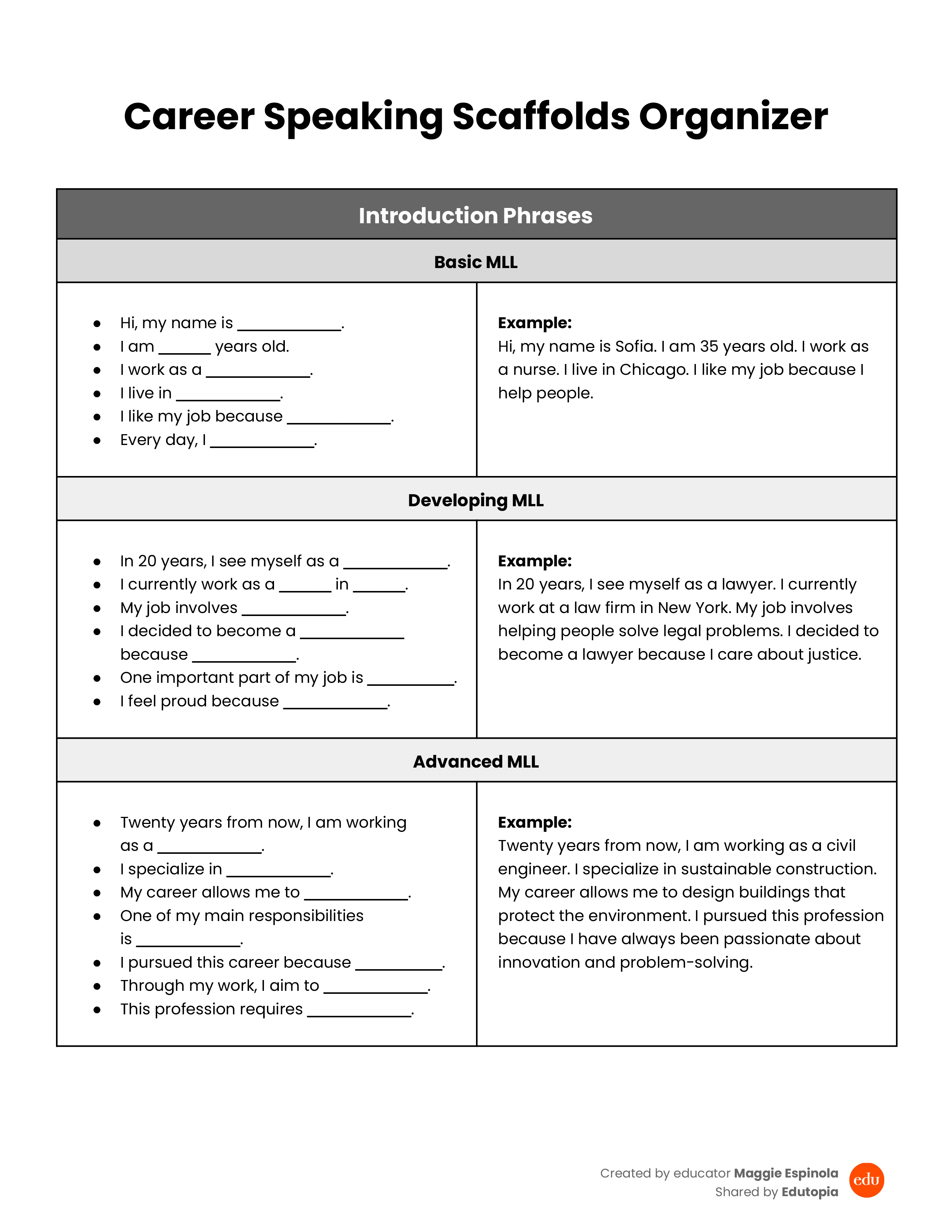
Practice for the big day. After students gathered all of their information, it was time to practice speaking. We used Screencastify and a scaffolded graphic organizer for different language proficiencies and had students record themselves. Students practiced how they would structure their responses—their volume, tone, dialect, grammar, syntax, word choice, speed, and so on. Students submitted their recordings privately, and we reviewed strengths and improvements that could be made. Students also chose one partner they felt comfortable practicing with after their recording to get peer feedback on their 2040 future-self narrative.
reunion 2040—the big day
On the big day, my students blew me away. Students came in dressed as electricians, barbers, nurses, stay-at-home moms, construction workers, and lawyers. In the auditorium, they floated around talking individually to their peers as though we were in the year 2040. It was one of those incredible teacher moments, where you just sit back and watch the magic happen. The students acted as though I was not even in the room. I witnessed a moment of students embodying their future goals and aspirations into fruition. And I can’t wait to do it again this year.