Using Talk for Writing in Pre-K
Encouraging children to ‘write’ their own versions of tales like ‘The Three Little Pigs’ helps them build crucial early literacy skills.
Your content has been saved!
Go to My Saved Content.Traditional tales like “The Three Little Pigs” can be much more than storytime. Familiar stories with repetitive language are a powerful vehicle for helping children understand how stories work—and how to tell stories themselves. When paired with a Talk for Writing approach, classic tales become a meaningful tool for language play, imagination, confident communication, and early writing foundations.
Talk for Writing, originally developed by educational trainer Pie Corbett, is a literacy approach widely used in the UK. It is based on a simple but powerful idea: children need to hear stories, talk about them, and internalize them before they can write. In preschool and pre-K, this means before they can meaningfully mark-make, draw, or attempt early writing. The approach is built around the principle that if children can tell a story orally, they can eventually write it. With our youngest learners, the focus is firmly on talk, actions, and play—not on writing sentences.
In my mixed preschool and pre-K classroom, we implemented Talk for Writing using “The Three Little Pigs” for a two-week project, with the aim of empowering children to become confident storytellers.
Step 1: Imitation
The first stage of Talk for Writing is imitation. In class, we began by reading “The Three Little Pigs” repeatedly over several days. Children were encouraged to join in with the repeated phrases, and we used puppets, masks, and props to bring the story to life. These repeated, interactive readings allowed the children to become deeply familiar with the story in a joyful and pressure-free way.
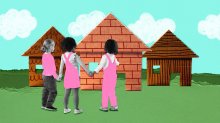
Next, we transformed our dramatic play area into a theater. We provided the children with different materials to create the houses from the story, which we then used as props.
After children began to take ownership of the story, we created a class story map. Story maps are a powerful way of retelling a story using simple pictures and symbols, acting as a visual memory aid that helps children “see” the structure of a story. As a class, we decided what pictures and actions to use for each part of the story. The children chose the actions, giving them ownership—and providing physical hooks for remembering the story. While many pre-K children cannot yet retell a story in full sentences, they can retell it through actions, sounds, and key words. This is still storytelling.
I modeled drawing out the story map in front of the children, emphasizing that the drawings did not need to be perfect. Modeling this process is vital. It shows that marks represent ideas and prepares the children to create their own story maps later. We used the story map to retell the story as a whole class. Oral retelling helped the children develop vocabulary, practice speaking in full sentences, and use story language.
With access to props, masks, puppets, and the story map, the children acted out the story repeatedly. They negotiated roles, supported one another, and helped younger children remember the sequence of the story. It was heartwarming to observe how the children not only developed a deep understanding of the story, but also strengthened their social and emotional skills. Even quieter children participated at their own level, using actions or repeated phrases as a way into the storytelling.
Step 2: Innovation
Once the children were secure with the story structure, we moved on to the innovation stage of Talk for Writing. This involves changing parts of the story while keeping its structure.
We began by introducing the children to different versions of the story, including The Three Little Wolves and the Big Bad Pig by Eugene Trivizas (illustrated by Helen Oxenbury) and The True Story of the 3 Little Pigs by Jon Scieszka (illustrated by Lane Smith). The children loved examining the other versions of the story and discussing how each one differed from the original. Exposing the children to variations of the same story allowed them to develop their own imagination.
Discussions then turned to how we would change the story. Soon, children began telling their own versions, such as “The Three Little Bats and the Big Bad Vampire” and “The Three Little Cats and the Big Bad Dog.” Some children changed the ending of the story so the bad character became good. The materials of the houses in their stories included candy, Magna-Tiles, Lego bricks, and even bones. Some children were not as confident coming up with their own versions, but even those children were able to confidently retell the original story.
Writing Their Own Stories
After a lot of oral work, the children were eager to “write” the story in their own way. We provided them with large, blank story map templates, which they eagerly completed. I am a firm believer in not forcing children to write for the sake of writing, so we didn’t make this a “must do” task, but I was pleasantly surprised at how eager even my reluctant mark-makers were to “write” their story.
The children held their story maps with pride and shared their own stories with everyone they could. The excitement of storytelling was spilling out of our classroom.
We then decided to share their wonderful stories with our school community and our families. The children practiced retelling their stories, which we then recorded. The children loved watching the videos of themselves and their friends retelling their stories. “We are story writers!” one child excitedly exclaimed.
Over the two-week project, children experienced iterations of the same story in a meaningful, engaging way. Through repetition, play, and talk, they developed confidence, storytelling language, and a deep understanding of narrative structure. They are now eager to create and share new stories.
One of the greatest strengths of Talk for Writing is its inclusivity. Children with speech and language delays, those who have lower confidence, and those for whom English is an additional language can all fully participate through actions, repetition, and play. There is no pressure to perform or “get it right.”
Talk for Writing in preschool and pre-K is not about worksheets or writing sentences. It is about giving children a rich oral foundation through stories they love. When classic stories like “The Three Little Pigs” are explored through talk, play, and imagination, children develop the language, confidence, and narrative understanding that underpin all writing. And they have a lot of fun huffing, puffing, and talking their way into becoming storytellers.