Bouncing Back After a Class Is Interrupted
You just found out every student in the band will miss two days of school. Or there’s a fire drill and now one section is behind. What to do?
Your content has been saved!
Go to My Saved Content.You get a school email—the band has qualified for regionals and will miss two days of school next week. Great news, especially for those students! But also bad news because your carefully planned lesson schedule just fell apart.
If you’re one of those teachers who have every day’s lessons mapped for weeks ahead, you know how frustrating it can be to have a schedule disruption, especially at the last minute. Of course many disruptions come from unanticipated natural events, which are unavoidable, and somehow we roll with them. However, there are also human-scheduled events that sneak into our schedule and throw everything off—the hundred students in the band will miss two days next week, or the fifth-grade field trip to the zoo is rescheduled because the penguin exhibit is under construction. All of these events are understandable, but they can have a domino effect, impacting our plans for days afterward.
We can’t avoid these occurrences, but we can pivot—even pivot deftly sometimes.
Consider the following suggestions the next time you face a disruption, whether it’s field trip day, half the students in a class being absent, one section being canceled entirely, one section being shorter than the others that day, or an unexpected drill that interrupts your test.
Long-Term Planning
In my research for this article, I asked many colleagues how they navigate planned schedule disruptions like field trips. It surprised me how many replied that they just “gave up” on planning ahead. For me, as a teacher who relies heavily on calendars, spreadsheets, and charts, this laissez-faire approach would not work.
I map out a general overview of units to guide the scope and sequence of my course (screen shot below). In this plan I include known school breaks, field trips, and a general idea of test dates. This level of organization might overwhelm some teachers, but I find it to be reassuring—at least at the time when I build it, everything I need to do fits.
This yearlong map may not seem like a strategy to assist in flexibility. However, there is comfort in knowing that shifting one lesson will not derail an entire unit or term. Below is a sample snippet of my Algebra I year overview, with each unit, event, and holiday date color-coded.
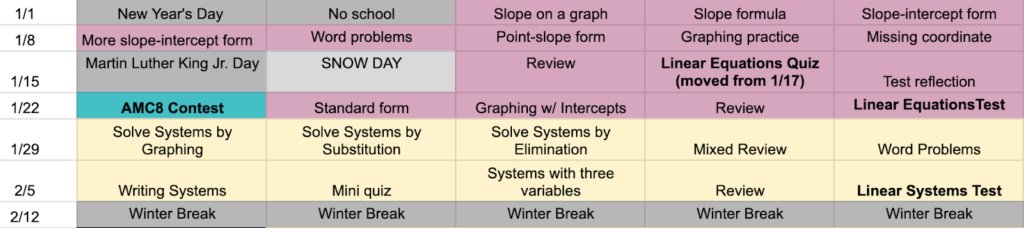
In the sample, one of the school days was canceled due to weather. I shifted the lesson, which in turn shifted the date of the quiz. I had to cut a lesson the following week because the math contest date (blue-green cell) could not be moved. Because I can see static events on my calendar such as the math contest and holidays, I can visually see where I can and cannot move lessons and assessments.
Shifting Our Mindset
In addition to the planned interruptions above, there are interruptions that are out of everyone’s hands, such as drills and inclement weather days—they are annoying, but there’s no way around them. But there are also seemingly optional events that somehow pop up throughout the year, like field trips.
The first thing to do if you start to get frustrated is to reframe your thoughts by reminding yourself that administrators aren’t trying to disrupt your schedule for no good reason. When our school was recently renovated, we evacuated three times in one week due to false fire alarms caused by the construction. A teacher, obviously frustrated, exclaimed, “Why do they keep doing this?!” After everyone settled back into the classrooms, the teacher reflected on her comment. Sometimes there’s no one to blame—we have to accept the reality that unpredictable, but still annoying, disruptions happen in schools occasionally.
It may seem that administrators disregard the inconvenience to teachers of a missed class or pulling out several students with little notice, but usually the decisions arise in a situation with competing priorities. Perhaps the librarian has been trying to book a popular author for a school visit. With only a few days’ notice, the author says they can visit Thursday from 12:05 to 12:45 only. Administration has to make the hard choice of forgoing the opportunity for students to hear from a favorite author or make a last-minute schedule change that will cancel or modify classes to accommodate the visit. In the shoes of a school leader, which choice would you make?
When you consider all the moving parts of a school—field trips, guest speakers, competitions, and more—it’s not so cut-and-dried when an administrator is faced with a tough decision to disrupt classes. I encourage you to take a wider perspective the next time you’re frustrated about a canceled class—it most likely was not an easy choice.
Building a Set of Tools for Pivoting
It’s definitely frustrating when you teach multiple sections of a course and you miss a lesson with only one section. It is not realistic or advisable to continue to keep that one section behind the others for the rest of the year—either you stall the other sections or cram the material for the missed class.
Ready-to-go lessons: When one section is behind the others, have “stall” lessons ready for the sections that are ahead. The word “stall” might indicate that the period is wasted, but for me it’s quite the opposite. Pausing to review material is never a waste of time. Make review fun with games like Kahoot, Trashketball, or Around the World. The amount of learning and fun during these class periods means they are anything but “stalled.”
Modify assessments: But what about an upcoming quiz? To avoid changing a quiz date for one section only, modify the quiz itself. If one section didn’t quite get enough time with the lesson on ser and estar in your Spanish class, remove those questions and add them to a later assessment. Not every class section must take the exact same assessment.
I often write multiple versions of math assessments to avoid answer sharing between classes. For years, I was stuck in the idea that each class section must take an assessment that covers the exact same material. If a class misses a day because of a special schedule, give that particular class a quiz that doesn’t include the missed material. If you’re already writing multiple versions, modifying the content won’t add much time, and you can keep the original assessment date for all of your classes.
Ketchup days: Alternatively, ask yourself if every single class period needs to be filled with a lesson. Sometimes a schedule disruption can be a blessing in disguise by making space for a much-needed break. When there is room in the curriculum plan, I build in “ketchup” days. The students know that when I project an image of a ketchup bottle on the screen, that is a day to “catch up.” Catch up on homework, catch up on reading, catch up on whatever the student needs at that time. Ketchup days are a welcome pause for students and me alike.
Getting Students Back on Track When a Class Is Shortened
When a class is canceled, the time lost is obvious, but we may not always realize the loss caused by a class disruption, as Caitlynn Peetz Stephens and Laura Baker write for EducationWeek: “With every interruption, the class veers off track not only for the length of the phone call, administrator visit, or intercom announcement, but also for the time it takes afterward to refocus the class on the learning at hand.” For a 15-minute drill, for example, many of us adults can easily leave the building and then return, ready to jump right back into the lesson. But not many children and adolescents can transition this smoothly, so be sure to add a generous buffer for them to reengage in the lesson.
I sometimes use the game Heads Up 7 Up. This is a game often seen in elementary classrooms, but my middle and high school students still enjoy it. They see it as fun, but I know that there is a calming effect when students put their heads down and wait in silence. I see it as a way to sneak in some meditation time to let them reset and prepare to transition into the next task.
The strategies listed here aren’t just about protecting curriculum time—they’re about protecting your bandwidth. When you plan flexibly so you’re able to roll with the punches, you spend less energy dreading the disruptions and more energy teaching.