
Making Space for Students’ Home Languages in the Classroom
Teachers don’t need to speak students’ home languages to use them as a resource for learning and creating a sense of belonging.
Your content has been saved!
Go to My Saved Content.Imagine having to wall off a part of your identity whenever you enter a room. For many of our multilingual students, this is the reality they face every morning when they step into school. Because so many of our classrooms are, by default, monolingual and English-only, multilingual learners are often unintentionally sidelined.
When they don’t see their home languages and cultures represented in the spaces where they spend so much of their days, it’s easy for them to feel isolated. But it’s not just about belonging, it’s also about access. When we tell students to leave their home languages at the door, we are actually asking them to leave behind the very tools they need to process new, complex ideas.
But, it doesn’t have to be this way. We can welcome multilinguals into our classrooms through translanguaging.
Translanguaging is the intentional use of a student’s full linguistic repertoire to support learning. It is different from translation, although the two are often confused. When we translate something, we simply change words from one language to another. However, with translanguaging, we go between languages.
In translanguaging, students use both English and their home language to make meaning of content. They are not doing the work in each language (meaning doing the work twice), but using two or more languages to do the work. The teacher doesn’t need to know or be able to assess the student’s home language—the goal is for students to use their home language as a tool to acquire the academic and content vocabulary they need to express themselves clearly in English.
Translanguaging in Action
Here are a few concrete examples from my own practice that show translanguaging in action.
I acknowledge and celebrate all languages spoken in my classroom by having each student create a poster with their name in English and their home language, their home country’s flag, and some pictures that represent them. Then, I hang the posters up on a bulletin board. The posters serve as visible symbols to anyone who enters the room that their background is important.

I also consciously include texts and examples from my students’ home cultures in my lesson plans. For example, we read a passage in my grade eight English Language Acquisition class about how people celebrate the Lunar New Year, since many of my multilingual learners are from China.
We discussed traditions and rituals, shared our own experiences celebrating, and then decorated the classroom for the holiday. So, while we were explicitly working on reading comprehension and analysis skills, the students were also receiving an implicit message that their home experiences were worth discussing.
5 PRACTICAL TRANSLANGUAGING STRATEGIES
1. Multilingual brainstorming. Students can complete brainstorming activities using both English and their home language. Students write, discuss, draw, and ideate in any language they choose. This strategy is especially helpful for newcomers or students at the beginning stages of English language acquisition, as it allows them to participate in the brainstorming process using words and phrases they understand.
It also lowers the affective filter and helps multilingual students feel more comfortable and confident in the classroom. Students can complete this kind of brainstorm independently or paired up with another student who shares the same home language.
2. Language pairing. Multilingual students with the same language profiles can work together in their home language to understand a task’s directions, break down prompts, or discuss a text before writing about it in English. Multilingual students are often silent in the classroom if they are only allowed to speak in English.
Opening up the languages available to students allows them to contribute to class discussions and make meaning of what they are learning using words and phrases they can access.
3. Multilingual anchor and vocab charts. Understanding subject-specific vocabulary is important if we want our multilingual learners to advance beyond basic conversational English language proficiency. Students can create three-column multilingual glossaries where they define key vocabulary words in English and their home language, and find a picture to help illustrate each term.
Teachers can create multilingual anchor charts with key content information and terms in both English and the students’ home languages. These help students quickly reference ideas in both English and their home languages. Even if you don’t speak all the languages in your room, you can use translation tools or—better yet—ask your students to help you write the translations on the anchor charts.
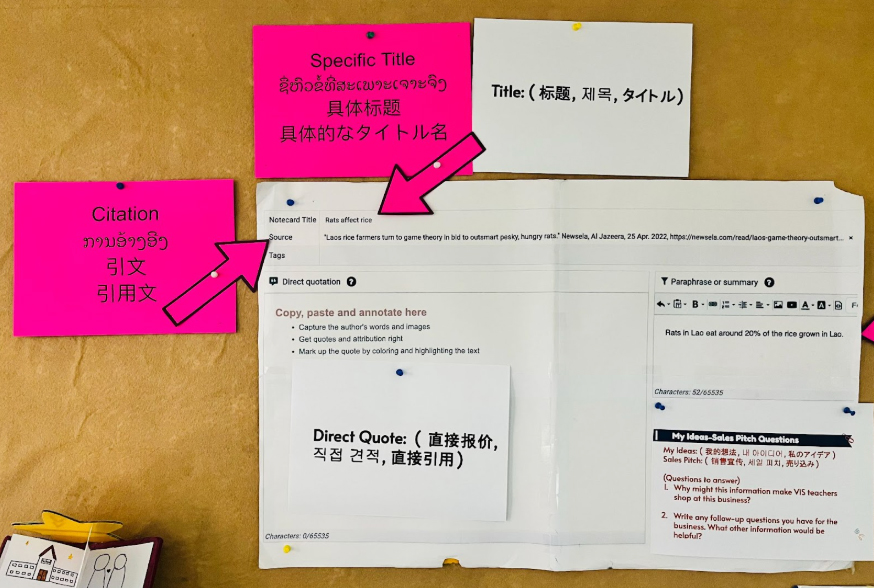
4. Translanguaging journals. In these journals, students use both English and their home language to explain how their understanding of a topic is changing. They also connect what they are learning to their home lives, experiences, and cultures.
For example, in my grade 11 English Language Acquisition class, students studied rites of passage like graduation and marriage, comparing how these milestones look across the globe. In their translanguaging journals, students wrote about what each rite of passage looks like in their home country, using all the languages at their disposal. The informality of the journal means that there isn’t pressure to spell everything perfectly; the emphasis is on students getting their ideas down in whatever way they can.
5. Family language integration. You can signal to parents that their languages are valued in many different ways. You can send emails out in the families’ home languages (using translation tools), with the English translation below. You can post signs around your campus in more than one language. Your school library can include books in multiple languages, and when you celebrate events like “World Read Aloud Day,” you can invite families to come in and read to kids in any language.
BUILDING LANGUAGE SAFE CLASSROOMS
Translanguaging improves access, belonging, and learning. When multiple languages are visible in a school, multilingual students and their families feel seen, valued, and welcomed. Translanguaging is a bridge between languages and cultures, and a way to ensure that all members of our school communities feel included.
Subtle shifts in practice can make a huge difference in how our multilingual learners feel and help schools move beyond the monolingual bias.