
How to Stay Organized as a Special Education Teacher
Rolling carts, file folders, QR codes, and a little bit of weekly upkeep make a huge difference.
Your content has been saved!
Go to My Saved Content.Special education and intervention teachers often provide academic instruction for multiple general education classrooms. During a single school year, I’ve supported three grade levels and worked with 10 general education teachers (that’s 10 different classrooms!) as well as seven paraeducators.
In specialized academic instruction, multiple schedules run simultaneously. Each type of instructional support has its own scope, sequence, and materials. In order for individualized education programs (IEPs) to be successful, all staff have to work in tandem. Clearly, strong organizational skills are a must.
When I began my teaching career, I tried out a variety of organizational methods. I printed my materials but sometimes forgot where I placed them. Other times, I handed my staff the activities and resources they needed, but I didn’t know where the finalized work samples would end up; mostly, I hoped they’d eventually land on my desk. Paraeducators constantly asked me what to do next, which did not lead to proactive, consistent planning. I often couldn’t remember whether a lesson had already been taught, and I questioned whether the instructions I gave to staff could have been organized better.
Something needed to change. I developed a system that I still use today, which has proven to be extremely effective.
Materials and Assembly
Below are the materials I’d recommend for special education teachers, as well as directions for assembling an organizational system.
Materials
- Multipocket file folders: I suggest pairing folder colors with specific subjects. For each class where I provide academic instruction, I use a black folder for math lessons and a purple folder for English language arts lessons. In other words, when I worked with 10 general education teachers, I had 10 black folders and 10 purple folders.
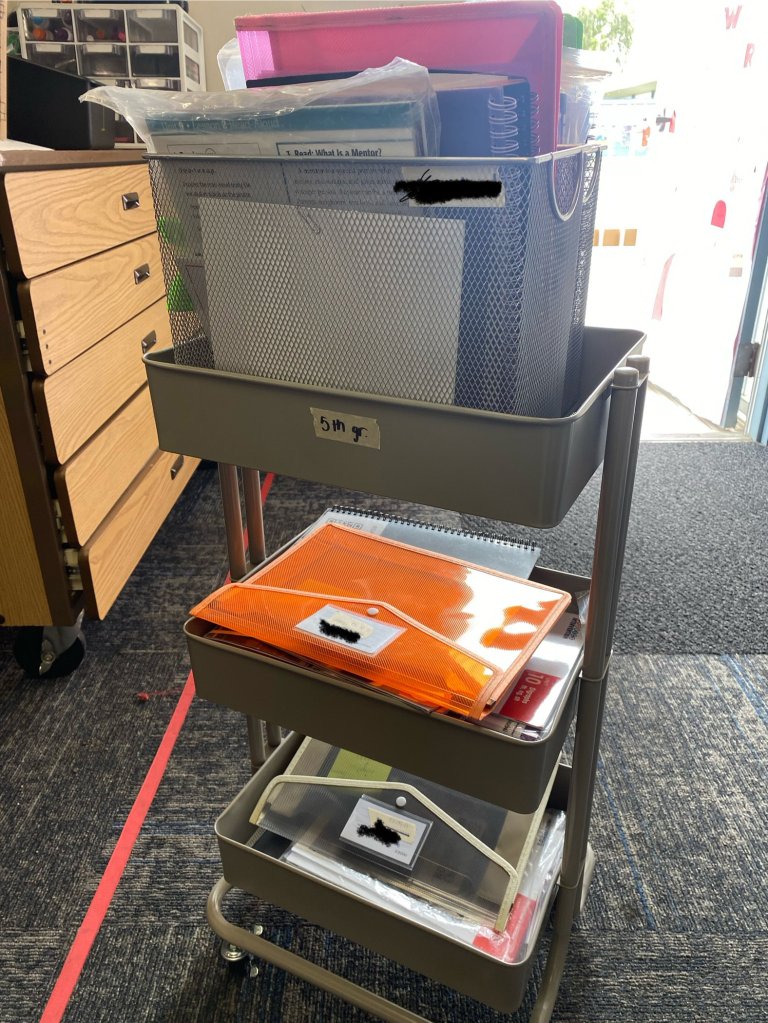
- Three-tier rolling carts: I use one cart for four to six classes. I keep all of the carts in my resource classroom, lined up against a designated wall. This provides consistency—I know where the materials can be located—and also accessibility when I’m lesson-planning and rotating the material.
- One basket per class
- Masking tape roll
- Permanent marker
Assembly
- Ensure that you have a set of folders for each general education class you support.
- Label each folder with the general education teacher’s last name, the grade level, and the subject.
- Label each basket with the general education teacher’s name.
- Label each cart with a grade level.
- Place the baskets on each level of the three-tiered cart. Depending on the amount of materials, you may need to dedicate an entire tiered level to one class. Make sure the baskets correspond to the correct grade-level cart.
- Place the corresponding folders into each basket.
Setting up the Subject Folders
In each subject folder, special education teachers place the learning materials that need to be distributed to students, as well as graphic organizers, scratch paper, anchor charts, and other tools that allow for differentiation. This setup helps paraeducator staff gain a better sense of how much work students are expected to complete during their allotted time. I personally gauge my students’ learning progress based on how much work I see in their folders and adjust as needed.
At the beginning of the school year, as I’m setting up my folders, I create a QR code that links to a series of videos covering the math topics we’ll be teaching. I then add the QR code in the corner of each folder. The QR code serves as an additional opportunity for staff to review the materials at their leisure, and it further reduces clutter.
When students finish their work, they are instructed to place it back in the designated folder. The folder is later placed in the respective general education teacher’s basket. This structure allows special education teachers to gather data from student work samples.
Why This Organizational Strategy Works
Primarily, this organizational system is a highly effective way to communicate with my team.
I teach my paraeducator staff that when it’s their turn to provide specialized academic instruction in a general education classroom, all they have to do is locate the grade and teacher name, then grab the folder for the corresponding subject. When paraeducators are done teaching, they return it to the same basket. When my paraeducators are asked about this system, they can confidently explain it to administration or new coworkers. Paraeducators can tell me when something is missing or if they need additional materials. And when I’m absent, paraeducators can still run their specialized academic instruction schedules and know how to find what they need.
My colleagues like the consistency that the system provides. It’s also generalizable and can be implemented at different schools. (I know as much from personal experience!) It does take some time to prep and put these folders together—I’d estimate one day of setup for the school year, and an hour or two of upkeep every week to rotate in new materials—but the payoff is worth it. The rest of the week, and the remainder of the school year, are much, much smoother for everyone involved.