
Exploring the Dangers of Technology Through Literature
E.M. Forster’s short story ‘The Machine Stops’ can help middle school students assess the impact of over-reliance on digital tools.
Your content has been saved!
Go to My Saved Content.We understand technology as any device created to make humans’ experience with their environment easier. E. M. Forster was a writer who considered what the future could look like with continually advancing technology. His dystopian tale, “The Machine Stops,” written over 100 years ago in 1909, asks young, impressionable minds to think twice about what is lost when, thanks to technology, everyday tasks are made too easy.
Supporting Understanding with Background Information
“The Machine Stops” is a wonderful text for secondary students. I recently included it in a middle school short story unit. The text centers around a futuristic society where all people live in underground pods. Human interaction with others and their environment has ceased, and the Machine (capital M) provides everything people need through tubes attached to each pod.
Characters communicate in ways that eerily resemble today’s video calls, phone notifications, social media shorts, and more. The text is dense. To support initial buy-in, I provided a brief review of the science-fiction and dystopian genres. My students knew that the story would address a human response to a societal “fix” gone too far, and how the plot would develop.
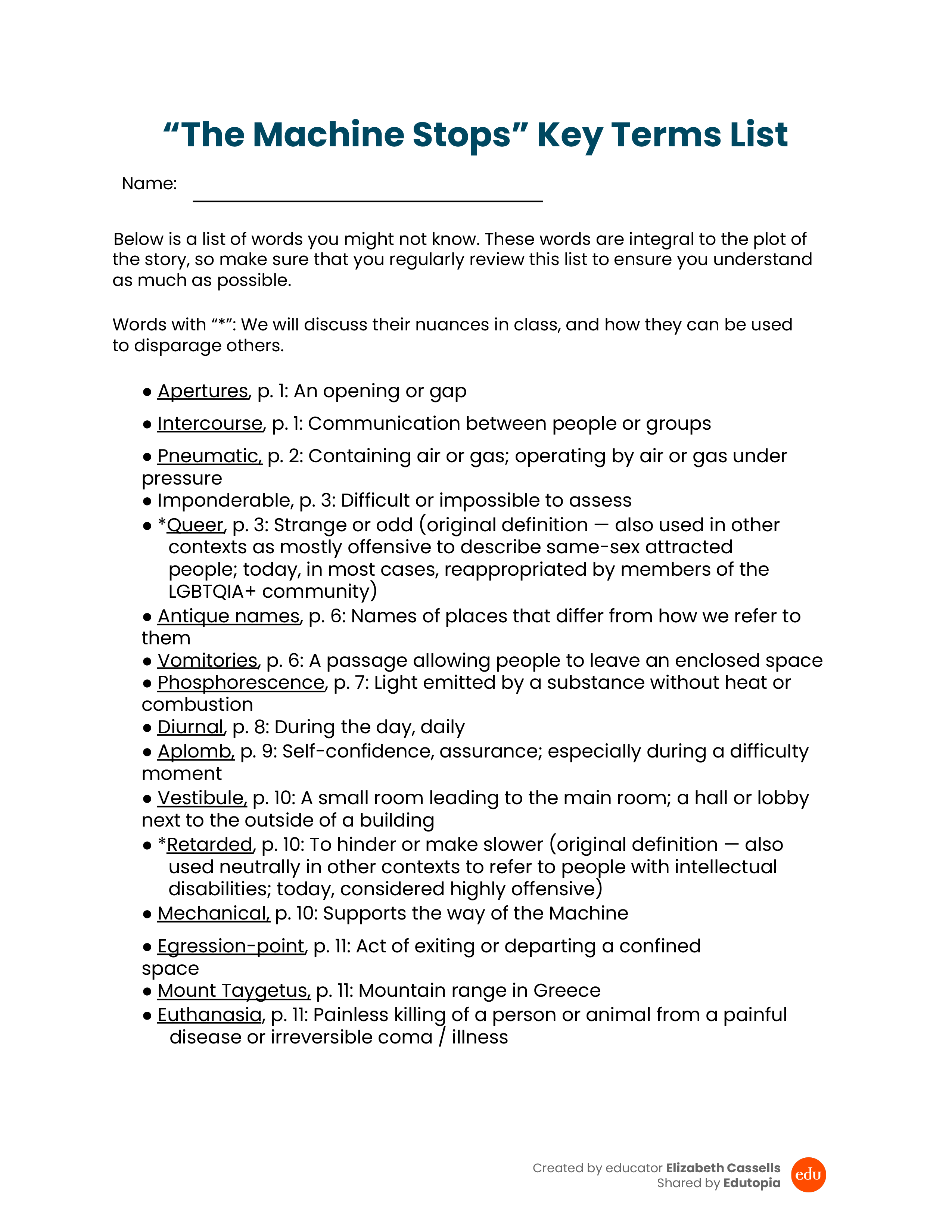
To support their understanding of plot development, we reviewed literary devices that often complement these genres: foreshadowing, mood, and figurative language. There are also many words in the text that aren’t currently used in our everyday lexicon. I underlined aplomb, vestibule, sedulous, petulance, and more, and defined them on a handout that I stapled to the back of the story. I also alerted my students that the words retarded and queer are in the story. I reviewed the origins of their meaning and how their context changed over time, as well as their use as slurs.
Merriam-Webster transparently defines both words and describes their etymology, including how they are used as slurs. When discussing the story, we decided to not say these words out of respect for how negatively they can be used today. Also, since this was a short story unit, I tasked my students with identifying some of its features (character traits, setting, text-to-self connections, internal and external conflict) early on.
“The Machine Stops” eerily connects to many features of modern, smart-based technology. Within the first pages of the story, my students quickly made text-to-self and -world connections that made the story resonate with them; I was also prepared to call them out in case they were overlooked. We spent most of our time considering instant gratification, news delivery, and connections to nature.
Exploring Instant Gratification
An obvious real-world connection to the story is the presence of quick delivery and streaming services. We regularly receive desired products within a few days or even an hour. This is convenient, but it has increased our discomfort with slow service. In “The Machine Stops,” the protagonist Vashti is easily agitated by having to wait. She repeatedly expresses this: “Be quick… I am in the dark wasting my time” and “I get no ideas” and “I have not the time.”
Vashti’s impatience is fueled by the conveniences available in the pods: “There were buttons and switches everywhere…for food, for music, for clothing… And there were of course the buttons [to communicate] with her friends. The room, though it contained nothing, was in touch with all that she cared for in the world.” In recent years, researchers have observed an agitation similar to Vashti’s. We read excerpts from “Instant Gratification & Its Dark Side.” Thereafter, students worked in small groups to complete a graphic organizer and brainstormed ways that, as the article states, “faster is better” in the story and our own world. They also reflected on the drawbacks of instant gratification and the ways it personally impacts them.
Inspecting News Delivery
Similar to today’s reliance on instant services, people in the U.S. are now increasingly comfortable and reliant on bite-sized news reports common on social media sites. Forster hauntingly describes this impending phenomenon in 1909: “Beware of first-hand ideas!... Let your ideas be second-hand, and if possible, tenth-hand, for then they will be far removed from that disturbing element—direct observation.” In the story, people don’t acquire knowledge by reviewing first-hand, primary sources or taking in multiple secondary sources, to support one’s own understanding.
Similar to the truncated forms of news sharing in “The Machine Stops,” news stories on social media are increasingly people’s primary form of news-getting. While social media allows for myriad perspectives in one platform that a typical report might not be able to cover, it has also permitted misinformation, unverified, to spread, via attractive reels that rely on sensational scripts for views. The problem with relying on minutes- or seconds-long accounts of contemporary or historical events (think YouTube, TikTok, Instagram) are their heavy reliance on cutting down a story to maintain viewer interest and understanding. There’s always a chance for curatorial choices that are sensational and biased.
To cement this fact, I provided excerpts from “The Perils of Drawing Conclusions from Second-Hand Accounts and Decontextualized Social Media Clips.” As a do-now, students read the excerpts, then responded on sticky notes to the prompt, What information can be lost in social media clips? Since most of my students were familiar with the terms misinformation and deep fakes, having them consider what was missing from their understanding could help them navigate future breaking news.
Considering Connections to Nature
The most compelling connection of the story for my students was the characters’ disconnection from the natural world. Vashti, the main character, was “seized with the terrors of direct experience.” She was entirely reliant on the Machine creating artificial replacements of everything that humans once naturally enjoyed in their environment: “Humanity, in its desire for comfort, had over-reached itself. It had exploited the riches of nature too far.”
For supplemental reading, my students examined passages from “Growing Together: UCA Professor Learns Art of Homesteading,” about a couple who, after experiencing food contamination at their local supermarket, upended their urban lives to cultivate a multi-acre homestead that could be entirely self-sufficient. Ironically, the couple’s learning is bolstered by fellow homesteaders’ YouTube videos. At the end of the story, my students tried to understand how society can utilize technology without becoming reliant on it, as well as maintain a connection to the natural world.
To conclude this unit on short stories, my students wrote their own. With a five-page limit, they worked their way through the writing cycle, replete with peer review of brainstorms and story arcs. After completing their first draft, my students revised their stories and found places to add in more figurative language and detail using our mentor texts and the acronym IADD (inner thinking, action, description, dialogue). I was pleased to see that a third of them wrote about the dangers of over-reliance on technology in society.