Lesson 1: How to Draw in 2-D and 3-D
Teach your students how to sketch polygons and objects in perspective.
Download Lesson 1 (68KB)
Math and art comingle in this first lesson, which gets students to think about shapes and objects from different perspectives. The information here prepares students for sketching and graphically rendering golf holes in future lessons.
Before beginning this lesson, define the project's goals. Will students build a playable mini-golf course from their designs? If so, when and where? Or will students just learn basic techniques? Be sure to discuss with students the project's agenda, keeping an open communication channel throughout the curriculum.
Lesson Objectives and Materials
Objectives
- To define and recognize a variety of polygons
- To represent the same shape in two and three dimensions in order to practice three-point-perspective drawing
Materials:
- graph paper
- protractors
- pens and pencils
- rulers
- objects or graphics representing different polygons
Engaging Students
Get your students interested in the lesson by asking them for the following information:
- Ask for definitions and examples of 2-D, 3-D, orthographic drawing, polygons, and perspective. (See the glossary for definitions.)
- Ask them to find specific polygons in the classroom or in their lives -- for example, a stop sign or the chalkboard.
- Ask for examples of movie studios that make films primarily in 2-D (Disney's older films) and primarily in 3-D (Pixar).
Project Application: 2-D Drawing
Ask students to draw a rectangle and another polygon of their choice in 2-D -- first in freehand and then using a ruler and graph paper. Here are some tips for practicing certain skills:
- To practice perimeter and area, assign students lengths and widths for the rectangle.
- To practice calculation, try changing the measurements.
- To practice estimation, convert from standard measurement to metric measurement and back again.
- To help struggling students, have them practice drawing a polygon until they're more comfortable using a pencil, a ruler, and graph paper.
Project Application: 3-D Perspective Drawing
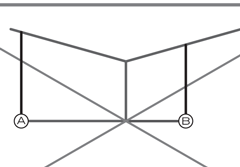
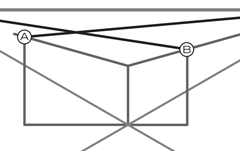
Perspective drawing requires finding the vanishing point and drawing rays that extend from that point. Get your students to draw a 3-D rectangle in perspective by asking them to follow these steps:
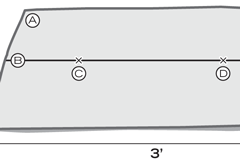
1. Using a piece of 2- by 3-foot blank paper or graph paper (A) oriented horizontally (landscape style), draw a line that bisects the paper from left to right (B). This is the horizon line.
2. Make a small x toward the left end (C) of the horizon line and another toward the right end (D). These are the vanishing points, the two points to which all visual lines lead.
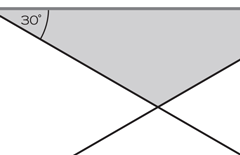
3. Use a protractor (or estimate) to draw a 30-degree angle at each vanishing point, extending the rays of the angle toward the bottom of the paper until they meet to create a large isosceles triangle.
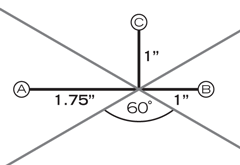
4. Form the base of a 3-D rectangle by drawing a dark 1.75-inch horizontal line from the bottom point of the triangle to the left. Then draw a dark 1-inch line from the bottom point of the triangle to the right.
5. Draw a 1-inch vertical line from the bottom point of the triangle up.
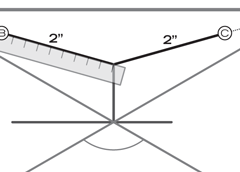
6. Draw a 2-inch line extending from the top of the vertical line to the left vanishing point (where the student put the first x on the horizon line). The line should not connect to the x. Repeat for the right vanishing point.
7. Draw a vertical line that connects the left edge of the bottom line (the base of the rectangle) to the left edge of new line you created in step 6. Repeat for the right edge.
8. Complete the 3-D rectangle by drawing a line from the top of the right vertical line to the left vanishing point. Then repeat the process by connecting the left vertical line to the right vanishing point.
If students are having trouble creating the rectangle, ask them to repeat the exercise, and help them when needed. Students who feel comfortable with the exercise can repeat it using different polygons.
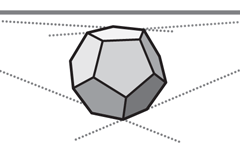
If some students come to class with drawing skills, ask them to freehand simple 3-D shapes (for example, a shoe box, a brick, dice, a cup, a chair, a table).
Project Application: Introduction to Orthography
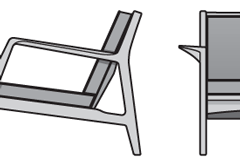
Help your students visualize objects from the three views of orthographic drawings: plan, side, and front. You will further develop orthographic drawings in Lesson 4. Here are some pointers to whet your students' orthographic appetite:
- Ask students how many ways they think they can draw their polygon.
- Form groups, and ask each group to look at the same complex item (a chair, a bike, or a backpack) from a different viewpoint -- one group from top down (the plan view), another group from the side (the side view), and another group in front of the object (the front view). Discuss what students do and don't see from each angle.
- Explain what each view means and its relationship to orthographic drawing.
- Ask students why architects create multiple illustrations of a building in different perspectives. How do multiple designs help in planning the building? Why is this important to investors and in the construction process?
Student Assessment
At the end of this lesson, you should have a good idea of each student's understanding and skill level with polygons, drawing in perspective, and the other concepts covered. Here are some guiding points to help assess each student.
The student's mastery of the subject matter is
- excellent: Students can differentiate between true polygons and other shapes and represent them accurately (2-D and 3-D are correctly drawn) and with a sense of composition.
- good: Students can differentiate between true polygons and other shapes and represent them accurately.
- fair: Students often spot polygons but mislabel some shapes; drawings are inaccurate or lack the depth of three dimensions.
- Poor: Students do not differentiate between polygons and other shapes; 3-D drawings look 2-D.
Vocabulary
We use these terms throughout this and other Build SF lessons:
- Polygon: A closed shape with three or more sides, such as a triangle, a square, or a pentagon.
- 2-D: A description of an object that has only two dimensions, usually just length and width.
- 3-D: A description of an object that has three dimensions, usually length, width, and height.
- Orthographic drawings: A series of related drawings from multiple viewpoints (usually top, side, and front) that show a 3-D object in two dimensions.
- Perspective: A method of seeing and drawing that allows artists to represent 3-D scenes in two dimensions.
Key Points
Review the following concepts before beginning this lesson:
- Geometry
- Orthography
- Perspective drawing