Technology Integration Professional Development Guide

An overview of the Edutopia professional development guide for integrating technology tools in the classroom.

An overview of the Edutopia professional development guide for integrating technology tools in the classroom.

Edutopia.org's Technology Integration professional development guide is meant for use either after completion of the Project-Based Learning Guide or with participants who are familiar with project-based learning. The guide is designed for a two- to three-hour class or session. It can be used in conjunction with trainings on technology used in classroom settings.

Part one is a guided process, designed to give participants a brief introduction to technology integration. It answers the questions "Why is technology integration important?" and "What is technology integration?"
Technology Integration Teaching Module

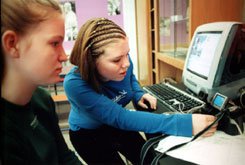
Students prepare a day ahead for Ben Franklin Broadcast News by downloading images to be used as backdrops for the credits.

Credit: Kathleen Duxbury

The Resources for Tech Integration page includes a PowerPoint presentation (including presenter notes), which can be shown directly from the website or downloaded for use as a stand-alone slide show, and sample session schedules. You will also find recommended websites, books, and additional videos to learn more about technology integration in this section.

This guide was designed to address many of the National Educational Technology Standards (NETS), established by the International Society for Technology in Education (ISTE).

To find the specific standards for your state, visit this page at Education World that lists standards by academic subject and by state.

Continue to the next section of the guide, Why Do We Need to Integrate Technology?


Acknowledgments: This module was written by technology-integration specialist Marian Shaffner. The Foundation extends its thanks to the following people who reviewed this module for content and usability: Peggy Benton, PhD, professor, former PT3 grant director and adviser, Department of Instructional Technologies, San Francisco State University, San Francisco, California; Patsy Lanclos, Apple Distinguished Educator, Smithsonian Laureate, Palm Education training coordinator/provider, Houston, Texas; Mimi Bisson, PT3 grant technology trainer, Department of Instructional Technologies, San Francisco State University, San Francisco, California; Elaine Wrenn, technology coordinator, Echo Horizon School, Culver City, California.

This article originally published on 11/5/2007

see more see less

Comments (40)

Comment RSS
Professor Emeritus, Literacy Education/Cognitive Psychology

Professional Teaching for Scaffold & Self-Directed Learning, & a

Was this helpful?
0

If you are a teacher one of your major questions is HOW to scaffold instruction and accommodate ELL & struggling students’ literacy development in a heterogeneously grouped classroom. Here are three methods that will help you do so while smartly advancing Content and Concept learning as well as knowledge seeking Inquiry skills: the Listen-Read-Discuss Heuristic; the ReQuest Procedure; and Enabling Questions. Each can be found at: http://teacherprofessoraccountability.ning.com/main/invitation/new?xg_so... And…http://bestmethodsofinstruction.com/ [If you are up to buying an even more inclusive book consider: Manzo/Manzo/Thomas (2009) Content Area Literacy…(5th ed.) Wiley Publishers.]
Should you be ready for an authentic 21st Century, “Community of Learners” project aimed at advancing the prestige & practices of Professional Education just indicate your interest when you go to the above teacher/professor accountability site or by email (below). Our first goal is to create a transparent electronic book addressing the means by which Best Instructional Practices would be identified and containing examples of exemplary & promising teaching methods in progress (innovation must always be welcomed). Currently it does not seem to be in anyone’s interests to seriously cull a core of Best Practices from the thousands of articles and books published in the last 5o years. There is no other respected profession that has failed to undertake the arduous but inexpensive labor of crafting a core curriculum of Best Practices. Strictly speaking it is illogical to hold teachers accountable for student learning until the larger profession has identified a menu of specific Best Practices, the current system of teachers and professors self-selecting methods to match “generic standards” is analogous to self-selecting the best stocks and bonds from the thousands available for one’s retirement account.
LiteracyMan
avmanzo@aol.com

Away with the chalk and talk

Was this helpful?
0

Away with the chalk and talk method of teaching. Technology is the way in which the world has been evolving. With technology, students become more motivated to learn. Children love variations. Which child wants to be lectured to at all time if any at all. With Computer Aided Instructions, students of different levels can be catered for in a more dynamic way. With the use of computers, students creativity is also enhanced. They can also learn at their own pace.

Debbie Mayer (not verified)

You are right - got any ideas

Was this helpful?
0

You are right - got any ideas how schools can afford more technology?

Debbie Mayer (not verified)

I totally agree with you!

Was this helpful?
0

I totally agree with you! Schools are just not able to keep up with the tech needs of students today - and of course, it is difficult for staff to, also!

Debbie Mayer (not verified)

I teach primary-age children

Was this helpful?
0

I teach primary-age children and still totally agree with you that more innovation is needed in the application of technology to education. Young children need movement and thus, I love the idea of an educational Wii!

Tammy (not verified)

This is an exciting aspect of

Was this helpful?
0

This is an exciting aspect of technology integration. Students who need support/extension can access this information in their classrooms, work at their own pace and move toward becoming more independent learners.

Gloria Pearce (not verified)

Technology applications

Was this helpful?
0

I agree with your comment Kirk. Have you taken a look at the web site Math-Kitecture?
http://www.math-kitecture.com/
It is an older web site but still very good and a good example of what you are talking about. I would also like to refer you to Achieve3000. I was retired and asked to work for them as the product is amazing. I have been waiting for it for a long time. It is a web-based, fully differentiated instructional tool that improves students' reading comprehension levels (specifically for non-fiction material), develops reading vocabulary, and improves writing skills. Take a look at KidBiz3000 for grades 2-5 and TeenBiz3000 for grades 6-8 and 9-12 at www.achieve3000.com.

Sue Colbeth Almendinger (not verified)

Math

Was this helpful?
0

My students in grades 7 and 8 are busy exploring sites to help a third and fourth grade group of students learn their multiplication/ division facts. I think I have gained resources from them as well. They have set up games and practice activities in such a short time with the use of their computers.

Dr. Kirk Harlow (not verified)

Technology applications

Was this helpful?
0

What I don't understand is why we haven't been far more innovative in the application of technology to education. There are many, many competencies that I can think of that could be developed more effectively by applying the technology used for computer games such as the Wii. We seemed to assume that technology should be an adjunctive to classroom education rather than an alternative freeing teachers up to do more interpersonal elements of education, as well as to focus on critical thinking. Fifteen years ago we developed an interactive instructional module on cost accounting and cost-benefit analysis in authorware that enabled students to learn the concepts by interacting and developing models through input. I can't even begin to imagine the possibilities if we applied today's technology. What better way to teach geometry principles than to have a young person design a building or bridge using design software that teaches concepts related to area, shape, etc. Ask any student why he doesn't like math, and the primary reasons will be that it is boring and that they'll never have to use it. Computer based training is common in industry, but we have hardly touched the surface in education.

Debbie (not verified)

technology help??

Was this helpful?
0

My Preschool classes are learning about Brazil and the Tropical Rainforest...it has been so much fun and the children are really intrigued by the information they are learning. I am thrilled that the children are asking questions about how to help save the Rainforest and the animals and plants that are found there....I would love to make a podcast or some sort of video with them stating facts they have learned and ways others can help out too....the issue is I don't know how to go about it with technology...any suggestions or ideas for us????

Thank you!!!

see more see less