What Works in Public Education
You are not authorized to post comments.

Truth and Consequences: Teaching Global Warming Doesn't Have to Spell 'Doom'

Turn fear to hope and action when discussing climate change with the next generation.

by Kevin Sweeney

Print Forward Share Comments(21) Comment RSS
Truth and Consequences
Credit: Indigo Flores

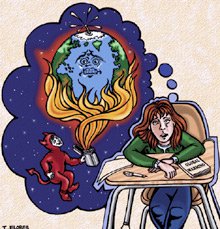
Last April, while chaperoning my daughter's field trip, I mentioned to a fellow parent that I was going to visit Ms. Jackson's class to talk about climate change. Another parent, not involved in our conversation, gasped and lunged toward us. "You're not going to talk to the class about climate change," she said. "They'll be petrified!"

On the day I spoke to the class, I arrived early, during recess. Two students were inside, sitting at computer terminals, and when Ms. Jackson reminded them of my topic, they both gave exaggerated negative looks that begged an explanation. They responded with the same message: Climate change is scary, and we don't want to be scared.

Both incidents were reminders that a conversation about climate change is often, really, a conversation about fear. And, to be clear, there is reason for fear. James Hansen, America's leading climate scientist, says if we continue with business as usual, half the species that exist today will be extinct at the century's end. It would be a heartbreaking saga, played out in slow motion during the lifetime of today's fifth graders.

Go Green Database

Click here for green educational resources

Related Green Articles:

Species loss is only part of the story. I spent most of last year working with eleven retired three- and four-star admirals and generals on a report assessing the national-security implications of climate change. (That work, incidentally, is what led to my invitation to talk with the students.) Their report suggested that water and food shortages, combined with violent weather events, could lead to massive upheavals and instigate conflicts in every global region. These were grown men, all of them battle tested, and they found the news about climate change to be very scary indeed.

What, then, does one say to fifth graders?

Lacking confidence that I might know this on my own, I asked a dozen friends for advice. Their responses brought focus to the one-hour classroom discussion.

One friend said to be honest but selective: Admit that the challenge is great, give them one or two examples of consequences, and focus on good things that are happening. This was helpful. The honesty built trust with the students, and talk of political momentum lightened the discussion.

Another friend suggested I give them something easy to do, something a bit more difficult, and something very challenging for "homework." This helped engage kids at different levels. For an easy task, I asked them to replace one incandescent lightbulb with a fluorescent one. For a midrange task, I suggested putting up a clothesline in the backyard and hanging out clothes to dry.

For the stretch, I suggested they talk to their parents about dissecting their family's energy bills, comparing next month's bill with the same month last year. If their energy usage and costs went down, perhaps they could split the difference with their parents. This way, it becomes a business for the student, who now has a financial incentive to turn off the lights, unplug the appliances, and find new ways to save energy.

The follow-up essays, assigned by the teacher, Ms. Jackson, showed that the clothesline idea clearly resonated with the students. In class, we had talked about how clothes, sheets, and towels feel different when line dried. The students liked the notion that giving up something (the convenience of a dryer) could also mean they get something (energy savings).

The best advice from friends was to focus less on the details and more on a framework. As the science of climate change gets better, the news gets worse. This generation of children needs a way to process these news accounts; without it, there is every reason to believe they might shut down emotionally or lose themselves in avoidance tactics.

Here, I made a quick point about bad news: It generally assumes we will continue with business as usual, doing nothing about the causes of climate change. That, of course, may not always be so, and these kids themselves can help bring about change. (See "A Climate of Hope.")

The bigger point was to consider what one might say of their generation seventy years from now. I talked of their destiny, at least as I see it, saying that their generation will be the one to develop solutions and help us understand how to live in a changing world. They would do so, in part, because they must. We talked of what it might feel like to be part of such a cause, or to know that their generation and their country would be leading an effort to help protect the planet.

This idea, too, was a focus of the student essays. They liked that they might be part of a movement, and that they might be called to do something great or heroic, that responding to this challenge might give their lives greater meaning. Their words were a reminder of a vital lesson -- one I need to review often: Climate change discussions may start with a sense of fear, but we can, and must, move them toward a sense of hope.

Truth and Consequences
Credit: Indigo Flores
Kevin Sweeney is a management consultant whose practice focuses on climate-change issues and corporate social responsibility.

This article was also published in the October 2007 issue of Edutopia magazine .

Advertisement

@edutopia on Twitter Edutopia on Facebook RSS feed link

Advertisement

0
was this helpful?
Bryan Wilkins
Posted on 10/03/2007 1:09pm

Climate Change

Avoid the "Chicken Little" syndrome when talking about climate change. Computer models can't fully describe yesterday's weather much less that of 10 to 20 years from now. Very complicated issue this weather and climate stuff. Did anybody consider the Sun may have something to do with the climate?? Don't hear much about that. Why?? Hmmm.

0
was this helpful?
Anonymous
Posted on 10/03/2007 1:59pm

It is interesting to speak to students about climate change. I teach junior and senior high and most students have already been exposed to the topic and sometimes will bring it up before I get a chance to bring it up. Many students will ask me if I believe it is a true eventuality. They seem to be trying to find a way to dismiss the information. I also feel as though they feel as though the adults have screwed-up everything and they are inheriting huge problems.

0
was this helpful?
Heather Beusse
Posted on 10/03/2007 3:45pm

Encourage Joy & Hopefulness to Teach Kids about the Environment

I want to thank Kevin for this insightful, creative and constructive response to teaching younger students about climate change. I agree that climate change is a serious issue but that it should be approached carefully with younger children. Non-profit GLOBIO, in collaboration with Ranger Rick magazine, develops free online educational resources and learning activities that encourage joy and hopefulness in young children on topics concerning nature and the environment. We have guidelines that ensure that our children’s programs are positive, encouraging, and sensitive to our audience. Rather than imposing our values on children, we encourage kids to find their own values through our leadership, support, and example.

Similar to Kevin’s articles, GLOBIO’s website, Glossopedia, in tandem with Ranger Rick stories work from the understanding that that while children mostly want to have fun, they are also eager to learn about all the things around them, and many are especially interested in animals. Thus we encourage children to learn and appreciate nature and biodiversity and to develop positive attitudes and behavior toward the natural world at their own paces and in ways that are most gratifying to them.

Rather than dwell on complex environmental problems that we know children will not adequately understand or that will sadden, frustrate, or discourage them, both Glossopedia and Ranger Rick focus children on opportunities for action that promise success — opportunities that they can meaningfully participate in. We also help them feel hopeful by showing them examples of people who are working to solve these problems.

Kevin’s article offers excellent ideas for how to approach climate change with younger students and a variety of positive activities for students to apply their learning. For additional ideas and educational resources, look for the Glossopedia article on climate change coming this fall (www.globio.org) or check out National Wildlife Federation’s climate change page.

0
was this helpful?
Anonymous
Posted on 10/03/2007 3:54pm

one of my favorite quotes

I remember hearing the Director of the Climate Trust quote his son in the weeks following a particularly bad hurricane season:

"Hurricanes, typhoons, thunder, and lightening - they're all pretty powerful forces of nature, aren't they Dad? Humans must be really doing something wrong if we're powerful enough to change the weather."

0
was this helpful?
Anonymous
Posted on 10/04/2007 8:44am

Because most people are smart!

0
was this helpful?
Ed Maibach
Posted on 10/04/2007 11:14am

Kevin Sweeney's classroom experience

Over the past 9 months, I too - for the first time in my life -- have found myself in front of middle school and high school aged students talking about climate change (as part of Al Gore's The Climate Project). The students have been hearteningly engaged in the content of my talks, and especially in what they can do. Like Kevin, I have been giving them a short list of recommended actions (although none quite as challenging as parsing the family's energy bill). The truly gratifying thing is that some of their parents have contacted me after the fact to let me know that their child acted on the recommendations...the most important of which is to call a "family meeting" to discuss what their family should be doing to become part of the solution.

0
was this helpful?
inel
Posted on 10/05/2007 9:35am

My generation needs to solve this now

You are a generation too late! Your penultimate paragraph says:

"The bigger point was to consider what one might say of their generation seventy years from now. I talked of their destiny, at least as I see it, saying that their generation will be the one to develop solutions and help us understand how to live in a changing world. They would do so, in part, because they must. We talked of what it might feel like to be part of such a cause, or to know that their generation and their country would be leading an effort to help protect the planet."

I agree with the advice to provide a framework to kids as well as suggesting a few specific actions to get them started. However, there is one point that needs to be repeated again and again:

this generation—my generation—our adult generation—is working as hard as we can to combat climate change.

If we are not, we need to tell kids why not. If we are too selfish, too lazy, or too busy to be bothered to be heroes ourselves, we should tell kids that too. We owe them our honesty.

If kids ask "How is your generation tackling climate change?" we need to tell them what we are doing at work and at home, and what all the adults we know are doing about it, and how many expert scientists are providing the information we need to understand the problem, and how many expert engineers are designing and producing solutions to combat climate change.

If kids ask "What are you doing about climate change yourself?" each adult should then be able to rattle off a list of ways in which he has reduced his own carbon footprint and that of his family. It is not good enough to tell children "Lucky you! Your generation will have all the excitement of dealing with our climate challenge." if we are not prepared to let them see how excited we are ourselves at the opportunities this new era affords.

If we cannot answer those questions honestly and explain how we have made a difference already by reducing our carbon footprints at home and at work, and how we intend to do more of the same, my generation of adults deserves the contempt of kids today.

0
was this helpful?
Mary
Posted on 10/05/2007 5:33pm

This is so important...

This is such an important topic to discuss with our kids, as well as with each other as adults. As mentioned in this article, these conversations must be done in a way that makes kids (and adults) feel empowered to do something. It's also just as important for the adults in this world to lead by example. As a 50 year old woman I am amazed every time I go to an alternative energy/climate change event and look at how many in attendance are young people in their 20's. Thank goodness for these young folks! Where are all the people in their 40's, 50's, 60's?
I taught middle school science and we investigated climate change. The kids were more than willing to learn the content and what they could do. They were proud to bring information home to their families and most families were proud to alter their energy consumption even if they did so in a small way. It feels good to do something that you feel is morally right.
As far as the Sun idea mentioned above..."What if you're wrong?" If we are saying that humans don't have an impact on our climate and we don't respond in any proactive way...what if we're wrong? The consequences of this error are too grave to gamble with. It's long past time to stop that dangerous thinking and start making the changes necessary so our kids and grandkids don't have to deal with our ignorance and avoidance.

0
was this helpful?
ktown realist
Posted on 10/09/2007 6:24pm

Mislead by poor science

The self centered focus of the majority of the inhabitants of planet earth is amazing. Perhaps we are polluting and being poor stewards of this wonderful planet on which we exist, which indeed calls for conservation action.

Yet, have we studied the relative temperatures on our fellow planets? If we can be so sure of our 'scientific' research of earth's temperature thousands of years ago, surely we can determine the relative increase or decrease of our fellow planets. Just maybe, it is true that our sun is responsible for this trend of increase.

I liken this to murder investigators who are so sure they know who the culprit is that they fail to consider other possibilities - including the true murderer.

After all, we still don't know what happened to the dinosaurs. And we weren't polluting the atmosphere then.

0
was this helpful?
Anonymous
Posted on 10/10/2007 12:21pm

Global Warming

I wish people would quit arguing about whether man is responsible for global warming or if it's even a reality. Regardless of the truth of either of those things, there are plenty of undisputed reasons for our country to have a crash program to promote conservation of resources and develop alternative enery--such as health problems, the dwindling of finite resources, the ever-increasing world population, increasing energy prices, and burgeoning demand for energy. This fall my elementary school organized an environmental team (with staff and students). We're starting with a recycling program and education about ways to cut down on waste, but we have harder goals in mind--such as persuading our district to quit using throw-away styrofoam trays (which will never decompose) in the cafeteria. I shudder to think of the number of them that go in our landfill each day, and our garbage bills have recently gone up substantially because we had to open a new landfill. Most people have no idea how many ways and to what extent each of us is negatively impacted by our wastefulness, consumption, and pollution.

Post a comment

(Sign in or create an account now, or after you post.)

Sign In

Thanks for your comment. It will be posted once you've signed in to your account. Please sign in here
Not yet a member of the Edutopia community? Create an Account

Create an Account

Almost there! As soon as your account is created, your new comment will be posted.
Mollom CAPTCHA (play audio CAPTCHA)
By creating an account, you agree to Edutopia's terms of use.