What Works in Public Education

Northern Lights: These Schools Literally Leave No Child Behind

In remote Alaska, an innovative district ditches grade levels -- and increases learning.

by Grace Rubenstein

Print Forward Share Comments(22) Comment RSS

What does it really mean to leave no child behind? The educators of Alaska's Chugach School District believe they have the answer.

Northern Lights

Night Vision:

The Aurora Borealis dances over the Chugach Mountains above Anchorage, the headquarters of the Chugach School District's reforms.

Credit: Veer

There are no grade levels in the rural district, which is based in Anchorage and serves tiny villages scattered throughout 22,000 square miles of remote areas of south central Alaska. Instead, each of its few hundred students tote around report cards as thick as history texts. Each packet details the individual student's progress through the district's more than 1,000 learning standards as they move from kindergarten to high school graduation.

AUDIO SLIDE SHOW: Jed and Nichole Palmer on Teaching for Mastery


Produced by Grace Rubenstein. Photography by Grace Rubenstein and Douglas Penn.

Ask any secondary school student, and he or she can tell you, for example, "I'm at level five in math, level seven in reading, level six in career development." Students mark up the packets to track how far they've come, turning each page into a hodgepodge of multicolored highlights and scribbles. Take a snapshot of all the students' report cards at any point,and each one will look different.

At the core of the Chugach model is this rule: To move to the next level, you must master the one that precedes it. There is no sitting in the back row and skating by. Every child must learn every subject at every level, passing with proficiency equivalent to at least 80 percent -- essentially, a B minus. And when they're done, they're done, whether that means they finish when they're sixteen or twenty-one.

"Time was the constant and learning was the variable -- that's the old model," says Roger Sampson, president of the Education Commission of the States, who led Chugach's transformation as district superintendent in the 1990s. "We switched. What's constant is learning. Time is the variable."

And Sampson says that switch, revolutionary as it may seem, can and should be made in every district, large or small, in Alaska and beyond.

AUDIO SLIDE SHOW: Jed and Nichole Palmer on Living in Tatitlek


Produced by Grace Rubenstein. Photography by Grace Rubenstein and Douglas Penn.

Uncommon Sense

Even as globalization and media propel our culture -- and our classrooms -- toward modes of production that are bigger, faster, and more alike, Chugach has refocused on an approach to education that is smaller, personalized, and variably paced. As Douglas Penn, the districtwide principal, explains, "Our kids graduate when they're ready. We're not pumping them out the door with D's on their diplomas."
This individualized pacing doesn't mean Chugach coddles its students. In fact, it places a great deal of responsibility on them. Teachers expect pupils to direct their own learning -- with guidance, of course -- and complete some of the district standards through projects they create and conduct. The older the kids get, the more leadership they must assume. An example of this ethos is the work of Jordan Geffe, who last spring wrote an essay on the healthiness of city life versus village life. He chose the assignment, topic, and argument (his thesis: Village life is healthier), and compiled evidence to back it up. In explaining the essay, Jordan opened his report card and pointed to exactly what he hoped to achieve: "Write a proficient composition that gives reasons."

At times, the demands can be "pretty upsetting," says Teresa Totemoff, a recent graduate of Tatitlek Community School, who recalls slacking off for a while and then realizing she had much work to do to graduate. "I remember crying, 'I don't want to do it no more!' But it was my own progress. I was proud of all I got done."

The Chugach schools arrived at their approach by way of disaster. In the early 1990s, the district had reached a crisis; its students could barely read, and graduates routinely failed to hold jobs or become productive members of their communities. The district had produced only a few college graduates in two decades. Alienation and mistrust divided the schools' staff from the communities they served. Superintendent Robert Crumley, a teacher at the time, recalls that staff talked about standing on a "burning platform" -- a foundation that could collapse at any moment.

Roger Sampson, a new arrival from Alaska's Kenai Peninsula, embarked on a complete overhaul by enlisting the support and input of both staff and the district's communities. Chugach serves 214 students. More than half are homeschooled, with district support; the others attend school in one of three communities carved out of the evergreens at the bases of mountains rising from Prince William Sound.
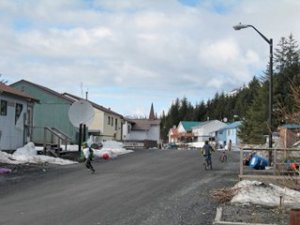
In Whittier, a former U.S. Army port, most of the 182 residents live in a high-rise building across the street from the school. Residents typically work at the cannery, at the small boat harbor, or in industries such as railroad, shipping, and tourism.

Northern Lights

Catching On:

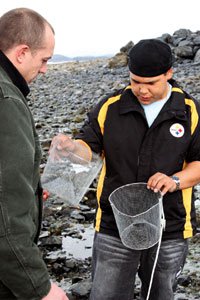
Jordan Geffe sets crab traps with teacher Jed Palmer for a science experiment.

Credit: Douglas Penn

The villages of Tatitlek and Chenega Bay, with populations of about 100 and 50 respectively, are accessible only by boat or charter plane. People here -- mostly members of the Native Alaskan Alutiiq tribe -- get by largely on government and tribal subsidies and their traditional practices of hunting, fishing, and berry picking. A handful of residents work on the trans-Alaska oil pipeline in nearby Valdez.

Native and mainstream American cultures collide in these two hamlets: A villager might go seal hunting during the day and then watch American Idol via satellite TV that night. Eagles glide over the houses while hip-hop music booms from open windows.

Over several years, Sampson and his colleagues repaired the schools' relationship with the villages and shifted to the standards-based system. In response to community concerns, they introduced standards in service learning; career development; personal, social, and health development; technology; and cultural awareness (particularly about Alutiiq culture). All of these subjects are required in different quantities for graduation, as are conventional studies in math, reading, writing, science, and social studies.

Teachers may assess students' skills through various means, including observation, projects, written work, performances, tests, and portfolios. In place of grades, students receive ratings of emerging, developing, proficient (the minimum required to pass), or advanced -- a nomenclature alumna Teresa Totemoff likes because "if you're developing, there's always room for improvement."

Video: Alutiiq Song and Dance

Lessons in the songs and dances of their own Alutiiq heritage count toward Chugach students' standards in cultural awareness.

Credit: Grace Rubenstein

Before the change, students felt school was disconnected from their real life, and the system as it stood obstructed teachers from assessing and providing for kids' individual needs. "Common sense had been weeded out of education," Crumley says, "so we tried to build a system that made common sense."

Sampson also trimmed back the administrative staff to help place more teachers in classrooms. There are now eight and a half teaching positions for the eighty-one students in Whittier, Tatitlek, and Chenega Bay. Principal Douglas Penn visits the sites regularly by charter plane.

Starting with the transformation, the staff made it standard practice to engage students in projects with real-world applications, such as research on the local effects of climate change. Educators see their role as preparing students not solely for college but also for work, military service, or myriad future endeavors. Above all, they want Chugach graduates to have choices.

Northern Lights

Quality Time:

Teacher Stephen Grajewski reads a student’s story with Jacob and Ayeisha Kompkoff.

Credit: Grace Rubenstein

Within four years, Chugach shot from the twentieth percentile in reading on the nationally normed California Achievement Test to the eightieth percentile. In 2001, the district won a Malcolm Baldrige National Quality Award -- the smallest organization and one of the first educational institutions to win. Nine other rural Alaska districts have adopted or are considering implementing models like Chugach's.

Now, more than 80 percent of Chugach students who took the state's third-grade and ninth-grade exams last year passed in reading, and more than 60 percent passed in math. Of the twenty-five graduates the district has tracked since 2001, fifteen are enrolled in college or have already graduated, five work full time, two are in the military, and two are stay-at-home moms. Chugach can legally fund enrollment for students until age twenty-one, though every student over eighteen counts against the graduation rate under the No Child Left Behind Act.

"It has made a big difference," says Pete Kompkoff, the tribal president in Chenega Bay. "Kids are doing more practical things than before. They're being exposed to the public more. It makes them realize that there's another world out there besides this isolated village, and everything they learn has to tie into that wilderness out there."

Way to Learn

Day to day, teachers weave independent learning time, direct instruction, and projects into a fluid matrix. One morning last April, Tatitlek lead teacher Jed Palmer took five students to a rocky tidal area to set traps for the nonnative green crab, arriving in Prince William Sound from points south in ships' ballasts.

Through Youth Area Watch (YAW), a district program funded by the Exxon Valdez Oil Spill Trustee Council, the students planned to count their catch and relay the information to local scientists studying the problem.

After the outing, Palmer returned to school to teach a higher-level math class, where eight or so students worked in books and on computers; he helped them individually as needed. Nineteen-year-old Margie Allen took a quiz on polygons, and Palmer scored it immediately: 90 percent. Allen, wearing the standard Tatitlek teen fashion ensemble of jeans and a baggy sweatshirt, was already halfway through the math book she had started two weeks earlier, determined to catch up after a five-month hiatus in Anchorage. ("I had to get out of here," she says. "It's too isolated.")

That afternoon, Palmer gave a lesson to all the older students on sedimentary, igneous, and metamorphic rocks. For conceptual lessons such as this, Chugach teachers typically give all kids the same instruction, then adjust the expectations for each one depending on his or her level. Palmer ended the day with time for students to work on their independent projects.

Besides these targeted lessons, teachers often weave multiple standards into larger thematic units that span content areas and levels. Two of the district's favorite such projects came from Chenega Bay, where husband-and-wife teaching team Stephen Grajewski and LeeAnn Galusha helped their students create books about two local staples, salmon and blueberries, including recipes, images, and stories about the foods' place in Alutiiq culture. All their students, from elementary school through high school age, contributed to the books, which sell in a museum shop, in a bookstore, and on the Alaska Marine Highway Ferry for $8.

Grajewski and Galusha like the standards-based system in part because it empowers kids to own their learning and gives them the opportunity for frequent, incremental successes. Reading comprehension, for instance, is not assessed as a single skill; it's broken into standards as minute as isolating the initial sounds in words and retelling a story from memory. Once a kid knows the material, Grajewski says, "you don't have to wait to move up. You can do it now."

"It's intuitive," says Galusha. "If you really think about it, this is how it should be done."

The standards-based system also gives students the flexibility to participate in online courses, outdoor projects such as YAW, and educational travel, which is supported by grants. Five or six times throughout their schooling, kids stay for three to ten days at Anchorage House, a district-owned home in the city, where they do job internships and learn to navigate the demands of urban life, a primer that eases students' often-rocky transition to college or work after graduation. If missing school meant they would fall behind their peers and fail their classes, they couldn't have these experiences.

One student who has capitalized on that flexibility is Chenega Bay's Ian Angaiak (grandson of tribal president Pete Kompkoff). He participated in YAW and Alaskan Scientists of the Future, another program that pairs students with scientists for inquiry-based learning, through which he traveled to Hawaii and learned methods to measure sun radiation and water salinity. Despite those continuity breaks, the sixteen-year-old will graduate a year early if he keeps his pace. (Principal Douglas Penn notes, however, that most early graduates stay with the district for advanced or college courses.)

Because he's ahead of most other Chenega Bay students, Angaiak does a lot of independent work, much of it from books, which he says gets boring. But, he adds, it's better than enduring what the other kids are learning, and better than his five years in Anchorage, where he remembers having more than thirty students in some classes. Here, he says, "you don't have to sit in a classroom with twenty students and just have the teacher talk to you." Angaiak adds that at his current school, students actually have to learn something to get by.

Scaling Up

The Chugach model presents challenges for participants. In 2002, the district introduced an electronic tracking system to help teachers monitor students' progress without drowning in paperwork. Ian Angaiak complains that there are an overwhelming number of standards and that some of the levels take too long to complete. (A revision of the standards will try to correct those obstacles.)

The demands on teacher expertise also are heavy: Jed Palmer points out that he is responsible for teaching ten subjects at four levels each, or the equivalent of forty classes. He has learned to feel more comfortable saying "I don't know" and recruiting students into the hunt for unknown information. His wife and fellow teacher, Nichole Palmer, says the system also requires a lot of self-motivation from kids -- a benefit for some, a struggle for others. She consistently pushes them, she says, but only the students themselves can decide how hard to work, what quality of work to produce, and how fast to progress.

Administrators don't pretend that the Chugach model is perfect, or that it would be ideal in every setting. "People think we've got the golden egg," says Superintendent Robert Crumley. "There is none. There is no magic recipe."

Still, the approach has proven itself, and district educators at all levels say it could work well or better in a larger school district. With more teachers, each one could specialize in certain content areas and levels, rather than trying to cover everything. The reform could be made with little or no change in state policies, Crumley says -- the only accommodation his district needed from the state government was a waiver from tracking Carnegie units, the measure of how much time a student spends studying each subject.

Although Chugach supplements its $5,380 per-pupil allocation with about $1 million per year in grants, the standards-based model does not hinge on finances, says Penn. It represents a change in thinking, he adds, "and it costs nothing to change your thinking."

Crumley has a caveat: "It cannot be done piecemeal." And, yes, it will be hard and frustrating to make such a big change, but education is hard and frustrating anyway, he says, so why not? "Instead of perpetuating a system where we try to force kids to fit, it's much more rewarding to do the hard work when you can see you're making a difference systematically, rather than just trying to put your finger in the dam," says Crumley.

Sampson calls this kind of reform an imperative. "We have to quit pumping kids through our system because they put the time in," he says. "We have to stop allowing teachers to use whatever criteria they want to give a kid a grade. We can't have your third graders all do page fourteen, because they're all over the map -- in any school."

The Chugach model demands a lot of its teachers and, consequently, the district gives them a lot of support. They get thirty days of professional development a year and have a say in what they want to learn. A set of detailed standards -- similar to those used for students -- spell out what is expected of teachers and how they will be assessed. Every year, all Chugach teachers receive an identical performance bonus ($11,000 each this year) based on the average of their evaluations -- a perk Penn says is designed to foster teamwork.

The result is a tight-knit, congenial staff (and not just the ones who are married to each other) focusing their daily efforts on individual needs. The Chugach schools are as different from their conventional, grade-based counterparts as tiny Chenega Bay is from downtown Anchorage -- and not simply because of size.

Penn sums it up with an anecdote from one of his visits to Whittier: He watched a teacher give an assignment. A new kid in town refused to do it, announcing, "I'm just going to take the zero." The boy's classmate leaned over to him and whispered, "Dude, it doesn't work that way here."

Go to "How to Get a Whole Community on Board for School Reform."

Grace Rubenstein is a senior producer at Edutopia.

This article was also published in the September 2007 issue of Edutopia magazine .

Advertisement

@edutopia on Twitter Edutopia on Facebook RSS feed link

Advertisement

0
was this helpful?
Michelle Sarabia, M.A.
Posted on 9/05/2007 5:49pm

Northern Lights article

BRAVO TO CHUGACH!!!! I've been hoping to see this happen! I am a special education teacher, and in my Resource program often watch kids great at math, science, art, etc. held back, treated like they're dumb, just because reading and writing is a challenge for them. In a model like this, whether they're reading at level 1 or level 5, they won't be judged so negatively because they can move ahead in their strengths. On the other hand, my Gifted program students wouldn't be held back by cookie-cutter programming in which they have to complete extremely mastered content paperwork just to fill in the teacher's gradebook.

I've been saying for a long time that rather than all the testing costs, stress, etc., just moving a passing grade to 80% would take care of things... YES!!!

I hope that this catches on everywhere.
WTG!!!

0
was this helpful?
Rich Morrow
Posted on 9/05/2007 7:39pm

Breaking down barriers

There some barriers that work to restrain many schools that need to be broken, and this article shows benefits and costs from busting through some of them.

One key barrier is the idea that students should be grouped according to when they were born, what I call the "nookie factor." There are much better ways to decide what a 12-year old should learn than to copy numbers off a birth certificate. Any school could choose to group students, particularly in math, based on what they are ready to learn, rather than on age.

Another restriction that should disappear is the idea that exactly 12 years of school is right for everyone. This limitation is tied into the idea that students need to pass or not pass a whole course in a year (or semester or quarter) and if they can't they need to repeat the whole course. When a student does poorly on the first two chapters of a sequential course, such a algebra, the class pushes on that student puts in seat time until the end. At the point the teacher either passes him on with low grades and poor preparation for what follows, or makes him repeat the entire sequence. In the meantime most of his peers (only those students with similar birth dates) move on.

Eliminating lock-step placement and advancement and allowing variable times to reach minor goals, give students more opportunity to succeed.

Any school could decide to eliminate or lower these walls.

0
was this helpful?
Anonymous
Posted on 9/06/2007 5:13am

I would love to teach in a system such as this one! Wow...individualized instruction, kids being able to move ahead at their own pace instead of waiting for the rest of the class to catch up, bright high school kids not being stuck in a malaise of "senioritis"...it would be amazing.

0
was this helpful?
Sharon Jubenville
Posted on 9/06/2007 10:13am

Chugach Model Drawbacks

While supervising student teachers here in rural Alaska, I have spent many hours in schools that are using the Chugach Model. The Model is outstanding and can work quite well anywhere. The problems arise not with the students but with the parents and teachers. Parents MUST be educated about the assessment system--why isn't their child getting an A or a B? Teachers also MUST be extremely well-educated about the standards and how they will be taught and achieved in an individualized manner; even project-based learning can be used effectively. Any district or school can make it work given the preparations necessary--hopefully many educators will take advantage of this enlightened model.

0
was this helpful?
Angus McIntosh
Posted on 9/10/2007 11:27am

Teach the kids, not the subject!!!

What a brilliantly simple concept...teaching the kids instead of teaching the subject! My school has dabbled in "ability grouping" over the past few years with varying success because we are stilled bound by birth year to certain extent! I think this a model such as could be the way of the future, as it is time to get rid of the old system that is tying the hands of real learning.

0
was this helpful?
Gerald Ardito
Posted on 9/14/2007 6:09am

Inspiring!

I was so inspired by this article, I just had to post about it on my blog.

I am left with so many questions, mainly around the topics, how could I make this work in my classroom? I cannot wait to work on this.

0
was this helpful?
Jorge
Posted on 9/30/2007 9:31pm

Wow, this program sounds very interesting! Where I teach I can't imagine what a huge deal it would be to take away grades and focus on something other than a test. So many of our students are focused on getting into a good college that they work very hard for the "A" and the high AP Exam score. Although this education system sounds great, I wonder what impact it would have on the students trying get into colleges and even if they do, how successful would they be competing with students who are used to the "time as a constant learning as the variable" system.

0
was this helpful?
Sarah
Posted on 10/02/2007 4:41pm

I can imagine this is a hard concept to change and get across to faculty and commuity. I am very interested in how the "grading system" works and what measures are taken to ensure students have reached a level correctly. I think it sounds facinating though. Do you also teach in a rural area like in the article?

0
was this helpful?
Joe Makley
Posted on 10/16/2007 12:19pm

School Change

To me, this kind of "credit" system is the obvious thing. I can't see any way to marry the "group pace" to standards. When experts say we must do away with "time in grade," this is what they are really proposing. There is room for different approaches, but the basic principles of Chugach are inherent in the notion of "standards for all." So many kids would benefit, if we would do more of this. And I don't think many would be hurt.

0
was this helpful?
Bob Crumley
Posted on 10/21/2007 11:19pm

Well said...
Thanks for insight.
Bob

Post a comment

Sign in or create an account now, or after you post.

Sign In

Thanks for your comment. It will be posted once you've signed in to your account. Please sign in here
Not yet a member of the Edutopia community? Create an Account

Create an Account

Almost there! As soon as your account is created, your new comment will be posted.
Mollom CAPTCHA (play audio CAPTCHA)
By creating an account, you agree to Edutopia's terms of use.