Technology Integration Subscribe to RSS
The Pros and Cons of Computer Labs
January 9, 2013 | Mary Beth HertzI have spent six of my almost nine years of teaching in a computer lab. Over that time, my feelings about computer labs have fluctuated. It may seem silly for me to be in opposition to my own job, but there are times that teaching in a lab can be frustrating and isolating. On the other hand, there are times when I realized that there is no other place that my students would be learning how to program, edit videos, create music or format text documents.
Neither of the schools in which I have been the technology teacher have had a library, a librarian or access to much classroom technology in student hands. As such, I have found that my role as the "Computer Teacher" has actually been many roles. In that way, the computer lab was an important place in these schools. On the other hand, it is challenging to try connecting what is taught in the lab with what students are learning in their classrooms, which is, in my opinion, the ideal way to structure technology education.
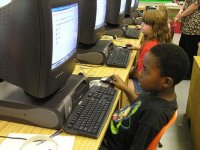
Another challenging part of teaching in a computer lab is the room layout itself. Most labs contain desktops lined up against a wall in either rows or pods. These layouts, due to wiring and cables, are not mobile or adaptable. In my lab, my younger students can barely see over their computers to follow what is going on at the board. In other labs I have visited or seen, students must turn their bodies to view the board.
Making It Work
Most computer labs are also not laid out well for group work. Technology lends itself to project-based learning, and this can be hard to manage or coordinate in a classroom that is not conducive to moving furniture or creating space for groups or teams to work. Often, the computer takes up most of the desk or table space, too, so there is less room for teams to work out ideas before creating them on the computer. A lot of this work must be done in the classroom before they get to the lab, which means that, even when groups are ready to start creating on the computer, they must wait until the day they use the computer lab. This interrupts the creative and design process and inserts an artificial break between the work students are doing and the technology they are using.
However, despite this, I know that there are certain computer literacy skills students are taught in a computer lab that make integrating technology in the classroom easier. If a teacher knows that students have a period or two each week for learning how to edit video, format text, manage files or create websites, then that is less instructional time in the classroom they have to spend teaching these skills. It allows them to focus on the content and process rather than specific computer skills.
Below is a table laying out some basic pros and cons of computer labs.
| Pros | Cons |
| Each student has a machine Unlike classroom pods or clusters in the library, most computer labs have enough machines for each student. |
Limited access as a shared resource Since labs are separate from the classroom, they are not immediately available and are often shared among many classes. |
| Focused computer literacy instruction Computer labs that have a teacher and are not just a room of computers provide students access to specialized computer literacy education. |
Technology removed from classroom When students have to travel to the computer lab, it means that technology is not truly integrated into the curriculum. Having technology in a separate room sends the message that technology is separate from what students are learning in the classroom. |
| Provide access in schools with no libraries or funding for large tech initiatives The bottom line is, if a school does not have a library or can't afford to put a lot of technology into its classrooms, then a computer lab is a viable solution to provide access to students for digital learning. |
Room layout This could be one of the most frustrating things about teaching in a computer lab. The layouts of most computer labs are rigid and fixed and do not lend themselves easily to dynamic lessons or projects. In addition, there is rarely room for real work, since keyboards and mice usually take up most of the desktop space. |
If you have discovered any additional pros or cons in the computer lab at your school, please share them in the comments section below.


Comments (31)
Comment RSSSign in or register to post comments
“This is a great blog, and I
“This is a great blog, and I commend you on your years in the field as a technology teacher, constantly searching for new ways to accommodate your lessons and the space you have for the benefit of your students. My comment will soley be around one of your ‘cons’ related to removing technology from the classroom. “When students have to travel to the computer lab, it means that technology is not truly integrated into the curriculum.” Although I understand why this is in the cons section, I don’t agree with the fact that technology is not ‘truly’ integrated into the curriculum unless you have direct access to computers at all times. Teachers must face the realities of the school culture and adapt to work with what they have. This does not mean we cannot be creative and still integreate technology as do teachers that have all the necessary tools right at their fingertips. Having said that, I am still trying to remember if I have ever been in a classroom where every teacher has all the necessary tools and gagets to ‘trully’ integrate technology and make it a part of the students’ everyday lives. Most classes I’ve had a chance to see (and I’ve seen quite a few having been supply teaching for a few years) have one, or two computers at most. Some if they’re really advanced have a smartboard and digital projector as well. It is unethical to assume that every school will be able to afford to place a computer or other digital tools in every classroom. There are many communities, where parent council donate a lot of money for new Ipads and other gagdets, where other schools might focus on providing their students with breakfast programs every morning. It would be ideal to see every classroom becoem equipped with all these great tools, but we must be realistic, and recognize that society does not work that way, and as teacher I will work twice as hard to be creative and resourceful and find ways of integrating technology despite the lack of necessary tools.”
8 Years Teaching Computers in a Lab
And I agree with much of what is said here.
I have acknowledged, time and again, that it is really a better paradigm to have technology readily available within the classroom and integrated into all of the learning. It's a tool -- much like pencils, or paper. We integrate those into the classroom, so there's no reason not to update it with the digital equivalent.
I have also acknowledged that, in such a utopian paradigm, my job should theoretically not even exist. However, in reality I (and my lab) are needed because the vast majority of teachers do not have the technological know-how and computer literacy to use them in their classes. Thus, students can come to me and get some integral techno-skills... or they can not receive them at all.
My hope is that the days of labs and specialized "computer teachers" (aside from programming and other highly-technical, vocational skills) will soon be numbered, and simply being a "classroom teacher" will automatically mean you are also a "technology teacher"
There are solutions to the cons...
Great points. As someone who works for a manufacturer of technology furniture for educational uses, it’s great to see this view from the inside.
There is probably no one good answer to the cons you put up, but one solution may be a “self-storing” computer desk. These are desks that have storage capabilities for the computer and peripherals – monitor, mouse, and keyboard – taking them out of the way when not needed. This does a couple of things for an institution. By using the self-storing desk, a room is now multi-functional and can be used as both a computer lab and a lecture classroom. This puts the students in the classroom and when needed, in the computer lab.
Room layout is often a big challenge whether in a computer lab or in normal classroom settings. However, there are solutions for this, too. Collaboration tables with single large displays can be used with a single computer connected, or multiple computers or mobile devices. Alternatively, there are also collaboration tables with the same type of self-storing capabilities so the table can be used as a collaborative table with and without a computer.
So, there are solutions to your cons, but not all will be appropriate in every situation.
How will next generation computing labs in schools look like?
partly inspired by this article and our work (see my other blogs on edutopia) - I wrote this blog
i.e. its a gedankenexperiment of how such a lab could look like ..
http://www.opengardensblog.futuretext.com/archives/2013/01/next-generati...
As a technology educator, who
As a technology educator, who taught in a designated computer lab for eight years, I have one more comment to add. A computer lab is a great place for students to integrate technology in their learning when the classroom teacher is unable to present this skill. All too often, the classroom teacher does not have the expertise or knowledge of 21st century learning tools. It is then the technology teacher/coordinator/specialist who should impart this knowledge and opportunities for the students and the classroom teachers.
I agree. The lack of access
I agree. The lack of access to technology can be an issue in many classrooms. At this point, computers/laptops are becoming more affordable. If schools are open to change, we'll start seeing more technology integrated into the classrooms over the next few years.
Sincerely,
Tony
http://teachergraph.com
Big time PROS and Cons!
I definetly Agree that teaching students in the Computer Lab can have may Pros and Cons. The number 1 problem i believe is getting the students attention and if so do they understand clear instructions? I also agree with the effect of the way MOST computer labs are layed out! Usually computer desks are up against the wall and teaching in a computer lab your pretty much on your own for each individual student. Group work is indeed hard! However, i guess when you look at it, you could monitor students more on a personal level. Confidentiality or privacy of student work would be hard . But on the other hand i agree with Pros and Cons of a computer lab..As technology is thus moving on, most students have their own access to their work through their own gadgets, i phones or laptops.
Teachers should be using the
Teachers should be using technology to extend learning and understanding whether this is in a lab in collaboration with a 'technology teacher' or in their own classroom.
Technology should most definitely not be an isolated skill taught only in the computer lab, but like mentioned by others, without student laptops or up to date equipment in classrooms, for some schools the only place to integrate tech is in the computer lab.
I love the idea that we need to be thinking ahead. What will this new generation "computer lab" look like? Even in districts with underprivileged kids, we need to find ways to have them 'catch up'! Or else the gap will just keep growing between digital natives and those who only see a computer in their school's lab.
I believe you are right.
I believe you are right. Computers need to be in every classroom to be fully integrated into education.
I found your blog entry to be quite interesting and I fully understand your feelings regarding the matter. As a 21st century educator, it is our obligation to integrate technology into our classroom instruction, regardless of the content area in which we teach. In order for students to use the technology, they must have access to it. Often times, students are only able to have technology “in their hands” when they are in the computer lab. We are living in a digital age where students are better able to use technologies such as smart phones, tablets, Promethean boards etc. better than the teachers. However, the access that they have to these technologies is quite limited, if it is even available to them at all. If we want to our students to be tech savvy and literate, I feel that we must increase measures to make sure that all students have access to technology in all classrooms, not just the computer lab.
Certified Art Education Teacher
I have been discussing this with several educational leaders since 2009. I had an integrated studio art lab as early as 2006 and as an art specialist I had worked on many grants to have access to such a program. All the computers in my current lab setting is a result of that effort and our school is doing well on technology. Sadly in 2010 due to construction on a new facility, those leading the efforts did not fully understand that a lab for film, design and photography should be in a studio art setting. My classroom is currently in a lab setting. When our studio arts lab was taken apart and separated as either or it was like a step back in time.
Our department went with a wired lab for 'mixed media' and arts integration because of the amounts of storage it takes for video and photography. Visual art using film, photography and design leads into mixed media and overlaps theatre, music, video for visual art and creative entrepreneurship. In reality computer labs are so very 1999.
I have now seen just how limiting a lab setting can be. Using a computer is virtual. It is tangible but not as tangible as it can be. If we don't change how others think they will limit our children because either or doesn't allow for opportunity. This article really hit the proverbial nail on the head for me.
Technology is not separate from the course. It's part of being successful for these 21c students. I'm so glad someone touched on this topic. Many thanks to Mary Beth Hertz, the author, for bringing this to the forum.
Kimberly Faye McClellan
http://www.linkedin.com/in/kimberlyfayemcclellan