Technology Integration Subscribe to RSS
The Pros and Cons of Computer Labs
January 9, 2013 | Mary Beth HertzI have spent six of my almost nine years of teaching in a computer lab. Over that time, my feelings about computer labs have fluctuated. It may seem silly for me to be in opposition to my own job, but there are times that teaching in a lab can be frustrating and isolating. On the other hand, there are times when I realized that there is no other place that my students would be learning how to program, edit videos, create music or format text documents.
Neither of the schools in which I have been the technology teacher have had a library, a librarian or access to much classroom technology in student hands. As such, I have found that my role as the "Computer Teacher" has actually been many roles. In that way, the computer lab was an important place in these schools. On the other hand, it is challenging to try connecting what is taught in the lab with what students are learning in their classrooms, which is, in my opinion, the ideal way to structure technology education.
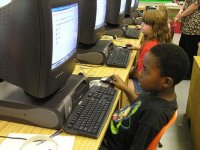
Another challenging part of teaching in a computer lab is the room layout itself. Most labs contain desktops lined up against a wall in either rows or pods. These layouts, due to wiring and cables, are not mobile or adaptable. In my lab, my younger students can barely see over their computers to follow what is going on at the board. In other labs I have visited or seen, students must turn their bodies to view the board.
Making It Work
Most computer labs are also not laid out well for group work. Technology lends itself to project-based learning, and this can be hard to manage or coordinate in a classroom that is not conducive to moving furniture or creating space for groups or teams to work. Often, the computer takes up most of the desk or table space, too, so there is less room for teams to work out ideas before creating them on the computer. A lot of this work must be done in the classroom before they get to the lab, which means that, even when groups are ready to start creating on the computer, they must wait until the day they use the computer lab. This interrupts the creative and design process and inserts an artificial break between the work students are doing and the technology they are using.
However, despite this, I know that there are certain computer literacy skills students are taught in a computer lab that make integrating technology in the classroom easier. If a teacher knows that students have a period or two each week for learning how to edit video, format text, manage files or create websites, then that is less instructional time in the classroom they have to spend teaching these skills. It allows them to focus on the content and process rather than specific computer skills.
Below is a table laying out some basic pros and cons of computer labs.
| Pros | Cons |
| Each student has a machine Unlike classroom pods or clusters in the library, most computer labs have enough machines for each student. |
Limited access as a shared resource Since labs are separate from the classroom, they are not immediately available and are often shared among many classes. |
| Focused computer literacy instruction Computer labs that have a teacher and are not just a room of computers provide students access to specialized computer literacy education. |
Technology removed from classroom When students have to travel to the computer lab, it means that technology is not truly integrated into the curriculum. Having technology in a separate room sends the message that technology is separate from what students are learning in the classroom. |
| Provide access in schools with no libraries or funding for large tech initiatives The bottom line is, if a school does not have a library or can't afford to put a lot of technology into its classrooms, then a computer lab is a viable solution to provide access to students for digital learning. |
Room layout This could be one of the most frustrating things about teaching in a computer lab. The layouts of most computer labs are rigid and fixed and do not lend themselves easily to dynamic lessons or projects. In addition, there is rarely room for real work, since keyboards and mice usually take up most of the desktop space. |
If you have discovered any additional pros or cons in the computer lab at your school, please share them in the comments section below.


Comments (31)
Comment RSSSign in or register to post comments
AP
You have just inspired a future blog post---what will the "computer lab of the future" look like? Something definitely needs to change. We've been having these same conversations for way too long.
Jerry
Jerry, I heartily agree. That is why it is so important for technology to be integrated into the classroom. Just as students might pick up a pencil or reach for their notebook at appropriate times, they should also have access to technology when the time is appropriate. I am an advocate for technology serving learning, not vice versa, and I have even written a post for Edutopia entitled "The Right Technology Might Be a Pencil."
Many of the educators I know don't "worship" technology, but rather understand that it is a vital part of the learning process for now and for our students' futures. The problem is that, like anything in education, schools fall prey to fads and trends that focus on all of the wrong things.
Jerry
Jerry, for more on what I mean by "integrating technology," you can read my post on it here: http://www.edutopia.org/blog/meaning-tech-integration-elementary-mary-be...
I also just wrote recently on the myth of the "Digital Native." (http://www.edutopia.org/blog/digital-native-digitial-citizen-stereotype-...) While many children use technology ubiquitously, we cannot assume that a) all children do and have access to these tools b) that they know how to use them for learning purposes.
I completely agree with you, however, that technology has the power to open up the classroom to the world!
Lilla
You make a great point, Lilla. Often, computer lab teachers are not necessarily prepared to teach computer literacy, or there is no set curriculum, or there is no set expectation of what should be taught in the first place. Like any teaching position, it is important that the person have a basic understanding of how children learn before they are expected to teach any subject.
Kimberly
Thanks for your perspective as an art instructor. Technological "advances" have definitely redefined what we consider "art." I'm glad you are incorporating technology into your art instruction. It's too bad that you had to take a step backwards.
Alisa
Just curious, did the classroom teacher stay in the lab to learn alongside the kids? I think this is a missing element in lab instruction. If the teacher stays with the kids, then he/she will feel more comfortable using the tools with his or her students without the technology teacher.
Ajit
Thanks for the link, Ajit. I love the work you describe using Rasperry Pi and Arduino. I think that we are at a tipping point for what we call "Computing" or "Computer Science." Great insight, thanks!
Tony
Thanks for your perspective, Tony. There are probably a number of ways, as you describe, to ameliorate the issue of furniture and room layout when using computers. I actually am not a proponent of desktops in classrooms, but if there were a need for a powerful desktop in a lab setting, I love the idea of being able to remove the computer peripherals from the equation when necessary.
Ivana
I agree, Ivana, that there is a huge issue with inequity in schools. However, I wouldn't call it "unethical" to expect all classrooms to have access. I would consider it "unethical" that all classrooms don't have access. The truly unethical part of this problem is that the existing funding gap in schools is only growing larger and larger.
I commend all of the educators I have met and know who find ways to be innovative and use technology in unique and creative ways despite their lack of access.
We also need to move beyond the concept that spending $4000 on an interactive whiteboard is a smart investment when that same money could buy 10 mobile devices/netbooks for a classroom.
Even though there are cons to
Even though there are cons to Computer Labs in schools, I believe they are a necessity. Ideally, schools would have a 1:1 technology initiative where students would be able to carry a laptop computer with them to each class. If this is not possible, schools may look into a mobile lab, where there are multiple laptops on a cart. But, if the only technology available to a school is a computer lab, flexibility must be required on the teacher's part because integrating technology into any classroom is important.