WHAT WORKS IN EDUCATION The George Lucas Educational Foundation
Facebook
Edutopia on Facebook
Twitter
Edutopia on Twitter
Google+
Edutopia on Google+
Pinterest
Edutopia on Pinterest Follow Me on Pinterest

Log In

Primary links

  • Home
  • About Us
    • A Word from George Lucas
    • Mission and Vision
    • Core Strategies:
      • Overview
      • Comprehensive Assessment
      • Integrated Studies
      • Project-Based Learning
      • Social and Emotional Learning
      • Teacher Development
      • Technology Integration
    • Topics A to Z
  • Browse by Grade Level
    • Grades K-2
    • Grades 3-5
    • Grades 6-8
    • Grades 9-12
  • Schools That Work
  • Schools That Work
    • View All Recent Schools That Work
  • Blogs
    • View All Recent Blogs
    • Administrators
    • Assessment
    • Brain-Based Learning
    • Education Trends
    • Five-Minute Film Festival
    • Game-Based Learning
    • New-Teacher Support
    • Project-Based Learning
    • Social and Emotional Learning
    • Student Engagement
    • Teacher Leadership
    • Technology Integration
  • Videos
    • View All Recent Videos
  • Support Edutopia
  • Classroom Guides
    • View Classroom Guides
  • Quizzes
  • George Lucas on Teacher Appreciation
  • Developing Active Readers
Sign in Join
We share evidence-based K-12 learning strategies that empower you to improve education.

Featured:

More School Time, Well Spent, Boosts Academic Achievement and Engagement at Edwards Middle School
high school girls in a step dancing class
  • 1
  • 2
  • 3
  • 4
  • …
  • Next
  • Last

Featured:

Five Keys to Successful Social and Emotional Learning
  • 1
  • 2
  • 3
  • 4
  • …
  • Next
  • Last

Featured:

How to Thank a Teacher
1
Project-Based Learning Subscribe to RSS

Khan Academy's Discovery Lab: Summer Camp Where STEM Meets PBL

December 18, 2012 | Minli Virdone
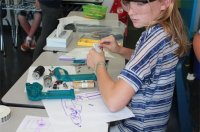
Some disassembly required: a Discovery Lab camper learns by reverse engineering
Some disassembly required: a Discovery Lab camper learns by reverse engineering Photo Credit: Khan Academy

Khan Academy is primarily known as an online portal of videos and exercises (we have delivered over 207 million lessons to date). We believe that online learning goes hand in hand with hands-on, project-based learning -- and that’s why we decided to run a summer camp, the Discovery Lab, to try out the deeper explorations that can be done in a physical space. As we fine-tune the lessons that work in this setting, we will try to integrate them more deeply into the core Khan Academy platform, so students and teachers around the world have the infrastructure and tools to fully explore their creativity.

The Discovery Lab summer camp had 66 campers, ranging from those entering 5th grade all the way to those entering 8th. They participated in a variety of different activities across the two-week camps. We were so glad that we could share our excitement about the topics with them!

VIDEO: Khan Academy Explores Hands-On Learning. See more videos about Khan Academy.

Here are some highlights of the camp experience. Many of these can be integrated in other classroom settings. Please see the links within each description.

Reverse Engineering Household Objects

All it took was lots of enthusiastic engineering minds and a little staff support. Campers had spent a couple days taking apart different household objects to understand how they work. They had a blast carefully tearing down a range of objects, including fax machines, DVD players, clocks, remote controls, radios and much more. Aside from the fun of being able to tear the items apart, they also had to carefully identify all the different components and understand why they were used in each object. Scroll down for a "how to" lesson for reverse-engineering.

Statistics and Economics Simulations

Campers participated in different market simulations and trading games to allow them to better understand the intuition behind basic economics concepts such as supply and demand. They also learned about probability and frequency stability (including how hard it is to simulate multiple coin tosses and why).

Hands-On Mathematics

We did lots of hands-on activities in polyhedra, platonic solids and fractals. Campers first drew two-dimensional versions of Sierpinski's triangle (a beautiful fractal), and were later encouraged to make the concept of fractals even more real by creating three-dimensional Sierpinski's tetrahedra. The great part about that project was that all we really needed were simple, everyday materials -- paper, scissors and glue or tape!

Robotics

Our campers used the Lego NXT kits to make many different types of robots. Some performed useful functions such as fetching items, some were tank bots (which taught campers about double gear reductions) and others danced with each other.

Computer Science

Finally, campers learned to program in Javascript through the Khan Academy Computer Science platform, an intuitive graphical programming interface that we built in-house. Within a couple days, we saw amazing programs such as Dancing Androids, Tweety Bird and cat, Minecraft-inspired art, Brickbreaker and many more.

Reverse Engineering: The Breakdown

Our campers brought in objects from home that were no longer used and were more mechanical in nature (tearing apart an iPhone would not be as much fun, not only because it is hard to actually take apart, but also too much of the functionality is hidden from actual view). We provided the tools (screwdrivers of various sizes were the most helpful) and basic safety glasses, but campers could also bring their own tools from home.

We think this project works best when students are in groups of two to three. It could take anywhere from one to four hours, depending on the complexity of the object. Here's one way to structure the session:

1. Provide the Context for the Session

The products that we buy have been created to meet a specific need. For example, a hair dryer was created to dry hair -- simple enough. But how does it work? What parts are inside? In this project, we will go inside some of the devices that we use every day to understand how they work.

2. Show an Example

To make sure students know what they are expected to do, show them a video. This link goes to the Khan Academy videos where our faculty member Karl Wendt tears into objects like hair dryers, alarm clock radios, digital cameras and more.

3. Share Guiding Instructions

Here is an example of how you might proceed:

  1. Select an object that you want to take apart. Note that the object may not be able to operate after the disassembly, so do not take apart something that you might want to use again.
    You may want to preview and approve the students' objects a couple days before to filter for things that will work within the timeframe you have -- i.e., if you only have a couple hours, stick to simple mechanisms like clocks, basic mechanical toys and any other objects that don't have too many parts.
  2. Each part should be removed with care and not damaged. If students are having trouble with something, they should ask an instructor.
  3. Every part counts -- do not throw anything away.
  4. Remove the parts from the device using screwdrivers and other tools.
  5. Research the parts. Use anything on the part you can find to identify what it is and then Google it. We have found this website helpful for the electronic components.
  6. Mount the parts on a board with an index that indicates the name of the part and its function (e.g. Motor -> Turns electrical energy into rotational energy to push air through the hair dryer; Fan -> Pulls air into the dryer).
  7. Include relevant science and math principles.

We hope this inspires teachers to take apart some household objects with their students! We loved doing this with our campers, and we hope that you do, too.

see more see less
  • Minli Virdone's Blog
1

Project-Based Learning

Minli Virdone Lead of Strategic Initiatives at Khan Academy

Tags
  • Blended Learning
  • Upper Elementary (3-5)
  • Middle (6-8)
  • Project-Based Learning
  • Math
  • Science
Related Resources
  • Salman Khan on Liberating the Classroom for Creativity (Big Thinkers Series)
  • National Lab Day: Connecting Teachers, Students, Scientists and Engineers
  • STEM Education
  • Khan Academy Explores Hands-On Learning
  • Blended Learning Energizes High School Math Students (Tech2Learn Series)
  • Sal Khan Maps Out Blended Learning
see more see less

Edutopia Blog Topics

See all Blogs
  • Administrators
  • Assessment
  • Brain-Based Learning
  • Education Trends
  • Five-Minute Film Festival
  • Game-Based Learning
  • New-Teacher Support
  • Project-Based Learning
  • Social and Emotional Learning
  • Student Engagement
  • Teacher Leadership
  • Technology Integration

Popular Tags

  • 1. Student Engagement
  • 2. High (9-12)
  • 3. Professional Development
  • 4. Upper Elementary (3-5)
  • 5. Middle (6-8)
  • 6. Primary (K-2)
  • 7. Curriculum
  • 8. Classroom Technology
  • 9. Lesson Plans
  • 10. Differentiated Instruction
  • 11. Performance Assessment
  • 12. Classroom Management

blog sidebar popular

  • Popular
  • Commented
  • Shared

Popular

Tools for Teaching: Developing Active Readers
by Rebecca Alber
Posted May. 13, 2013. 6:49 am GMT
A Note from George Lucas: Celebrating Unsung Heroes in Education
by George Lucas
Posted May. 7, 2013. 6:03 am GMT
Rethinking Difficult Parents
by Dr. Allen Mendler
Posted Apr. 26, 2013. 11:50 am GMT
"School Time" in New Zealand
by Adam Provost
Posted May. 6, 2013. 2:10 pm GMT
Building Social and Emotional Skills in Elementary Students: Empathy
by Randy Taran
Posted Apr. 26, 2013. 1:27 pm GMT
More Positive, Not Punitive, Classroom Management Tips
by Larry Ferlazzo
Posted Apr. 29, 2013. 6:42 am GMT
Celebrate Educators on National Teacher Day 2013
by Matt Davis
Posted Apr. 30, 2013. 5:49 pm GMT
Mirror, Mirror on the Wall: How Can I Be a Better Teacher Next Fall?
by Dr. Richard Curwin
Posted May. 9, 2013. 11:10 am GMT
Gamifying Student Engagement
by Matthew Farber
Posted May. 2, 2013. 6:57 am GMT
Four Suggestions to Help You Lead by Relationships and Realize Your Vision
by Scott Taylor
Posted May. 2, 2013. 4:33 pm GMT
Back to Top
Join the movement for change

Get Inspired

  • A Word from George Lucas
  • Mission and Vision
  • Our Strategies for Learning:
    • Comprehensive Assessment
    • Integrated Studies
    • Project-Based Learning
    • Social & Emotional Learning
    • Teacher Development
    • Technology Integration

Support Our Mission

Donate

Find Solutions

  • Browse by Grade Level:
    • K-2
    • 3-5
    • Middle
    • High School
  • Schools That Work
  • Blogs
  • Videos
  • Classroom Guides
  • Quizzes
  • Topics A to Z

Get Our Free Newsletter!

Sign Up

Join the Conversation

  • Facebook
  • Twitter
  • YouTube
  • Google+
  • Pinterest
  • Edutopia Community
  • Sign up for RSS

Connect

Join/Sign In

The Foundation

  • Advertise
  • Contact Us
  • Terms of Use
  • Privacy Policy
Enter for a Chance to Win!Weekly Giveaway: $500 Corwin Press Gift Card
  • EDUTOPIA
  • WHAT WORKS IN EDUCATION
  • © 2013 The George Lucas Educational Foundation
  • All rights reserved.