What Works in Public Education

What If It Breaks?: Tech-Support Concerns Impede Adoption

By Ken Messersmith

4/10/07
Print Forward Share Comments(16) Comment RSS

I teach an online graduate class titled Technology Tools for Teachers. Most of the class members are practicing educators with several years of experience teaching in rural areas. We have been discussing the potential uses for various Web 2.0 applications to enhance learning in our classrooms.
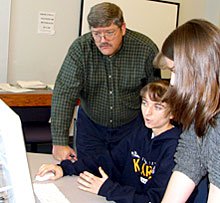
What If It Breaks?

During our discussion last week, one of the students mentioned that she was convinced that some of the new tools would motivate and engage students, but she was reluctant to try them. Her reticence, she said, stemmed from her doubt about whether her school’s network was reliable enough to support use of the tools. “We have enough trouble just getting email in and out of the building on a regular basis,” she said.

This discussion makes me wonder about technical support in schools. Many of the schools in our area are small, consisting of fewer than 300 students. Technical support is most often provided by a person trained as a classroom teacher but released from one or two classes during the day to provide technical support for the building. Most of these teachers got the support job because they learned something about computers on their own and happened to know more than anyone else in the school. They generally have very little or no training in computer science.

The question is, can we expect to make gains in technology use in schools with this support structure? Should schools reduce their teaching staff in order to hire a person who is actually trained to provide technical support?

I am interested to know about the level of technical support at your school. Do you believe the lack of trained support is impeding progress in the implementation of technology in the schools with which you are familiar? How do you address the support issue, or how would you if it were your responsibility?

0
was this helpful?
John Kain
Posted on 4/16/2007 4:56pm

We are an inner-city district with about 3600 computers (desktops and laptops). We have four technicians. You can do the math. Each tech is assigned to four schools. They work their tails off, but we have uncompleted work orders that are 4 and 5 months old. However, at least our techs are trained and certified to provide tech support. The fact that some schools are getting tech support from a teacher "who learned something about computers on their own" is distressing.
Yes, the lack of trained support (or adequate trained support) is slowing the implementation of technology, and not just in rural districts. Schools boards need to start treating tech support as a critical component of each school.

0
was this helpful?
Tim Taylor
Posted on 4/22/2007 11:27pm

I do not believe we can make the gains with technology needed to prepare students to function in a knowledge-based economy with this support structure. Would we ever hire a trained computer technician and ask him or her to teach one or two periods a day because this person "learned something about teaching on the side"? This has long been my response when I encounter schools that rely solely on teachers for any semblance of technical support. I would advocate making very minor reductions to the teaching staff to add technology support if doing so were the only way to make it happen.

In a perfect world, a teacher would wait no longer than one school day to have a technical support issue addressed. But, we all know that the perfect world does not exist and we have to make the best of the situation in which we find ourselves. The best tool I've found for evaluating a school's or district's technical support effort is ISTE's Technology Support Index . It provides a rubric-based approach to documenting where one's strong and weak points are and provides common-sense suggestions on making improvements.

BTW, I am technology coordinator for a 4,000 student suburban school district with 1,200 computers. Our technology support team is not unified; the technical support side reports to the facilities superintendent and the instructional integration side reports to the curriculum superintendent. We have 5.5 approved FTE positions for technical support (technology coordinator, three computer technicians, .5 administrative software support, and one formative testing clerk). The instructional integration side is comprised of one district-wide technology integration trainer and three site-based technology integration specialists. The instructional integration positions are always the nearest ones to the budget axe and we strive constantly to keep them funded.

0
was this helpful?
Bryan Wilkins
Posted on 4/20/2007 6:39pm

Ya gotta spend some bucks on people; technitions and teachers with the skills if you want to have a good program. Try all the half measures you want and I wish you well. But like anything else, you get what you pay for.

0
was this helpful?
Arthur Ellis
Posted on 4/20/2007 1:03pm

As a 442 student private school, we have an academic administrator and teacher who service day to day problems. We have a volunteer parent who is a systems operator to help with network problems. Utilize those with whom you are associated. Make them your "Champion" and show them they are appreciated. Helping is very satisfing to someone in that field because they love doing it.

0
was this helpful?
Daniel Assisi
Posted on 4/19/2007 9:16pm

Just recently come to work in the educational world, I was extremely surprised to see how behind schools are in terms of IT mentality -- great educational ideas, but poor operational grasp of what it takes to really make use of the equipment.

A different approach is needed -- and some schools are already undertaking. We have been fortunate to start shifting that mentality and now we have 1 technician on each of our inner-city four sites. Running approximately 600 desktops for 1400 students (pre-k to 12), things have been working well on the support site.

Also, it has allowed us to really drive technology use -- HS students have both email accounts and websites (digitial portofolios). Middle Schoolers are following suit next academic year -- all users have storage shares, etc.. And it keeps growing.

It is great to see the enthusiams of teachers and students alike when the tools are there for them to use. But, first, the investment must come from visionary administrators that understand the power of technology...

0
was this helpful?
Chris Heidelberg
Posted on 4/19/2007 8:56pm

Consider creating internships for local college IT students through universities and community colleges to assist you with the manpower issues. Also, consider creating partnerships with federal, state and local governments that have large IT staffs that may be able to volunteer time, co-op students, equipment and technology associations. Finally, consider creating partnership with large and small employers who have expertise in this area. Technical schools can also provide you with students and support staff with internship opportunities. I work for a large federal organization that has utilized these partnerships to assist two local school districts and it was successful.

0
was this helpful?
Jennifer Neuman
Posted on 4/19/2007 7:55pm

I am the "tech" person at of 180 student inner-city charter high school. Our little mini-district is made up of three high schools and one grade school. We have a two level approach to technology issues. The first level in my building is me. Any problems that occur with student or teacher computers are brought to my attention and I fix what I am able to fix. If I don't have the knowledge I then send it on to the next level which is a contracted company that costs a ton to bring in for issues so we usually wait until there are multiple ones to cut down on costs. The problem with this set up is I teach a full corse load and have to find the time to deal with the "minor" computer issues myself, which means I bring a lot of my other work home with me becasue I spend the majority of my time when I not teaching dealing with the various computer issues. I think the lack of trained support is part of what is slowing the implementaion of technology in our school, but I think the other part of it is a lack of knowledge and familiarity among some of the teachers and administration with what is actually available and how different aspects of technology can be used in the classroom. Granted to implement any more than we have we would need much stronger tech support put into place becasue adding on to what we already have will only increase the problems that we have to deal with. But I also think that the staff needs training. Then we run into the problem of budgeting for technology and there not being enough money to add new technology resources let alone train the staff and have a permanent technology person or two on staff.

0
was this helpful?
Myra
Posted on 9/29/2007 12:05pm

I teach in a small K-8 school district with about 300 students. I have one computer in my 3rd grade classroom which is to be for my use to receive and send email, communicate within the building and for students to take AR tests through the Accelerated Reading program that we use in our library system. We do have a computer lab and one young man, Terry, our computer tech. It is his job to take care of all the computers in the building.
The problem is- our computers are old-and often cannot support the software or program we are trying to run. My class of 24 students can't always go to the lab, because there are not enough working computers so that each child can work on one by themselves. We do not have a technology teacher, so it is up to me to develop and implement a technolgy curriculum. This is not easy to do, since I am not that savvy on the internet myself.
I know that the school board professes to want to keep up with the times, and parents always ask about technology training. But, in truth, it is just not happening in an affective way without the dolars to fund it. Like everything else, if the classroom teacher can't pull it out of his/her "bag of tricks", it just isn't going to be a quality program. We need more money.

0
was this helpful?
Walden Student
Posted on 9/29/2007 1:49pm

Technology Support

My district, in rural Minnesota, shares our wonderful tech support with the county, each paying half his salary. The problem with this compromise is that both employers expect him to be working on their tech support issues. This man simply can't be in two places at once. Our district has chosen not to pay his full salary (plus benefits), and that decision leaves us all with broken computers, a network that often fails, and students without access to the necessary technology. Here's one example. I teach a ninth grade English class of twenty-three students. There is not a lab in our building with enough working computers to take my class that allows each student to have his/her own computer. They have to share. I think this technology issue comes down to money and priorities. Too many times "good enough" is the norm.

0
was this helpful?
Hope Newell
Posted on 10/02/2007 5:12pm

I totally understand everyone's concerns. I teach at the Model Technology School in my county. We have a wonderful tech. support team. But like many have stated, they can't be in two places at once. When I first received my smartboard and CPS units I was very intimidated, but after using it for two years it has almost become my life. Once my smartboard was broken and it took four days for the parts to arrive. It was the worst week of my life, It is very easy to become dependant on great technological equipment. I realized that week that technology has made my job much more productive.

Post a comment

Sign in or create an account now, or after you post.

Sign In

Thanks for your comment. It will be posted once you've signed in to your account. Please sign in here
Not yet a member of the Edutopia community? Create an Account

Create an Account

Almost there! As soon as your account is created, your new comment will be posted.
Mollom CAPTCHA (play audio CAPTCHA)
By creating an account, you agree to Edutopia's terms of use.

Edutopia.org Blogs

Advertisement

@edutopia on Twitter Edutopia on Facebook RSS feed link

Advertisement