The Universal Learning Machine
By Ken Messersmith
3/7/07We are speeding toward the day when students will bring an electronic learning device with them to school. The MIT $100 laptops are about to ship, and I believe it is inevitable that similar devices will soon be available for American students. This future brings up the question of what would happen if teachers were allowed to design these things. Let me start with a list of features and then see what the Spiral Notebook community thinks.
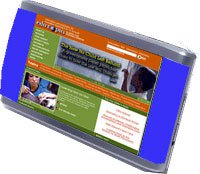
The device should be small but not too small. It is important that the display be large enough to clearly show the contents of a Web page. Something between a portable game player and a laptop in size should work. A good bright color display will be essential.
The memory, for durability and to conserve power, should be based on flash memory. Some type of wireless battery-charging system would be ideal. Solar power would be best, but we might have to settle for one of those wireless pads for charging the battery during lunch or recess. Wireless capability must be included, and a couple USB ports would add flexibility.
If we could make it durable enough, I would like to see a touch screen, which eliminates the necessity of using a separate mouse. The touch screen might be able to double as a keyboard, or we could include a fold-away keyboard that could be stowed out of the way when we are using the touch screen.
What about software? Necessities would include a browser, a word processor, and photo-editing, video-editing, and multimedia-presentation tools. I would also include a spreadsheet with graphing capabilities for math and some type of graphic-organizer building tool for abstracting and note taking. Some of these tools might be Web based, making it unnecessary to maintain them on the machine.
This device needs to be in the $100-$300 range to make it affordable for families to buy or for school districts to provide. What have I missed, or what have I included that should be modified or eliminated? Please let me know.


Usability, technology, education, and emerging technology
Submitted by Lynn Marentette (not verified) on June 2, 2007 - 11:14.
By now, you probably heard of Microsoft Surface, an interactive touch table. Something like Microsoft Surface, or Philip's Entertaible, would be great for co-operative group projects in educational settings and in libraries/media centers.
Microsoft will be marketing the tables to businesses such as casinos and restaurants first, and from what I've read, they are quite expensive.
Last semester, I had to work on projects for a class in Human-Computer Interaction, as well as a Ubiquitous Computing class. I had no idea that Microsoft was working on a touchtable.
I spent good portion of the last few months working on prototypes for use on large-touch screen displays, and I didn't have access to a table. I was thinking about rigging a touch table up myself, using something like the Next Window Human Touch display and mounting it to an adjustable drafting table surface.
I'm sure readers of the Edutopia blogs will have some great ideas of how touch tables could be used for education! Think about the old story-book and flannel board activities of the past. Those might translate well to touch-table activities.
This type of machine is
Submitted by Kathleen Dunn (not verified) on March 8, 2007 - 23:30.
This type of machine is critical for students in all but the most affluent schools today. The machine needs to have more than just a touch screen. It needs to be easy to input data and writing. Thus I think that it must be easy to attach a key board to it.
Software like Inspiration for webbing and mapping would also be very helpful. It would also be good if there was enough memory so that additional software could be added to meet new needs, especially in science.
This is very exciting. As a
Submitted by Jan Conkrite (not verified) on March 8, 2007 - 22:49.
This is very exciting. As a teacher so much of what we do that involves technology needs to have instant access to a computer. Our school has 2 labs and 2 or 3 computers in each classroom. This does not work if you want all the students engaged in the learning, and you want learning that doesn't have to be delayed until you can schedule the lab. Also, with the price of text books it is becoming very difficult for the schools to stay current. A student friendly, family cost expenditure friendly, and teacher friendly system would be great.
You're right!
Submitted by Le Thanh Ruby (not verified) on September 26, 2007 - 10:30.
I work at a school where each classroom is supposed to have 2 computers per class in the primary grades. Upper grades have about 4-6 computers. Honestly, I think everything should be equitable, but that's just not the way the world works. Primary grade kids need the foundation to help them become technologically informed just like the upper grade kids do. We have a computer lab that is way behind in everything. This device seems interesting, but of course, is it affordable is always the question when it comes to education. Pretty sad, when it comes down to us educating future, doctors, leaders, and educators of America.
dream digital device
Submitted by G P Witteveen (not verified) on March 8, 2007 - 22:53.
dream digital device (convergence)
To the GLEF article's outline I would add some sort of unique identifier to help locate (or track?) the whereabouts of the device; alternatively a beeper that one could use to help find the small (and perhaps easily misplaced) device. And if there were an easy way to dock with a multi-media room equipment or home AV system, then the same device could playback content on something besides the onboard screen & speakers. Some sort of Skype-like phone functionality would be nice, too, in case project teams were at a distance from each other. Voice recognition technology might be good. Other in/outputs: external mic (to use high quality mic for fieldrecording in a pinch), flashmemory expansion, headphone, built-in lens/webcam? Of course one can go on, but then the idea of a durable device at cheap cost with clean design and streamlined frequent functions is diminished.
I am so looking forward to
Submitted by Mary Koski (not verified) on March 8, 2007 - 22:54.
I am so looking forward to the day that these are available for our students.
That being said, durability is key to their extended use. Laptops need to be sturdy enough to withstand being stuffed into backpacks and lockers or knocked off desks and tables. They need to be waterproof enough to be spilled on, dropped in puddles, and left on half-melted snowbanks. It will be a sacrifice for many families and districts to purchase one laptop per child and an impossibility for them to replace them many times over if the laptops are not durable.
I agree with much of the
Submitted by Susan (not verified) on March 8, 2007 - 22:56.
I agree with much of the criteria suggested in the article, but the parts also must be recyclable -- currently the issue of e-waste is huge. If devices become more pervasive - there will be more of them and hence more eventual waste ...
Susan
Almost all of hte specs that
Submitted by Bruce Braciszewski (not verified) on March 8, 2007 - 23:38.
Almost all of hte specs that Ken mention exitst in the -pad used at the Lemon Grove School District in San Diego County. See this link. www.classroomofthefuture.org
Hello Ken, excellent piece!
Submitted by Bruce Wilcox (not verified) on March 9, 2007 - 00:42.
Hello Ken, excellent piece! To me, what you are describing is the "Inkwell Functional Requirements for Student Devices". At Inkwell we've been creating a short list of desired features for a student's Personal Learning Device or "Universal Learning Machine" (ULM) as you call it. Much of what you discuss here resonates with the Inkwell requirements developed the past two years in collaboration with pc and electronics manufacturers (various), semi-conductor companies (AMD, Intel, VIA Technologies), and, more important, school personnel and students from both here in the USA and overseas. The Inkwell requirements are available to schools to inform RFP development –just drop me a note at bwilcox@projectinkwell.com and I'll be happy to forward them along. By incorporating the requirements into RFPs developed by school systems we can, in fact, influence and encourage many companies (e.g, Apple, Gateway, HP, Dell, Lenovo, Fujitsu, Samsung, others) to release your ULM in the near future. This will have the effect to drive K12 school motivated innovation in technology design throughout the electronics and computing industry in several key areas such as form factor, battery optimization, bootable operating systems, ruggedness, maybe that wireless battery recharging capability you seek, eco-friendly, low carbon footprint materials usage, pricing and support models, and so on. We should encourage multiple manufacturers to adopt a common minimum standard for the ULM thereby accelerating the competitive cycle that drives innovation in product design, price and operational efficiencies from the vendors –all to the benefit of our schools and students! This will also stimulate growth in demand for technology in the K12 market thus making unique R&D invested by the equipment vendors (specifically for the K12 learner and institution) more attractive, and, because of a larger unit volume of demand, likely a margin generative investment rather than resulting in a low- or no margin offering which they fear. Whether you choose Apple, HP, Dell, Gateway or others, two companies, Quanta and HTC, manufacture the majority of the laptops offered by these US brands. These Original Design Manufactures (or ODMs as they are often called) source the parts, often assemble the parts, creating a finished product marketed by the "Brands". At the component level, and across the device ecosystem, standardization allows Quanta/HTC to buy parts at lower prices thus driving down the overall cost of the ULM offering, all the while making it possible for the "Brands" to meet the aggressive price points you describe and still have margin to ensure this a sound and sustainable investment.
The software stack of the device enables the essential learning experience of the student. Thus, why should we stop at suggesting only school friendly hardware? As we move to a web infused learning experience, and because this is a ULM, and not a general purpose business class or consumer laptop, we should push for software application pedagogy standards (possibly instructional design) infused into application software resident on, or accessed by, the device –else we'll end up with the same generic bundled software offerings designed for every other customer segment –except schools. From the software community I'd like to see a similar focus on school needs (*some instructional attributes*) reflected in the tools resident with the device –else, we'll end up with a machine designed for students, but a software experience oriented around the working adult or consumer electronics user --rather than a learning tool. My hope is that this linking of relevant instructional software (or web-ware), and content, to the decision to acquire the ULM will yield stronger instructional outcomes making the investment in technology infused learning in the K12 arena an irrefutable undertaking.
After two years of work setting the 'spec' for the ULM it's good to see that you and others see this student friendly horizon of overall lower cost, kid cool, and school friendly products entering the market. The big question is: should we buy what is available now? Or, wait for something actually designed for schools? And, at a sub-$300 price point, these devices may be purchased by Parents, in all SES categories, before the schools have a choice in the matter –then what will we do? Stop the students from brining their ULMs to school?
All the best to you.
Bruce Wilcox
Kids should be empowered to
Submitted by Richard Xiang (not verified) on March 9, 2007 - 03:56.
Kids should be empowered to take advantage of the current technology development. Those tools such as skype, netmeeting be better available to them.
Richard
Post new comment