What Works in Public Education

Online Interactivity for Educators: A Teacher's Tour of YouTube

By Chris O’Neal

9/25/06
Print Forward Share Comments(13) Comment RSS

As computers and Internet access have become more ubiquitous, and the tech savviness of our nation's youth continues to rise, it only stands to reason that the online experience has begun to evolve drastically in the last few years. The Web is rapidly changing from being simply interactive to becoming more of a user-centric and user-guided experience. Web 2.0 technologies, open source software, and the tech expertise of our nation's youth have opened up a new world of online interactivity.
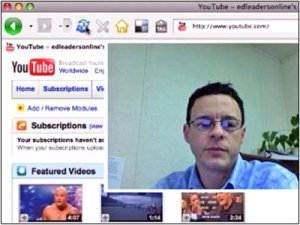
Teacher's Tour of YouTube

One exciting layer is the proliferation of video on the Internet. In a matter of minutes, anyone with a basic video camera and a high-speed connection can create, edit, upload, and share video with ease. This is a powerful tool, and to harness what it holds and turn it into something educational can be a thrill and a challenge.

The number of video-sharing sites is growing, and well-recognized names such as Google and Yahoo offer up video content and encourage viewers to upload their own. However, the hugely popular YouTube probably has the most videos (and buzz) to date. Ask any teenager, and you're sure to find that YouTube is one of his or her favorite destinations. One can find music videos, self-created talent auditions, vacation videos, vintage footage of sports events, and a smorgasbord of the odd and unpredictable. According to YouTube, each day, visitors view more than seventy million videos on the site.

So, what do these sites mean for educators? What might it offer classrooms? I spent several days browsing YouTube, and I found tons of fun things and lots of potentially beneficial classroom video clips, as well as the usual eye-opening experience when dealing with the world's population and the things people want to share.

If you're new to the site, search for a favorite musician, or a specific date, or even an old movie. There's everything from video footage of a 1940s school picnic to a frightening (and controversial) look at Hurricane Katrina issues. The most subscribed channel at YouTube is that of an English widower who muses on everything from growing up during World War II to his experiences during college.

One critical issue to keep in mind when sharing and discussing these videos with your students is media literacy, including general Internet reliability. Are the videos truly what they say they are? Might some of these clips violate copyright? What constitutes a "good" video?

My main concern in using any of these video-sharing sites is that what makes it so powerful is also what makes it a tricky tool to use with ease. There are great discussions and commentary on many of the video clips, but those discussions are, for the most part, completely unfiltered and only mildly moderated. However, using and showing YouTube clips, then having your own classroom discussion about the clips, is an incredibly robust classroom approach. Working with students to create and upload their own videos is an even more powerful application.

I think that taking advantage of the excitement this kind of technology brings to our children is a worthwhile endeavor. Children love to produce, and teaching them the skills to make good productions takes advantage of their interest and provides them with a wealth of skills. See the Edutopia article "Film School: Making Movies from Storyboard to Screen" for a look at the use of video in the classroom. In addition, weaving in good media literacy and skills for navigating the new waters of the Web helps us all.

One last note: To learn more about video sharing on the Web, see the USA Today article "Video websites pop up, invite postings," the Digital Video Guru site's comparison of ten video-sharing services, and RateItAll.com's Video Sharing and Download Sites page.

Share your thoughts on video sharing sites and the potential they hold for classrooms.

0
was this helpful?
almc224
Posted on 5/02/2007 11:58pm

Youtube and other video sharing sites are going to be the future of education in the classroom. Never the less, teacher have the responsibility and the knowledge to patrol these sites and point out to their creators and also Yahoo, Google, Youtube etc. what should be pointed out as educational material, and junk or garbage material. What must go up as "Educational" must be kept educational and not to be confused by some other genre. Also, what is uploaded be the correct, dates in history, grammar, equation/procedure. I've seen in many website errors of all kinds. From error on dates to horrible syntax/translation which really give allot so say. As long as the information is correct, valid, and under the principle ethics of education, drive on.

0
was this helpful?
joshua janssen
Posted on 4/01/2007 12:11pm

How YouTube is starting to work for students and alumni of the Academy for Visual Arts:
CABK ArtEZ Zwolle, the netherlands.

0
was this helpful?
Barbara Meredith
Posted on 5/17/2007 4:17pm

YouTube in Education

In US K12 education, there may be limitations due to bandwidth considerations. This is true in my school district. YouTube and some other streaming media sites are blocked. YouTube movies use high levels of network resources and slow down our e-mail and other network functions. There may be concern that some movies have material our district considers unsuitable for student viewing. (I am not aware of whether YouTube puts restrictions on submissions and obviously have not explored its depths.) I assume other school districts will experience similar issues.

0
was this helpful?
Barrie Jo Price
Posted on 5/26/2007 10:04am

You-Tube

I think You-Tube, even in its current state, is a valuable resource for teachers. True, you have to search and review a lot to find what you can use, but when you do, it's so powerful it can't be ignored. I use clips a lot for my own classes, especially those that are asynchronous. I use them, too, for homework assignments (always have the parents sign that they know I am going to use You-Tube). I think Teacher-Tube is a wonderful idea, a place where we can post lectures, demonstrations and such to share.

Those who would paint all such media with a broad brush of distrust should remember that anything can be put into print; it's the user who elects to read it or not. The same is true for TV, so obviously SOMEONE likes the reality TV stuff!

0
was this helpful?
H. Avanesian
Posted on 6/05/2007 7:40pm

It's a have to!

I believe that using all these new things that are available are a have to for us educators. If we educators don't do it children will use them them any way, so it would be nice to use them to educate our future generation. Just like books, they can be educational or they can be not educational the reading and writing is taught in schools. Therefor, we need to introduce new technology and we need to use them to teach more effectively and most important, we can teach students to use technology to self-teach themselves in a right way, to seek information and to post comments on issues that are important to them and their society.

0
was this helpful?
brian619
Posted on 6/26/2007 10:28am

YouTube in the classroom

I agree with other educators who have commented that we need to help students be ready to think critically about the various messages that they will be exposed to through all of the types of media that will be employed. Higher order thinking skills are what will be most required of them, and practicing how to think critically is essential. By guiding the students in differentiating between quality and trash, we will be taping into powerful discussion and thought processing.
When students use our computer lab and we are using the internet, they know to quickly raise their hand if a web site opens for them that is of questionable content. Our firewall has been doing a really good of late, however once in a while something slips through. Very young children understand when they are viewing objectionable material. While at school their viewing content can at least be moderated by the classroom teacher.
I wouldn’t post video footage of my students to a site like youtube. If individuals want to put themselves into the public forum to that extent, then I feel they should be allowed to do it, however my responsibility is to provide a safe learning environment for my students, and putting their images into the public to that extent is beyond my comfort threshold.

0
was this helpful?
B Sherry
Posted on 9/27/2007 3:27pm

Teacher Tube

Other place to look for resources and to have students producing is:

http://www.teachertube.com

0
was this helpful?
Sue
Posted on 10/03/2007 5:07am

YouTube Question

Are the videos on YouTube safe to view? What are the possibilities that viruses are attached the the videos?

0
was this helpful?
Edutopia Staff
Senior Technical Producer, Edutopia
Posted on 10/03/2007 11:22am

A good concern

There have been reports of viruses attached to videos, but generally speaking they seem to have been mainly social engineering type hacks ( "Watch this video then download the software seen in the video"). However, that seems to be changing. Here's a relevant article:

http://news.yahoo.com/s/ap/20071002/ap_on_hi_te/cybersecurity

0
was this helpful?
carolw
Posted on 10/11/2007 12:28pm

Youtube and copyright laws

My concern is copyright laws. If we show a Youtube video for a valid content-based lesson, could we be sued?

Post a comment

Sign in or create an account now, or after you post.

Sign In

Thanks for your comment. It will be posted once you've signed in to your account. Please sign in here
Not yet a member of the Edutopia community? Create an Account

Create an Account

Almost there! As soon as your account is created, your new comment will be posted.
Mollom CAPTCHA (play audio CAPTCHA)
By creating an account, you agree to Edutopia's terms of use.

Edutopia.org Blogs

Advertisement

@edutopia on Twitter Edutopia on Facebook RSS feed link

Advertisement