A Novel Approach to Feelings: Using Literary Characters to Teach Emotional Intelligence

When it comes to learning real-life lessons, fictional characters offer a strategy all their own.

by Traci Vogel

Print Forward Share Comments(20) Comment RSS
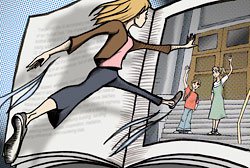
illustration of a girl running into a book
Credit: Ian Roberts

"I've picked you to accompany me on the greatest adventure of our mutual lives," the character Claudia tells her younger brother Jamie in E.L. Konigsburg's Newbery Medal-winning young-adult novel, From the Mixed-Up Files of Mrs. Basil E. Frankweiler. The adventure Claudia is referring to is running away from home to take up residence at the Metropolitan Museum of Art, but the invitation addresses young readers as well. Reading is an adventure, full of discoveries: new lands, new words, and new emotions.

That last subject, emotions, hasn't traditionally been addressed in language arts curricula. But in the past decade, spurred on by growing scholarly evidence of the impact social-and-emotional-learning (SEL) initiatives can have on classroom productivity and academic performance, teachers have begun to weave such lessons into their literature segments. Books like From the Mixed-Up Files provide a starting point for discussions about community building, handling anger, listening, assertiveness, cooperation, mediation, celebrating differences, and countering bias.

Such lessons enable students to "access their own background and emotions, and their relationships in the class, in a much different way," explains Kelly Stuart, national education consultant at the Developmental Studies Center, in Oakland, California. The nonprofit organization has spent the past seven years researching and compiling the Making Meaning program, a K-8 reading-comprehension curriculum that uses read-aloud books to develop social values. Making Meaning, in use in almost every state, "marries the academic and social," Stuart says.

One Making Meaning lesson plan is based on Lois Lowry's Newbery award-winning young-adult fantasy novel The Giver. Aimed at eighth graders, the curriculum helps students understand the underlying themes of the novel, in which young Jonas learns disturbing truths about his supposedly utopian community.

Students are paired up for the entire lesson, which spans several weeks. After each reading, they're asked to analyze character relationships, outline the plot of the story, and explore character change as a result of conflict and resolution in the plot. In "Heads Together" sessions of four students, they're then asked to discuss their feelings about what they've read. The lessons are carefully constructed to teach talking and listening skills, using strategies such as verbal prompts ("I agree with what you said, and I think . . . ."), clarifying questions, and confirmations.

The literature chosen for these lessons is important, Stuart notes. "By using texts with strong characters, with kids -- not just adults -- solving problems and taking on some big issues that may have cross-curricular applications, we find the kids not only connect to the stories but also really can learn a strategy that way, over time," she says.

At New York's Morningside Center for Teaching Social Responsibility, executive director Tom Roderick created a curriculum based around the books The Librarian of Basra and Alia's Mission: Saving the Books of Iraq. Inspired by a July 2003 New York Times article by Shaila Dewan, the books tell the real-life story of Alia Muhammad Baker, chief librarian of Basra, Iraq. Books are "more precious than mountains of gold" to Alia, so when her country is invaded and the library is threatened, she single-handedly organizes people to move an estimated 30,000 books to safe locations. Alia is a strong character who is proactive in a time of conflict, an important role model for kids who may feel powerless.

Roderick's lesson plans address reading comprehension questions such as "Who is the story mainly about?" and "What is Alia worried about?" But they also help students connect the story to their own lives with questions such as "Alia is worried that the books might be destroyed in the war. Are there things going on in the world that you worry about? What are they?" The lesson then moves into practical applications: "Has there been a time when you made the world better by something you did?" If the students can't think of anything, teachers are urged to remind them that small things count, for example, "helping your mother, sending a card to someone who is sick."

Most stories and plays involve conflict and can provide valuable SEL lessons, says Roderick. "It's useful to distinguish conflict from violence; conflict and violence are not the same thing," he says. "If, in their language arts class, they're reading a story where the main character is having a conflict with somebody, you can say, 'What do we have here? We have a conflict. Did the character deal with it the right way? How do you think these characters are feeling?'" These discussions can lead to real-life lessons. For example, says Roderick, "You might have kids talk in pairs about a recent conflict they've been involved with, and how it turned out."

In curriculum developed by the Orange County Department of Education's Institute for Character Education, conflict in From the Mixed-Up Files leads to just such a discussion. Claudia runs away from home because she "felt she was treated unfairly, that she had too many chores, and that her allowance was too small," the lesson plan notes. "What else could she have done instead of running away? What negative value illustrates her decision to run away?"

Good literature has long been a window into our psyches. As historian Barbara W. Tuchman put it, "Books are humanity in print." Incorporating SEL lessons into reading curriculum can put students in touch with the universality of literature, its power to transport us to different experiences and to connect and even change human beings. After all, as Claudia says near the end of From the Mixed-Up Files, "I didn't run away to come home the same."

Traci Vogel is a freelance writer and editor in San Francisco.

This article originally published on 10/1/2008


Comic Book Project

Submitted by Cal Joy on October 13, 2008 - 15:33.

I'd like to point interested readers to the recent Edutopia article, about comic books called, 'A New Literary Hero: Comics Make for Colorful Learning' (www.edutopia.org/comic-books-teaching-literacy). This article looks at how teachers have begun to accept comic books as a tool for teaching literacy through group projects.

Edutopia Staff
Cal Joy

SEL novels

Submitted by connie pruitt (not verified) on October 11, 2008 - 04:28.

I am interested in samples of novels that teach social emotional learning.

Books that teach emotional intelligence

Submitted by Sarah Ritter (not verified) on October 17, 2008 - 13:33.

Even more effective than The Giver, by Lois Lowry, is her novel, Gathering Blue. This is the second in her three book series that begins with The Giver. Unfortunately, schools all over the country have been using The Giver as class books with younger and younger students, therefore losing a great deal of the emotional connections within the conflicts of the novel. Many of my sixth graders arrive at our middle school having been 'taught' The Giver in fourth and fifth grades. Gathering Blue differs from Lowry's previous novel by having a protagonist who has support from lesser characters, and a major antagonist who is at first perceived in a positive light. My students could relate to the problem of assuming someone was a good friend when that person was actually acting from a self serving and/or manipulative position.

Better yet, the hero of this novel moves along most of the steps of the first stage of Robert Campbell's Hero's Journey, thus supporting how truly difficult 'doing the right thing' can be. Lowry also gives young people a delightfully accessible understanding of the use of literary symbolism. Many of my students go back and reread The Giver after we finish our study Gathering Blue. They are thrilled to understand so much more of the first novel once their emotional and intellectual development is more mature.

Another wonderful example of a novel that addresses emotional intelligence (and its development) is Susan Fletcher's Shadow Spinner. This novel gives marvelous little "Lessons for Life" that offer students moments to reflect and connect with the protagonist, Marjan's conflicts, and provides openings for wonderful classroom discussions and journal prompts. I plan to use the Lessons for Life as my major focus for our class blog on the novel this year.

Thank goodness there is YA literature so appropriate and meaningful, and worth sharing with our students.

Character Novels

Submitted by Laura Pazourek (not verified) on October 10, 2008 - 05:12.

Please send samples of novels to our school of social and emotional learning. My students are predominately minority, lower economic level and many are practically raising themselves under difficult circumstances. We are a center for teen parents, grades 6 through 12 with age ranges between 11 and 21; so my reading classes are both levels middle and high school.
Thank you in advance for your help in reaching these children.

Life Skills

Submitted by Carol Mathews (not verified) on October 6, 2008 - 10:45.

I am interested in samples of reading materials to teach character
education.

Character Education through Storytelling

Submitted by Ken Arneson (not verified) on October 21, 2008 - 07:24.

Stories and storytelling are powerful ways to reach and teach children about character education. That is the core of the LifeStories for Kids program (http://www.selmediainc.com/products/index#charEd). It is an award-winning program and is research-based, results having been recently published in the Journal of Research in Character Education.

Please contact info@selmediainc.com if you would like to learn more.

The art of weaving character

Submitted by Lisa Boerum (not verified) on October 4, 2008 - 05:41.

The art of weaving character education and social-emotional learning into the teaching of a novel is paramount to bridging art and life for student learners. As a former special education teacher for over 18 years, I have had the opportunity to use Abraham Maslow's Hierarchy of Needs, Lawrence Kohlberg's Theory of Moral Development, and Stephen Covey's Seven Habits as a framework for analyzing characters in literature, and ulitimately having the students in my special class Language Arts sections analyze themselves using the same framworks. The thinking is then paired with recognition, which is the first step. Combining this with goal setting and reflection supports changes in behavior as well. These are all actions, based on rigorous thinking. I appreciate the article's affirmation for effective teaching and learning with the whole child in mind.

Using Literature to Connect SEL

Submitted by judi harris (not verified) on October 2, 2008 - 07:14.

Traci Vogel's article highlights the power of using literature to elicit conversations and understanding about social and emotional issues that are authentic for children. The valuable concept of utilizing literature as a means of understanding social norms and values is a wonderful tool for teachers. Picture books work well too!
I'm not sure i agree with the last post....
The more time doing than thinking is a strange phrase. Dewey would have us do both, creating balance.
Daniel Goleman is a wonderful resource for teachers interested in understanding emotional IQ (EQ).

Graphic Novel

Submitted by Valeri (not verified) on October 1, 2008 - 15:42.

[Graphic Novels use] strong characters, kids -- not just adults -- who solve problems and take on some big issues.

Big Issues, Big Questions are supported in Glencoe Literature program.

Glencoe Graphic Novels are built into all there programs. including Glencoe Literature, Glencoe Focus on Science and Glencoe Discovering Our Past. This is why Glencoe is a leader in education, they don't follow the educational research and trend. Glencoe leads education.

If you'd like to request a sample of Glencoe Literature or any of it State adopted programs that embed this powerful genre of Graphic Novels please reply to this email.

Media Specialist 9-12

Submitted by Wynelle Scott (not verified) on October 8, 2008 - 13:12.

Some feel the graphic novels are "demonic" and a waste of money. There are many students asking everyday for these materials. Any materials on using graphic novels with any student, not just reluctant readers, would be great.

Post new comment

Share your thoughts with others. Please increase the credibility of your post by including your name, school, grade level, and city, and by demonstrating respect for others' opinions. Comments will not appear immediately; all comments are moderated and will be posted in order of submission.

The content of this field is kept private and will not be shown publicly.
  • Allowed HTML tags: <a> <em> <strong> <cite> <code> <ul> <ol> <li> <dl> <dt> <dd>
  • Lines and paragraphs break automatically.

More information about formatting options