Emotional Intelligence Is the Missing Piece
Social and emotional learning can help students successfully resolve conflict, communicate clearly, solve problems, and much more.
Emotional Intelligence: An Overview
Credit: Edutopia
Whether it's in the boardroom or the classroom, individuals need the skills to communicate, work in teams, and let go of the personal and family issues that get in the way of working and learning. Such skills add up to what is known as emotional intelligence, and they are even more important as educators realize that these skills are critical to academic achievement.
Emotionally intelligent individuals stand out. Their ability to empathize, persevere, control impulses, communicate clearly, make thoughtful decisions, solve problems, and work with others earns them friends and success. They tend to lead happier lives, with more satisfying relationships. At work, they are more productive, and they spur productivity in others. At school, they do better on standardized tests and help create a safe, comfortable classroom atmosphere that makes it easier to learn.
Psychologist and author Daniel Goleman popularized the term "emotional intelligence" in his landmark 1995 best-selling book of the same name. What emotional intelligence is, says Goleman, "is the capacity for recognizing our own feelings and those of others, for motivating ourselves, and for managing emotions well in ourselves and in our relationships." Or, as Maurice Elias, Rutgers University psychology professor, puts it, "It's the set of abilities that helps us get along in life with other people in all kinds of life situations." He calls it the "missing piece" in American education.
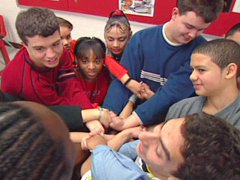
Students in Sarah Button’s fifth-grade class at P.S. 15 in Brooklyn learn how to defuse potentially volatile incidents.
Credit: Edutopia
Self-Awareness and Empathy
Jonathan Cohen, president of the Center for Social and Emotional Education in New York, argues that attributes like self-awareness and empathy play a huge role in every aspect of life. "We all know that how we feel about ourselves and others can profoundly affect our ability to concentrate, to remember, to think, and to express ourselves," he says. Kids without emotional intelligence "don't follow directions, continually go off-task, can't pay attention, and have difficulty working cooperatively.
Social and emotional learning, the increasingly common term for emotional intelligence instruction, can be a lesson on the hurtfulness of put-downs followed by discussions on ways to communicate "put-ups." It can be a regular morning meeting, in which students share such personal feelings as the pain of their pet dying or the joy of a family outing. It can be an analysis of a conflict in great literature and a discussion about different paths the characters might have taken. It can be a common plan to take a moment to think, rather than react automatically, and often aggressively, to distress. It can be a districtwide commitment to community service. It can be a software program that lets students get a clearer idea of their reactions to risky situations.
At Ben Franklin Middle School in Ridgewood, New Jersey, social and emotional instruction is a top priority.
Credit: Edutopia
Miraculous Transformations
Many educators say they are gratified by the results of such instruction in their schools because of its effect on both the school environment and academics. Fifth-grade teacher Grace Wiesner calls the transformation in her Waldport, Oregon, classroom "miraculous." "Disruptions due to acting out, arguing, or talking back have been significantly reduced," she says. Tina Valentine, a fourth-grade teacher at Kensington Avenue School in Springfield, Massachusetts, agrees. "I find I'm not spending as much time with behavioral management issues, so I actually have more time to spend with academics." A number of studies also have found a correlation between social skills and academic achievement.
Instruction in emotional intelligence is not a quick fix or a one-time lesson. The best programs, says Elias, "take no less than three years" to get to a place where teachers are comfortable and students are showing the benefits. Cohen adds that while a growing number of school programs include elements of instruction aimed at a child's emotional needs, too many of those programs are fragmented, short-term, and not well-integrated into the regular curriculum or school structure. "Just as we don't expect kids to learn a language in a year, we don't expect kids to learn social and emotional skills in one year," he says.
Skills More Than Values
Parents need not fear that emotional intelligence translates to a set of values that may be affiliated with religion. "We're not really teaching values. We're actually teaching skills," says Linda Lantieri, cofounder of the Resolving Conflict Creatively Program, one of the longest-running conflict resolution and social and emotional learning programs. "They're almost like tools in a toolbox. I remember one parent saying to me, 'You know, in my place of worship, I teach my kid to be honest. But you give the child the skills to be that way.'" The character education movement, which promotes universal values like respect, honesty, justice, and compassion, is also closely aligned to social and emotional learning.
Social and emotional learning programs work best when parents and teachers are partners, and that means schools need to train both parents and teachers in ways to promote behavior that improves communication, empathy, self-awareness, decision-making, and problem-solving. Parents, educators, policymakers, and business people all have a role to play in supporting the social and emotional learning of schoolchildren.
"We're talking about a whole new vision of education that says that educating the heart is as important as educating the mind," says Lantieri. Rutgers' Elias puts it another way. He says that parents don't just want SAT-smart kids. They want kids who are also responsible, non-violent, and caring: "We want the whole package."


Comments (80)
Comment RSSSign in or register to post comments
Need for acknowledging emotions
I run anger management programs in a low socio-economic are in Sydney. Violence, crime, abuse, broken relationahips are the norm. Education for their kids is OK, not for them - the adults. I believe education about emotional intelligence is essential for parents, children and adults in all areas of society , but not just to be taught in schools or money-hunting businesses. I will keep on looking for ideas to develop a positive short-term program for people in the area in which I work. Unless someone can help me out....
Emotional intelligence
This article is what I really needed to read. I have a couple of student who fit this lack of emotional intelligence to a "T". These students come from what would be called a good home, but this piece is missing. I am anxious to find out more about this topic.
Emotional Intelligence Program
Our school is in the third year of an emotional intelligence program. Like you, we started with teacher in-service to train teachers in the techniques used to develop students EQ. As we progress through the phases of implementation, I am amazed at the power my students have to use their voice in positive ways. The most important aspect of our program is the advisory component. We begin each year with a weeklong intense "Advisory Week" in advisory classes K-12 participate in team building activities as well as activities that increase emotional awareness and growth. I have seen a major impact on discipline and how our students handle social issues. As a classroom teacher, I have found that the time I use to spend handling social conflicts has decreased - now I have to time to actually teach. Our program was created with the help of a facilitator/psychologist to fit the needs of our campus. Can you tell me more about the RHC program?
Anger management
I work in one middle school in the city of Louisville where I think the students could benefit greatly from the Emotional Intelligence approach. In spite of being a Youth Services Center in our school that tries to help, particularly with anger managemnet, I believe this approach should be implemented in every school in the country. I agree that there is a correlation between academic achievement and emotional balance. How can someone learn in an atmosphere like the one I see often in my school?
Modeling Emotional Intelligence
Emotional Intelligence is certainly a missing link in our educational system and the gap is widening in our society as a whole. So many schools, based on the fear of reprisal, are hesitant to demand the behaviors that develop emotional intelligence and hold students accountable. We have been a "touchy-feely" anything goes society for some time and the results of that approach has been the dissipation of responsibility for ones actions. If we allow students to continue to act inappropriately based on their homelife or disability we are impairing the development of their emotional intelligence.
The media, video games, and adult behavior is sending the wrong message to our children. Unfortunately, if adults lack emotional intelligence and do not model appropriate behaviors it makes it doubly hard to develop them in our children. The term is new but the behaviors have been the repetoire of well adjusted successful people for a very long time. Are we stunting our children's emotional intelligence by modeling inappropriate behavior? I think so. Have we forgotten selflessness and the ability to take responsibility for our actions. Many of the tenents of Emotional Intelligence used to be synonomous in our culture with maturity unfortunately now the behaviors associated with immaturity seem to be dominant.
Emotional intelligence is
Emotional intelligence is definitely a missing link in our educational curriculum. We're given all the tools for sharing academic lessons, but often we're ill-equipped to handle the stress that our students bring with them day in and day out. I'm a regular ed. teacher, but I feel like I need more know-how on how to handle students that struggle with emotional disorders. I've done ok on my own so far, but one of the best classes I ever took was called, Discipline with Dignity. During this class, I was asked to think about how my students are feeling and what I can do to help them get through these feelings. As I assess each new situation, I find that I learn so much about my students when I take the time to listen to their concerns. I wish I had more time to talk with them. One of my first mistakes as an 8th grade teacher was to think that the kids should just listen to me. What I have found, after almost 10 full years of teaching, is that I need to listen to them. This is an article I will pass on to my peers.
Implementing the Program
After reading this article, I had to chuckle. I am currently on the implementation team for our elementary school's emotional intelligence program: "Raising Healthy Children." Just like the article mentions, we are taking 4 years of teacher in-services to learn how to bring the program into our classrooms. Furthermore, as part of the implementation team, I am responsible for observing my colleagues while they teach and sharing program ideas. We are only in the beginning of our second year of RHC, but we are already seeing some improvement in the way students handle their emotions and solve problems. It is amazing how students can manage problems on their own if they are only shown the steps to finding an effective resolution. I can honestly say that taking a half-hour here and there from my schedule for emotional intelligence activities or class meetings can actually save hours of instructional time in the long run.
This article really peaked
This article really peaked my interest in the topic of social intelligences. I teach predominantly high school freshman and my biggest struggle is their imature approach to comunicating with each other. So many of them can not hear another student speak withour fealling the compulsion to chime in, and then someone else has to comment on what they said. They bicker and fight and it digusts me more than anything. I look forward to investigating this program with high hopes that I can one day impliment something to help my student learn how to act like humans.
Emotional Intelligence and Teaching
The article provides valuable information for teachers. As a teacher, I am responsible for the whole child in my classroom, not just the academic dynamic. I have several students who are EBD (emotional behavior disorder) and require the teaching of social skills. The emotional intelligence of students is as the article states been found to have a “correlation with academic achievement.” When my students are well emotionally, they tend to progress in class. When they are not doing well emotionally, the students shut down and learning ceases.
I enjoyed the article and look forward to searching and reading more about emotional intelligence that will assist me in making sure that my students progress with a well-balanced, healthy educational attitude.
self-control
I agree that Emotional Intelligencew is a real missing piece in our young people. The interesting thing is that as adults we must work with young people to manage life in our absence not just in our presence. This requires the quality of self-control to be developed so that our students know the correct responses when the lights are out and no one is looking.
for more about Jim
Burns http://behavioral-management.com/