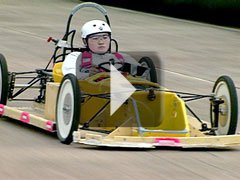
Race to Knowledge: Putting Project-Based Learning on the Fast Track

At this charter school in Hawaii, students build electric cars from start to finish and, in the process, learn how to practically apply what they learn to everyday life.

by Diane Curtis

Share Forward Comments(6) Comment RSS Print

VIDEO: WHEA Electric Car: Project-Based Learning on Wheels

Running Time: 5 min.

The Hawaiian Electric Company's generous cosponsorship of an annual state high school electric-vehicle competition isn't purely altruistic.

"It builds a better workforce for us," says Ralph Dobson, senior technical services engineer at the electric company. "What we're trying to do is get students to understand more about electricity and what it's like to work as a project team." The work doesn't involve "just the fun part" of getting ready for a race, he adds. The students do write-ups of their design, budgets, schedules, and work. "It's just like a real job. The boss gives you so much to spend, and that's all you can spend."

Students from West Hawaii Explorations Academy, Hawaii's first charter public high school, have competed in the race for four years -- first as a school within a larger school in Kona on the Big Island and then as a separate institution headquartered on the grounds of the Natural Energy Laboratory of Hawaii. In fact, the students' enthusiasm for the interdisciplinary electric car race and a previous solar-car competition gave WHEA founder Bill Woerner the idea of starting a school devoted to project-based learning.

Race to Knowledge

West Hawaii Explorations Academy student Quinn Keogh works under the guidance of volunteer mentor Bill McKown.

Credit: Edutopia

The Team to Beat

In 2001, WHEA students were returning to the race as the team to beat. The school's team won the state championship in 2000, even with the handicap of making its own parts because of the limited stock in local hardware stores. Students built the frame out of rejected carbon-fiber sailboard masts, cut and welded pedals and T-joints, designed and built the steering system, and lashed aluminum rods together to build the car's canopy.

The 2001 car -- futuristically sleek, snug, and covered with an ironed-on fabric that took seven coats of bright red paint -- was the result of months of work under the guidance of Bill McKown, a retired director of research and development at General Mills and a volunteer mentor at WHEA. Like other teams, WHEA's received a basic kit from the Hawaii Electric Company that included a motor, a controller, a potentiometer, an emergency disconnect switch, a fuse, a contact, gears, a steering kit, and a brake kit.

The students buy their own batteries -- two 12-volt batteries, in WHEA's case -- and put the car together. The work requires a range of academic applications. Students do math equations. They study electricity, aerodynamics, and the effect of weight and strength on car performance. But the student work doesn't stop there. Extensive documentation is required of the design and building process, the business and community contacts, and money raised and spent. Total spending for the car is limited to $2,500. An oral presentation also is required based on questions picked at random, and students create a Web site.

Race to Knowledge

Champions in 2000, the WHEA team finished fourth in 2001.

Credit: Edutopia

Real-World Lessons

Throughout, the young builders are doing what people in the real world do -- bouncing ideas off one another, researching, trying proposals that sound good, failing occasionally, and then coming up with alternatives. Vehicles are judged on design, construction, safety, appearance, aerodynamic design, and use of recycled materials.

McKown says he believes the main benefit -- aside from the fact that students will remember what they're learning because they're using that knowledge in a practical way -- is that it gives them experience in completing a job on time. "A lot of people emerge into adulthood and have never had to complete a multidisciplinary project on time with all the uncertainties of making a device work," says McKown. "Putting things together often requires a type of disciplined thinking that gives instant feedback on whether you can follow through to complete a job in a timely way."

The car that completes the most laps wins. In 2001, that wasn't to be for WHEA's team. The car had some brake problems, and the school came in fourth. But the team vowed to return.

Diane Curtis is a veteran education writer and former editor for The George Lucas Educational Foundation.

This article originally published on 11/1/2001

Sign Up for Our Free Weekly E-newsletter!

Sample | Privacy Policy

Advertisement

@edutopia on Twitter Edutopia on Facebook YouTube link RSS feed link

Advertisement

Comments

0
Was this helpful? Sign in to vote!
Rhodna
Posted on 7/03/2007 6:44pm

electric car

This is called education.

0
Was this helpful? Sign in to vote!
Anonymous
Posted on 7/04/2007 9:01pm

love this project but would like to hear more about how much time the students spent on it per day or week, how long the project lasted and how it fit into the school day. also, would like to know more specifics about the roles of the students and mentor.

0
Was this helpful? Sign in to vote!
Tiare
Posted on 9/02/2007 12:37am

I go to WHEA now, and we work on a project based learning system. Meaning, we choose the projects we are interested in and work on them throughout the school day. Most of the school day (9am-2pm) is spent on project work, and we go to school all five days a week. Most projects last from September to May.

In individual projects, students are split into groups (ex. design, construction, fund raising), and an advisor teacher gives responsibilities for the week to accomplish. Students submit background papers to be accepted onto projects, and are required to submit written work as well as participate actively on the project products.

Field mentors are for the purpose of assisting in whatever problems or questions may arise for the project.

The people on the Electrical car project are the most dedicated and spend most of the school time and beyond working on their project. This year, WHEA is planning to build a solar powered car.

Please visit the school site at http://www.whea.net

0
Was this helpful? Sign in to vote!
Joseph Osmann
Posted on 7/09/2008 6:53am

Active learning--putting PBL on the fast track

This is a good example of structure and freedom as a learning model. I teach television production at a community college with a minimum of instructor-centered presentations. Students practice skills and produce projects that demonstrate specified quality levels.
The project content is, within reason, up to the student groups. They use skill-rubrics, production
schedules and progress reports for structural support but since their project is their own creation, the commitment is strong.
I teach one course a semester at a four-year college and notice some resistance to active learning since the students are more used to lectures.
The Ancient Romans said that no one learns very much while sitting down.

0
Was this helpful? Sign in to vote!
Rod Mejia
Posted on 8/29/2008 3:07pm

Hi-Tech Devices & Safer Driving

I thought I'd shared this from http://www.buyingadvice.com/hi-tech-device-survey.html
57% of respondents say hi-tech devices distract drivers
58% said limits should be placed on the use of hi-tech devices to prevent accidents
26% said navigation systems are their favorite hi-tech device
Ford unveils new "Smart Intersections" system that gives new meaning to the term "hi-tech device"

DETROIT - In a recent BuyingAdvice.com survey about hi-tech gadgetry, 57% of respondents said they think smart devices distract drivers, while another 26% said they love on-board navigation systems and if they didn't already have one, they soon would.

But interestingly enough, none of those surveyed considered new safety devices being developed by automakers amongst the smart devices that piqued their interest.

Maybe people think a radio that plays jazzy music by a simple voice command is intriguing enough.

"I know I don't think about the smart things being built into my car," said Dennis Donaldson of Detroit, who oddly enough, is a computer programmer.

"I mean, they come with the car, right? It's just what's supposed to be (on) there anyway, isn't it?"

Not necessarily.

Just Thursday, Ford Motor Company took the wraps off its new "Smart Intersections" that communicates with specially equipped test vehicles to warn drivers of potentially dangerous traffic situations, such as when a vehicle is about to run through a red light.

The intersection is outfitted with technology that can monitor the status of a traffic signal, GPS data and digital maps to assess potential hazards, and then transmits the information to vehicles.

"For real?" said Donaldson when told about the system that's now undergoing testing at Ford's experimental facilities in Dearborn Michigan. "Now that is something I'd be interested in knowing about," he said. "That is interesting."

If Donaldson is impressed by what Ford's doing, his socks might be knocked completely off by what DENSO Corporation is up to.

The Japanese company, a leading supplier of advanced automotive technology systems and components for all the world's major automakers, unveiled technology at January's North American International Auto Show in Detroit that might eliminate drivers falling asleep at the wheel altogether.

It's called eye-gaze technology, and it's closer to becoming reality than you might imagine.

"Drivers are liable to close eyes or slowly move eye-gaze right and left when they feel drowsiness," said Miwa Kurokawa, DENSO Manager of Corporate Communications, DENSO Corporation. "Therefore, we believe that we will be able to detect driver's drowsiness by detecting such driver's conditions."

Once the system senses that a driver may be falling asleep at the wheel, it begins a series of events designed to get their attention and, essentially, wake them up.

Vents embedded in the headrests and overhead blow cold air to snap them out of their doze. At the same time, warning lights on the instrument panel flash and a warning buzzer goes off.

Detractors of the system say it has its flaws. For instance, it apparently cannot recognize certain eye colors like blue or gray.

Kurokawa admits there are challenges to overcome, but said it has nothing to do with the color of someone's eyes.

"One of the issues in eye-gaze technology is the shape of eyes and their periphery," she said.

"It's not the color of cornea. For example, Western (civilization) people generally have eyes recessed, (different) when compared to Japanese. We are currently developing technologies to be able to correctly detect eye-gazes regardless of shapes of eyes and their periphery."

But DENSO isn't stopping there. They're also working on systems that will help vehicles recognize things going on with the environment around it.

"Correct and appropriate recognition of the environment around a vehicle is indispensable to ...safe driving and smooth traffic flow," said Kurokawa. "We're developing various detecting technologies to help drivers recognize the environment, including pedestrians and road signs around the vehicle."

The system works by having you look into a screen upon entering the vehicle. It then records specifics of your "gaze" and can then know in which direction you're looking at all times. "The system can warn the driver when it is detected that he/she does not recognize (or isn't looking in the direction of) pedestrians or road signs."

In other words, if the system senses your eyes are looking somewhere they shouldn't when imminent danger is approaching, displays flash and audible sounds will alert you to it.

"It's a remarkable system." she said.

Donaldson thinks its kind of a neat system himself. "So, if I'm not looking at something, it knows it?" he asks. Correct, he's told.

"And once it knows I'm not, it tells me to get with the program or there's going to be trouble? Right again, Dennis.

"Wow," he says.

Wow is right.

0
Was this helpful? Sign in to vote!
Marie Curie high school
Posted on 10/24/2009 11:53am

It's called eye-gaze technology, and it's closer to becoming reality than you might imagine.

Marie Curie say:
"Drivers are liable to close eyes or slowly move eye-gaze right and left when they feel drowsiness," said Miwa Kurokawa, DENSO Manager of Corporate Communications, DENSO Corporation. "Therefore, we believe that we will be able to detect driver's drowsiness by detecting such driver's conditions."

Once the system senses that a driver may be falling asleep at the wheel, it begins a series of events designed to get their attention and, essentially, wake them up.

Vents embedded in the headrests and overhead blow cold air to snap them out of their doze. At the same time, warning lights on the instrument panel flash and a warning buzzer goes off.

Detractors of the system say it has its flaws. For instance, it apparently cannot recognize certain eye colors like blue or gray.

Post a comment

Sign in or create an account now, or after you post.

Sign In

Please sign in here
Not yet a member of the Edutopia community? Create an Account

Create an Account

Almost there! As soon as your account is created, your new comment will be posted.
Mollom CAPTCHA (play audio CAPTCHA)
By creating an account, you agree to Edutopia's terms of use.