WHAT WORKS IN EDUCATION The George Lucas Educational Foundation

Stop Blocking Online Content

Severely limiting Internet access does high school students a disservice.

Severely limiting Internet access does high school students a disservice.
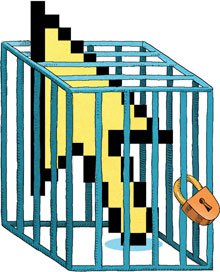
Illustration of a Web pointer arrow in a cage.
Credit: Wesley Bedrosian

The blocking problem started back in August 2007. Each time desktop-publishing students tried to access images, they were blocked. When my English teacher, Lisa Huff (profiled in this Edutopia.org article), needed to get to information from Flickr and the document-sharing site Scribd, she was blocked. My classmate Megan Holifield wanted to watch a news clip on YouTube for inspiration in producing her own broadcast, and she was blocked.

Instead of embracing technology as twenty-first-century schools should, the Batesville, Arkansas, schools -- along with many others -- have been turning on the firewalls, preventing students from realizing the full opportunity the Internet offers.

Students and teachers need online tools to create projects, dispense information, and deepen their understanding of the subject matter. After more than a year of imposing a strict blockade, it's high time for the Batesville schools to bulldoze the firewalls and let the light of the Internet shine on students and teachers.

Last fall, a classmate at Batesville High School told me he spent forty minutes trying to access his school-assigned blog, one our English teacher graded regularly. Another classmate said she couldn't get to the images she needed for her desktop-publishing class; she had to download them at home. (Luckily for her, her family owns a computer.)

Not only is this blockade frustrating, it's also hindering our prospects as college- and work-ready students. In a multimedia world, it is essential that students leave high school with a deep knowledge of digital tools. Blogs are not only a cool way to publish your opinions, they are also the future of social and business networking. RSS reader sites like Google Reader enable users to sort and consume massive amounts of information efficiently. The use of photo sites is vital to creating multimedia projects.

District administrators and technicians have been aware of the problem since we voiced our concerns back in September 2007. Last year, I confronted a technician who was remotely accessing my computer about the growing problem of blocked Web sites. He told me that was just too bad -- some things we can't change.

Well, some things we can change. Some things we must change. As of this fall, it seems our district is beginning to grasp the need to equip students with up-to-date technology skills -- our blogs, Flickr, and TeacherTube are now unblocked. But there's still a long way to go.

To be fair, it's not just administrators and technicians who control the Internet at our school. The federal Children's Internet Protection Act states that schools and libraries may not receive the E-rate discount on communications technology unless they have technology protections and an Internet-safety policy. Such policies, according to CIPA, must include measures "to block or filter Internet access to pictures that: (a) are obscene, (b) are child pornography, or (c) are harmful to minors." My blog includes (d) none of the above. Neither does the information Mrs. Huff needed to access, nor does Megan's video.

Of course, the Internet does include some inappropriate material that school technicians need to block. However, blocking educational sites along with the nasty ones is not the solution. Clearly, we need a better, more efficient filter -- one that allows for unhindered educational use while also preventing twelve-year-olds from viewing pornography.

Beyond filters, there lies a fundamental issue of trust. Where is the district's trust in well-meaning, hardworking students when their Internet access is limited to the school home page and CNN?

Think back to when your parents first let you start driving. In the back of their minds was the knowledge that you might ding a door, hit a pole, or even smash into another car. However, they eventually realized they couldn't hold your hand forever; they had to let you drive by yourself. In the same way, districts must loosen the reins and let students "drive" by themselves. And, just as parents teach their teens how to make a left turn on a busy street, schools must mentor students so that they learn to navigate the information superhighway for themselves.

How much longer will schools compromise students' education? To those who have the responsibility to make a change, hear our cry: Tear down that wall.

Illustration of Jon-Michael Poff
Credit: Wesley Bedrosian
Jon-Michael Poff is a senior at Batesville High School, in Batesville, Arkansas.

This article originally published on 12/3/2008

Comments (25)

Comment RSS

Students should be able to do

Was this helpful?
0

Students should be able to do what they want, as long as it is educational (when it comes to school). Just like parents should trust their kids until they prove other wise, so should teachers/administration. Kids should have the freedom of exploring the internet and learning new things as long as it is nothing sexual.

Times have changed, and the

Was this helpful?
0

Times have changed, and the way we communicate has definitely changed. Schools need to do likewise. Students and teachers should have internet access.I absolutely agree with you that both students and teachers need internet to research information on assigned projects. Irena from cheap web hosting

panteraroz - 40789

I don't agree with the

Was this helpful?
0

I don't agree with the blocking of any online content. While I was growing up my parents didn't need to do this, and I really didn't access any of these sites so much incriminated. Now, I have a child and I haven't blocked any of the internet content from him. He never did anything to deceive my trust. I use microgaming casinos every day, he sees me, but he was never even curious about it. I thing it's all a question of education.

panteraroz - 40789

Filtering some of the

Was this helpful?
0

Filtering some of the internet content seem a good idea to me, but the biggest problem with it is that the software used for this purpose is usually not very good, as it blocks more than is should. I have an internet connection with filtering from the provider, but except for the adult content which I totally agree it should be blocked, it also restricts access to gambling sites. Why is that? After long talks, they told me they could only unblock one gambling site, and I chose, naturally, bonusrating.com. I think that the filtering software should be revised so that people may choose which sites will be blocked and which not.

ugh

Was this helpful?
0

im sick of needing to to my work and find lots of information but everthings blocked and at the end of the day i have no info whatsoever its completely stupid im on a project about primary sectors and when i need local examples the websites are block i mena whats the harm nothing you can find stupid or wrong images its just a fishing website !!

2007? I think not.

Was this helpful?
0

I was the tech administrator at our high school (class of 2003) and got to wrestle with the dogmatic and fascist blocking software employed by our school district at the time. The net wasn't as integral then as it is now (it's amazing what a difference 6-7 years makes), but it caused headaches for trouble makers and aspiring scholars alike.

The more I study our public school system, the more convinced I am that my children will be home schooled. There's no sense in wasting seven hours of their day to relegate them to an inferior and limited education.

Kids Will Always Find A Way

Was this helpful?
0

The interesting part about restricting internet access in school is that it motivates students to find work-arounds which invalidates the system the school has put in place. The more tech savvy kids will just use proxy bypass sites and software to get to the content they are after. Other kids will just refuse to adopt the systems the schools use and wait till they get home to use their unadulterated high-speed internet. I'm not saying there should be some sort of system in place but understand that students are smart and will get what they want.

Jonathan Aragones

internet in the classroom

Was this helpful?
0

In the 1970's the only research resource in my local library was the the Encyclopedia Britanica. All of the papers for an entire class was what we would call today a "cut and paste" job. Now even with all the multi-media available on the internet, kids still cut and paste but today its from Wikipedia.

I am not a classroom teacher but an afterschool program teacher. Kids have told me that everything they need to know about a subject is on Wikipedia or everything they need to know about a book can be found in Sparknotes. In a way they are right. Teachers are still assigning and expecting the same papers as they did before the Internet was invented. For example the kids were doing a report on Egyptian pyramids, I showed them several websites including the National Geographic site which included high quality video. "But all the answers the teacher asked can be found on Wikipedia," the kids say, "We don't want to learn, we just want to finish our homework." Maybe what today's teachers should do is stop the bull and just hand their students a printout of the wikipedia article. Say it is their starting point, cut apart the article sentence by sentence and ask "Is this statement true? What more can you add to this Wiki Article to make it more valuable to you."

Alistair B

Blocking

Was this helpful?
0

I am sure in an ideal world well behaved and motivated students use the internet for research purposes and for exciting and creative projects.

Trouble is this is not an ideal world.

This does not happen.

Students given half a chance will spend an entire day/week/term watching pop videos (also they seem fascinated by car crashes as well...) on You Tube and innane chatter on Bebo. After an trial period of 6 months with all of these lauded social networking sites freely available we have just been forced to re-introduce an across the board block and then selectively unblock the sites that staff can actually use with students, in the real world.

Blaming bad student behaviour on bad teachers misses the point - students are brought up to believe that they are allowed everything and while 'good' teachers can mitigate this to an extent it needs helped along.

John

Shouldn't we be educating

Was this helpful?
0

Shouldn't we be educating students on appropriate and safe use of the Internet instead of hiding it from them?