Educating Hearts and Minds: An Interview with George Lucas
George Lucas and Daniel Goleman discuss the many ways that
social and emotional learning enhance the education process.
Your content has been saved!
Go to My Saved Content.To obtain the audio CD of the full interview, visit More Than Sound.
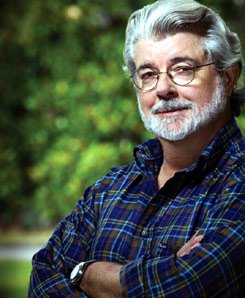
Daniel Goleman and George Lucas may have taken very divergent career paths -- one is a renowned psychologist and author of the bestseller Emotional Intelligence, and the latter is a celebrated filmmaker -- but they share many things. In addition to growing up near each other in the hard-baked farmlands of central California, they both believe the classroom should be a rich emotional environment that frequently touches and teaches the soul. They recently had a chance to sit down and talk about these issues.
Daniel Goleman: You and I grew up in adjacent towns in the Central Valley in a sleepy time in American history. It was the 1950s, and school was very conventional. OK, it was boring. Wasn't it?
George Lucas: Well, it was organized in a way that was designed to mass-produce education. It was boring in that, if you really weren't that interested in getting great grades, and that wasn't your motivation in life, it was very hard to get to the root of what you were learning, because it was mostly memorization.
It wasn't really arranged with a consideration for what makes kids excited about learning. What happened to you that got you excited about learning?
When I went to college, I was allowed to have much more say in what I was learning. For instance, I loved social science, and I could take a social science class, whereas in high school, we were so focused on math skills, science skills, language arts skills, the sorts of things I wasn't very good at. It wasn't until I had a wider range of possibilities at my disposal that I was able to say, "I like psychology, sociology, anthropology. I like these classes, and I want to learn. I'm curious about this stuff and I want to know more about it."
Today, I think we need to focus on three things: teaching kids how to find information, figuring out how to test that information, and using that information in a creative way to do something tangible, as opposed to teaching abstract concepts, which never seem to have much relationship to a student's daily life. This is put forth in processes such as project-based learning and cooperative learning.
What do you mean by "project-based learning"?
An assignment like, say, to design and build a house. You use the house as a way to get the kids interested in math and science and design and lots of other things. PBL also promotes integrated studies, so that students are learning lots of subjects at the same time -- not just portioned out, learning this at this hour and that at that hour. So we say,"Here's your project: Build your house."
The students then have to control the environment in a particular way. For instance, they may have to build it for a particular price; maybe the house has to withstand a tornado, or it has to be cool inside when it's 105 degrees outside. You set a bunch of restrictions that have to be dealt with, so the kids have to figure out thermodynamics and math and all these things in order to build the house. Then they present what they've figured out.
What you've done is to get someone excited and motivated about a goal that they have to achieve in order to learn.
Right, and the goal is not necessarily simply a grade. It's something more tangible. We have discovered that abstraction in education, while favored by the ivory tower, doesn't really work that well for most kids. They want to have a practical, straightforward reason for what they're doing.
One of the other issues is that a lot of education in the past has been taught in isolation: each student learning by himself, the teacher not having much contact with the students other than through lecturing, the teacher not having much contact with other teachers, the school not having much contact with the city it's in, and, most importantly, the students not having much contact with one another.
We have discovered that in teaching social and emotional learning, rather than saying, "We'll have a class on it, and it will meet Tuesday at 4 o'clock," you simply embed the social and emotional lesson into the educational process by saying, "You have to do this project with four other people. You'll be graded individually, you'll be graded as a group, you'll be graded on the intellectual quality of the project, but you will also be graded on your emotional relationships with each other. How did you get along? How did you manage to work as a team?" These are the things ultimately in the real world that are the main factors in getting hired and getting fired.
I remember some years ago talking to people at computer companies, high-tech companies, who were saying we have a problem with people coming out of schools like MIT, which is that they don't realize that they have to collaborate here. We have to reTRAIN them so they can work on a team.
There are human skills -- how to get along, how to cooperate, how a group can have emotional intelligence, be self-aware -- that are off the standard academic curriculum. They're part of what we call social and emotional learning, where kids learn self-awareness, how to manage their emotions, how to handle impulse, how to empathize, how to notice other people, how to see things from the other person's perspective. They learn social skills, how to get along, to work out conflicts. These are the skills that we find make people successful over the long haul.
Definitely. Anybody who's an adult, working in the adult world, realizes that your ability to encourage other people, form groups, and get the best out of everybody is the secret to success. One of the things we discovered is that the primary driving force for young people is curiosity: They naturally wonder how things work. And the other one is that they want to be adults. So, you give them adult projects like building a house, building a rocket ship, running a newspaper. You've got to give them an actual goal, and it has to be a goal they enjoy. Kids love to create things, and they'll learn if you let them create.
From a neuroscience perspective, you're talking about helping kids get in an optimal state for learning. You're talking about projects that are Exciting, that move them -- projects that they want to do, instead of the Boring, rote learning you and I had to put up with.
Well, it's also about changing the learning process, which is the gathering of information, learning the facts, learning the processes, learning the rules. But if you have a purpose -- I need to read the instructions to know how to turn on my VCR, for instance -- you'll do it.
The next step is to have a skeptical look at the facts, which is this: No matter who is telling you something, no matter where this information is coming from, always sit back and look at the facts. Can I prove it? Can I test it? How accurate is it? You know, when you put the board across a chasm, don't just run across it. You slowly walk out and make sure it's not going to break. And then use this information you have tested in a creative fashion.
Creativity and the creative process demand that you think. You're not learning, you're not learning facts and laws -- you're thinking. You're saying, "How can I create something completely new or use this information in a completely different way and be creative about it?"
I like your pointing out that kids need to learn to question the value or the truth of what they're told, particularly today, when the kids are going to the Internet to get their information because that's the way you can get the most access to the data. One new learning skill is learning to evaluate the source itself. I think that's absolutely crucial.
It also puts the kids in the driver's seat, which is where they want to be, especially when you get above the sixth grade. They don't want to be subjected to the authority figures that have usually been presented to them -- mainly their teachers.
A really good teacher is not a person who is dictating information to students. We have discovered that if a teacher approaches teaching saying this to the student, "You are a bright intelligent person who can figure this out on your own, and if you need help, I'll help you" -- if you take the teacher out from the front of the classroom dispensing information, and you encourage students to find the information on their own with the teacher as a guide or facilitator in their information-finding adventure -- the students will learn a lot more and be much more empowered.
The best thing that a teacher can be is a human being. There is nothing more powerful for students than to have the teacher pat them on the back and tell them they're doing a great job. It works wonders if a teacher asks a student,"What are you doing? Explain it to me." Or, "Have you ever thought about this?" For the teacher to be a guide, to send students off in different directions, or to be someone a student can go to for help when they really get desperate, it makes them, dare I say it, a mentor rather than a teacher.
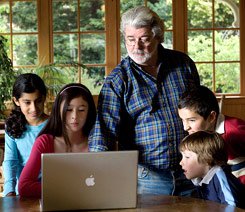
Isn't it a paradox, George, that in the digital age, when more and more of what in education is becoming looking at a video monitor -- gathering Information and getting the data -- the teachers are still important?
The teachers are even more important. The digital age allows the teacher to get to know the students, to be on a one-to-one basis with the students. There are some teachers who like to be protected by the screen of a plan that they do every day and that they've done every year. They don't talk to the students; they just deliver their little spiel, and that's the end of the class. But there are a lot of teachers who understand that the students are discovering something, and they like to watch that process. They like to actually watch the light bulbs going off over the students' heads.
The human connection is more vital even as kids are learning to use their computers.
Yes, and that's also where emotional intelligence comes in, because, if you're working in groups, you really do have to learn the process of argument, the process of presenting facts, of proving your point of view, not just sort of demanding it, or hitting someone in the face, or taking it at face value. You have to learn to let go of your beliefs when they are proved to be erroneous, and not let your pride and other factors get in the way. You have to learn to admit when you're wrong about something, like, "The information I gathered is wrong, and we're all going to use this other information, because it is better."
That is a very, very important thing to be able to do. It's something that is not taught in schools, and it is extremely important in the outside world. Otherwise, you have a lot of organizations that refuse to change, and change is the name of the game in the twenty-first century.
The important thing is that you are always questioning what is going on and that you are respectful of other people who are also questioning. And, when someone has an idea, you respect that idea, and you learn in a respectful way to challenge that idea, without hurting their feelings, without calling them a lot of names, without punching them in the face.
So, you're talking about people in school learning the ingredients of a healthy give-and-take. But let's unpack the personal ingredients you need for that. You mentioned that social and emotional learning (SEL) helps kids with this component of success: working together collaboratively. And SEL teaches the skills of emotional intelligence and self-awareness. In other words, first you need some introspection, you need some self-insight; you need to understand what you are feeling about things and why you are Feeling that way.
Again, it's like project-based learning. It's one thing to learn these things in the abstract, but it's another thing when you are sitting in the middle of an argument. They learn in a very practical way that we're not going to get anywhere unless we readjust our relationships. And the way we readjust our relationships is to take and use the knowledge that the teacher has given us, and that we are learning about our own self-awareness.
It's much more effective to teach this in a situation where kids are actually confronting an issue and say, "Now, think about what you're thinking about here. Why are you doing it this way?" And you're also teaching the group, because in this situation, if you're the student, you aren't by yourself.
In other words, SEL puts into the classroom a live situation kids can extract these lessons from.
Well, also, one of the problems of the modern age is the remoteness from which people deal with other people. And it's true on the Internet and on computers, but it's also true on talk shows and on radio where bad manners aren't called out. We don't say, "Hey, you can't say that; that's hurting someone's feelings." Some of these talk show hosts believe that if they're talking to thousands of people, millions of people, and they're hurting a few people's feelings, so what?
You can have that rationale, but when you get down to five people and you're modeling that behavior from these other situations, someone has to say, "Hey, wait a minute. If someone said that to you, how would you feel?"
And that's a lesson in empathy. A very valuable one.
These people, on some talk shows, trash people for fun; but in the end, when you're the one being trashed, it isn't much fun. You can make the decision to trash someone, but no one is going to want to work with you, nobody's going to respect you, nobody's going to pay attention to you. If you are working on a team, what does it do to your team? This is something you can learn in physical education; sports teams are all about this sort of thing. But it's time to bring it out of the gym and put it into the classroom.
I think so, and one of the greatest hopes for me is that kids will get, and everyone will get, SEL and learn how to respect other people, how to empathize, and how to get along, rather than these other lessons mass media -- particularly junk television -- is teaching, which is just the opposite.
Well, they're pandering to the worst possible aspect of the human animal, which is to inflict pain on other people and enjoy it.
Doesn't this require something new of teachers? Is there a way to prepare teachers for that future?
Again, it would demand that teachers are trained much more in the world of SEL and awareness, and know how to teach it and how to deal with difficult situations. I think it also means being more one-on-one with the students.
You need to have interpersonal skills that are stronger than are demanded in today's classroom, which means you really do have to become interested in the student beyond his or her name. You have to be interested in the students' home lives and be able to reason with them and be able to take into account their personal lives and how that affects all this. So, it is a much deeper relationship between the teacher and the student, in which, ultimately, I think you can be much more effective, because you can get at the root of some of the problems.
This kind of teaching goes beyond our standard model. It goes into caring about kids in a deep way.
I am completely convinced that most teachers really want to make a difference. The way the system is set up now, however, teachers feel like parents of a teenager: You talk, but you don't know if they are listening. This is not very gratifying.
If teachers can become more involved with the everyday lives of the students and their learning process, the teacher gets to experience the tiny, tiny victories. And those are the victories that represent the reason they got into teaching in the first place. They get to experience the joy of that student overcoming a problem and being proud of it. That student then gets to show it off to somebody personally, not grandstanding in front of the classroom, but in the moment of discovery, being able to say, "Look, I figured this out." For everybody involved, it is a much more rewarding and joyful experience.
What Is It?
Project-Based Learning
An experiential method of instruction that engages students in group-oriented projects, providing active instruction in an interdisciplinary array of skills, including math, technology, language arts, fine arts, geography, and science.
Social and Emotional Learning
A process through which children and adults develop fundamental competencies to recognize and manage emotions, develop caring and concern for others, establish positive relationships, make responsible decisions, and handle challenging situations constructively.