What Works in Public Education

Listening to Literature: Struggling Readers Respond to Recorded Books

Teachers find that audio books are sound reading tools.

by Grace Rubenstein

Print Forward Share Comments(8) Comment RSS
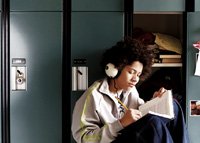
Listening to Literature
Credit: Veer

Abbie Root, a fifth-grade teacher at Brookside Elementary School, in Grand Rapids, Michigan, started the year with only six of her twenty-seven students reading at grade level. She and itinerant reading specialist Janise Cole tried a new approach: Using recorded books from Pacific Learning's New Heights program, they asked children to listen to the text on tape while following along on paper, and repeat the exercise until they could read each story on their own. Between November and April, the number of grade-level readers in Root's class doubled, and, as she said then, "We still have six weeks of school left."

Root attributes much of the progress to the audio books and believes the tool would benefit her strong readers, too -- and teachers across the country are drawing the same conclusion. At J. T. Henley Middle School, in Albemarle County, Virginia, teacher Pat Harder (a member of The George Lucas Educational Foundation's National Advisory Board), uses audio books to expose students to text that's beyond their reading ability but that challenges their vocabulary and comprehension. That way, struggling readers aren't stuck with boring content, and they have the chance to learn to love literature.

Education professor Timothy Rasinski, of Kent State University, in Ohio, has also seen projects in which older students record audio books themselves for kids in the younger grades. "It definitely works," says Rasinski, who puts audio books in the same category as other forms of assisted reading. "There have been studies that looked at captioned television or just reading with a parent. Across the board, it seems to have wonderful potential for helping kids."

A perk of audio books is their accessibility -- an attribute that has everything to do with the Internet and its accompanying boom in audio technology. With a click, educators can download a book for multiple students to hear, either digitally or by burning the narrative onto a CD. For instance, Audible.com, a massive clearinghouse for digital audio, hosts an education section where visitors can download audible children's books, textbook supplements, newspaper articles, speeches, and SparkNotes, Barnes & Noble's online version of CliffsNotes.

Denise Johnson, assistant professor of reading education at the College of William and Mary, cautions in the Web-based journal Reading Online that audio books are not for every student. They're too fast or slow for some, and too cumbersome for those who prefer to read only on paper. She adds, though, that the technology can introduce children to new genres, cultivate critical listening, and highlight the humor in text, among other benefits. Johnson writes, "Understanding the message, thinking critically about the content, using imagination, and making connections are at the heart of what it means to be a reader and why kids learn to love books."

Grace Rubenstein is a senior producer at Edutopia.

This article was also published in the June 2006 issue of Edutopia magazine .

Advertisement

@edutopia on Twitter Edutopia on Facebook RSS feed link

Advertisement

0
was this helpful?
Kathy Rosser
Posted on 9/29/2007 5:52pm

Listening to Literature - On line Resources

I am excited to find this information on-line. I am a kindergarten teacher who is working with children to build their skills (sounding out words/letters)to begin the reading process.

I was glad to find the website audible.com. I will try this with my students. I know that they already love to listen to the books that I have on tape now.

As a teacher, I know that my students love to hear a variety of people read to them - so books on tape/CD are an excellent resource.

Kathy

0
was this helpful?
Ross
Posted on 2/16/2008 1:32pm

Audio Books for High School Students

Just to make you aware that we have identified a number of audio books from the English Curriculum for High School students. The website address is
High School Audio Books

Thank you

0
was this helpful?
Jeff
Posted on 3/04/2008 4:55pm

Using an iPod in my listening centers

I love listening centers, and not just for my struggling readers. I also use it with my high readers as well. The challenge I have found is that the audio books are read too fast for children to keep up. This is particularly challenging for second language learners. The solution, however, is through the use of technology. I have been using an iPod all year to support my listening center for my second graders. The iPod allows me to slow down the rate without sacrificing tone quality, something you can't do with outdated cassettes and CD's. My students can now follow along in their books without getting left behind. They absolutely love it!

0
was this helpful?
Joy Widmann
Posted on 3/04/2008 8:05pm

Reading while listening strategy

I've heard that if you download an audiobook to an MP3 player or iPod, you can slow down or speed up the recording with no loss of voice quality (no "Mickey Mouse" or "Darth Vadar" voices)

0
was this helpful?
Amber
Posted on 7/14/2008 10:20am

Pacific Learning has 4 other great resources that offer audio components!

Splash (Prek-2)
Speak Out! Readers' Theater (Gr. 2-4)
Toocool (Gr. 2-4)
CSI (Grades 3-8)

If you like the audio aspect of New Heights you should check these out!
Great resources for listening centers!

0
was this helpful?
Jamie Shell
Posted on 12/18/2008 8:41am

slowing down the recording for audio books

Can you tell me how to slow down the reading pace of an audio book on an ipod?

0
was this helpful?
JoAnn
Posted on 3/30/2009 7:29am

listening to literature

I really believe in the benefit of having children listen to books on tape/cd's as a way of helping them become a better reader. During our literacy time, one of the stations is listening to a book on tape. The students pick a packet that contains the book, a tape or cd and headphones. Integrated into this time is also a reading program called Read Naturally. Students listen to key words, the story and practice reading the story until they can meet or pass their reading goal. I have found that the more students listen to book and practice reading them, the more successful they feel as a reader.

0
was this helpful?
Melinda
Posted on 4/01/2009 12:05am

Can you tell me if there is a way of having a group of children listening to the same story on the one ipod like the traditional listening post - not sure if the technology available?

Post a comment

Sign in or create an account now, or after you post.

Sign In

Thanks for your comment. It will be posted once you've signed in to your account. Please sign in here
Not yet a member of the Edutopia community? Create an Account

Create an Account

Almost there! As soon as your account is created, your new comment will be posted.
Mollom CAPTCHA (play audio CAPTCHA)
By creating an account, you agree to Edutopia's terms of use.