What Works in Public Education

A Recipe for Success: Kids, Dirt, and Gardening

By Bonnie Bracey Sutton

6/15/07
Print Forward Share Comments(12) Comment RSS

On warm spring days, instead of leaving their hearts and minds in the classroom, my students often turned to the outdoors.
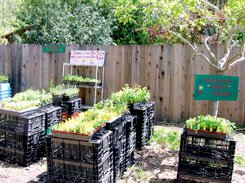
Gardening for Children

The study of plant life is a staple in biology curricula -- children explore seeds and how plants grow, young adolescents focus on cells, and teenagers continue their studies with more in-depth investigations of botany and plant physiology.

Reading about plants is usual in the traditional school curriculum, but working with the soil, growing different varieties of plants, and eating the plants you grow is uncommon.

However, my plant lessons rarely required a textbook. The scope and sequence of my lessons on plants ranged from learning about soils (undertaking a soil profile) to studying seeds ("What is a seed?"), digging in the dirt (good for building strong bodies and minds), and making a classroom garden.

Soils

I had a lot of help from the local 4-H agent, who conducted soil profiles for me and provided eggs for our chick-hatching observations. From time to time, the agent would stop by the classroom to share and to see how things were going.

The local 4-H Club did professional soil samples for the class garden and other gardens in our community. We learned about soil layers, textural classes, color, water-holding capacity, organic content, and pH balance. We also discovered how to alter the soil in order to make it better for our work.

All this made my students think more about the dirt beneath our feet. Soil is one of our most important natural resources, and it's important that students know about this aspect of the natural world and apply their knowledge to important factors such as land use, erosion, pollution, and urban planning.

School Gardens

There is no salad in the world as wonderful as the one you grow yourself, especially for students who have never tasted a homegrown tomato or pulled lettuce and other salad fixings from the rich earth. I remember being on a farm in the summertime with a saltshaker in my pocket, sampling the soil's tasty bounty. But my students didn't know where their food came from.

At another school where I worked, however, there were strawberry gardens. During recess, we would check on the progress of the strawberries, and, later in the season, we'd eat them -- so delicious!

A parent then convinced me to do a gardening project. He brought his little tractor and plowed the land, bought us tools and seeds, and contributed his know-how. An important learning was to plant only varieties of crops that are harvested early in the area so that we could collect and eat our lessons before school got out for the summer. We found out about the National Gardening Association and applied for and received a Youth Garden Grants award.

Let me direct you to some resources for ideas about gardening lessons and activities. Start planning now for the next school year so you can cultivate a more interesting way to learn about plants! And please add your own advice and thoughts about how to enrich learning about gardening.

Edutopia.org Resources

Down & Dirty: Getting a Handle on Mother Nature

Garden of Eating: Middle Schoolers Grow Their Own Lunch

That's Soil, Folks!: Garden Gear That's Not Garden Variety

Play with Food: A Game Teaches Healthy Diets

Veggies to the People: The People's Grocery Store

Other Resources

A Soil Profile (U.S. Department of Agriculture)

The Great Plant Escape: What Is a Seed? (University of Illinois Extension)

Planting Science (Botanical Society of America)

Fast Plants (University of Wisconsin at Madison)

Bottle Biology (University of Wisconsin at Madison)

0
was this helpful?
Karen Henke
Posted on 6/21/2007 11:56am

School garden grants

I love to garden, and have so many fond memories of tending flowers and growing food in the summertime in Iowa. On Grant Wrangler, we list quite a few school garden grants that can help teachers get started on these types of projects. Most of them are listed in the science category, but you can just search for school garden as a key word: www.grantwrangler.com.

0
was this helpful?
Bonnie Bracey
Posted on 7/05/2007 9:05am

Gardening

Thank you for your comment on gardening. As a city kid sent to the country
in the summers, I learned from family, but in Arlington, Virginia we had
a high school that accepted elementary students to investigate many innovative learing initiatives on a weekly basis and gardening was one of the most successful projects. ( well the most successful was pet care).

The gardening grants provide wonderful resources for the students

0
was this helpful?
Bonnie Bracey-Sutton
Posted on 7/06/2007 12:35am

Urban Gardening and Grants

Children love to dig in the dirt. They may not understand "perennial" or "alkaline," but they're curious about worms and beetles and colorful flowers, fruits, and vegetables. Gardening is a great way to get kids outside, active, and interested in the natural world, no matter whether your garden is a few deck planters or a backyard or community plot.

You can learn about worms, soil, get involved with thinking about the weather, and sharing information with others.

The educational garden is a means of exploring a range of ideas inside and outside the elementary school curriculum. The garden can be integrated into one subject area, such as science, or it can be interdisciplinary, incorporating, for example, science, art, language arts, and music. The project can be limited to one grade, or it can be an opportunity for cooperative learning among several grades. An interdisciplinary, inter-grade approach maximizes the garden's influence, but these goals can be met gradually, over several years of gardening experience. Be sure the goals of the garden complement the needs of the school community.

What is a seed?
Say what?

There used to be a study of seeds that gave students the task of classifying things as seeds or not. On their desk they would have several types of corn seeds, a red hot, a lima bean, a stone, a grass seed,
a good assortment of things to decide if it was a seed or not.
Well the red hot ( a candy) was always the first thing they wanted to claim not a seed, but they had to give the definition of a seed to declassify this candy treat. You can gather your own examples.

There is an online initiative by the University of Illinois that helps kids to learn about seeds and plants.

It is called the Great Plant Escape.
http://www.urbanext.uiuc.edu/gpe/index.html

The Smithsonian also had lots of great information on seeds of change. We created web pages to celebrate the history corn, tomato, the potato
seeds of change..
http://www.mnh.si.edu/archives/garden/history/

We actually had a garden on the mall in Washington.
We had a lot of help it was near the Gazebo on Pennsylvania Avenue.

Our project is archived but it has a lot of information that can be hepful to teachers. parents and students. Don't miss the recipes.

This was our recipe for success

Great Garden

Ingredients:

Lots of different children, leave no one out
Loving parents from many backgrounds and cultures
Dedicated staff and teachers

Mix above ingredients together with leadership and season with community support, time, and money. Add one garden and stir vigorously with many volunteers. Cook with hard work and love until done.

These were some of our favorite plants

Dwarf sunflower (Helianthus annuus cultivars) — large seeds; quick germination; drought tolerant; bright flowers

'Sungold' tomato (Lycopersicon 'Sun Gold') — easy care; lush growth; fragrant leaves; plentiful, cherry-sized, sweet, orange fruits

'Chilly Chili' pepper (Capsicum 'Chilly Chili') — easy care; drought tolerant; colorful, mild chile peppers

Purple bush bean (Phaseolus vulgaris cultivars) — large seeds; quick germination; colorful bean pods

Mini pumpkin (Cucurbita pepo cultivars) — large seeds; quick germination; decorative fruits; edible fruit and seeds

Dill (Anethum graveolens) — quick germination; airy, yellow flowers; edible; food source for swallowtail butterflies

Spearmint (Mentha spicata) — easy care; shade tolerant; drought tolerant; fragrant leaves; flavorful in drinks

Basil (Ocimum basilicum)(buh-sill) of the Family Lamiaceae is also known as Sweet Basil. It is a tender low-growing herb that is grown as a perennial
I was fortunate to teach this course at the Smithsonian. We had help with the garden in two ways. There was a gardener who helped us create the seeds of change garden. In that garden we had squash, corn, beans, tomatoes , cucumbers and some herbs.

On the weekends, homeless people would come and eat the tomatoes and the corn. We didn't fence it. We knew how great those tomatoes tasted.
We still got a few tomatoes from time to tme.

Later we did the garden again on the school property.
This is a good time to think about planting bulbs and organizing for a
spring garden at school.

Bonnie Bracey Sutton

0
was this helpful?
elm
Posted on 10/17/2007 9:16am

Gardening for kids

Thanks for the awesome information provided, especially the list of the favorite plants. As a mother of two small children, I'm always searching for educational activities that not only help them develop strong bodies and minds, but also that create an awareness of good environmental living. I believe that we as parents have the responsibility to guide and encourage our children to care for our environment and the future health of our planet. Gardening is a simple and fun activity to capture kid's interest in nature and help them grow a sense of respect for the enviroment. I also want to add that the little ones obtain great benefits from this activity, from creating a sense of pride for their accomplishments, to being willing to eat the fruits of their labor (those veggies!)
Again, thanks for posting the recipe for success!!

elm

0
was this helpful?
kerryGowan
Posted on 10/30/2007 5:56am

thank you

Thanks, this site is great im studying primary teacher traing at college this helped me for an assignment giving me great ideas. thank you.

0
was this helpful?
Danielle Mehl
Posted on 11/24/2007 1:49pm

Fantastic Idea!

As a primary teacher, this is a fantastic idea to encourage students to learn and be involved in the learning process. Setting aside the book is something that we do not always have time for, as we still need to teach specific information. Yet by studying while participating in this hands-on project, students will be more likely to learn and retain the information. In addition, it is something they will enjoy and can do outside of the classroom as well. Great idea!

0
was this helpful?
Andrea
Posted on 11/26/2007 3:44pm

Thanks for the great idea and resources. Kids learn so much more by doing. One activity I do is have the students plant grass in plastic bags. I have them water and we watch it grow. Then students can see the roots grow. We talk about what plants need to live and we can identify different parts. The students love it.

0
was this helpful?
A.
Posted on 11/28/2007 4:44pm

Teachable moments

Earlier in the year, my second graders learned about the basic parts of a plant and essentials for growth and survival. At the time, I was lucky enough to have MANY "babies" on my Spider plant. I allowed each of the students to pluck off a "baby." They then planted them in container and watched them take root in the soil. The kids were able to keep the plants on their desks as long as they didn't fool with them. A few kids got their plants taken away. Those poor plants were put outside and almost died from the cold. However, I rescued them just before freezing to death. Now the kids have been able to watch the plant come back from their near death experience. They think it is so cool things can appear dead, but really aren't.

0
was this helpful?
Anonymous
Posted on 1/28/2008 6:57pm

Thanks for providing some of the resources I can use when I teach a unit on plants/planting. I teach in Ohio, and I usually try to do some things with my students that involves planting and growing different seeds and plants. Last year, we planted sunflower seeds, and one of the kids came in at the beginning of this year and told me how much hers had grown over the summer, and she was so excited about it! It was exciting to hear about her excitement from growing her own flower. Thanks for some of the new ideas you provide here...I can't wait to start growing again this year!

0
was this helpful?
lyndsay144
Posted on 3/02/2009 12:38pm

Thanks

I really apreciate this information!!! thank you I need some help in order to build up my garden

Post a comment

(Sign in or create an account now, or after you post.)

Sign In

Thanks for your comment. It will be posted once you've signed in to your account. Please sign in here
Not yet a member of the Edutopia community? Create an Account

Create an Account

Almost there! As soon as your account is created, your new comment will be posted.
Mollom CAPTCHA (play audio CAPTCHA)
By creating an account, you agree to Edutopia's terms of use.

Edutopia.org Blogs

Advertisement

@edutopia on Twitter Edutopia on Facebook RSS feed link

Advertisement